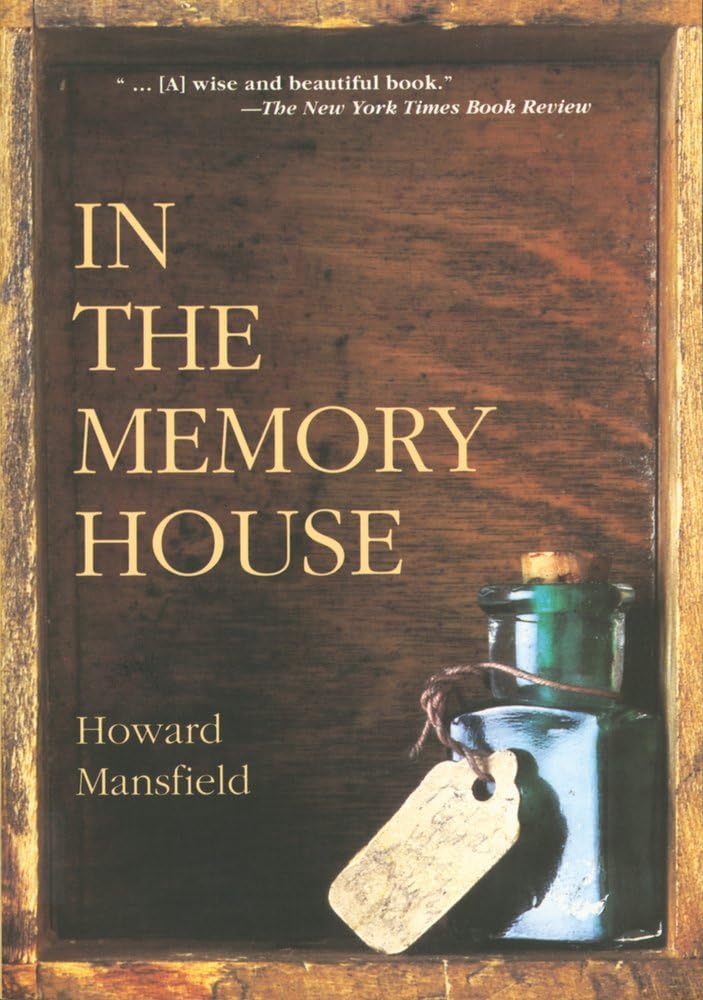



In the Memory House recalls what American society has forgotten--the land, its people, and its ideals. By examining what we choose to remember, this important book reveals how progress has created absences in our landscapes and in our lives. Howard Mansfield writes about architecture and American history. He is the author of Cosmopolis: Yesterday's Cities of the Future. He has written for national publications including The New York Times, Los Angeles Times, American Heritage and Historic Preservation. He lives in Hancock, New Hampshire. In the Memory House By Howard Mansfield Fulcrum Publishing Copyright © 1993 Howard Mansfield All rights reserved. ISBN: 978-1-55591-247-5 Contents 1. Preface, 2. Modern Times: A Prologue, 3. Part I: In the Memory House, 4. Part II: Choosing Our Ancestors, 5. Part III: Us & Them and Them & Us, 6. Part IV: Absences, 7. Modern Times: An Epilogue, 8. Partings, 9. Acknowledgments, CHAPTER 1 Part I IN THE MEMORY HOUSE In Brownington, Vermont, there is a small bottle. The bottle is green, maybe four inches long, and has a label. In fading ink it says, "This barley was grown in 1883 and given by Mrs. Selden Gray." The bottle is filled with barley. * * * Brownington is a village a dozen miles from the Canadian border, home to 708 souls and the Old Stone House Museum. You can't miss the museum; it is housed in a four-story granite building that was once part of an academy run by Alexander Twilight, said to be the first black to earn a degree from an American college, Middlebury, back in 1823. When the oxen were done hauling the granite slabs for the great dormitory in 1836, the building must have seemed huge. Today it still seems somewhat misplaced, a roaming academic building far from the herd in Dartmouth or Middlebury. The guidebook says, "The collections are rural and vernacular in scope" (i.e., a mongrel collection) "with many fine examples of local folk art and folk technology" (i.e., bad paintings and old tools, once coveted, now merely curious). In short, the next blockbuster Metropolitan Museum of Art show — tickets by Ticketron, T-shirts, hoopla — will not be stopping in Brownington. But when the museum is open, the director, Reed Cherington, or one of the volunteers will kindly show you through, and in this age of mass tourism, they are ready to accommodate groups of up to forty people. From the guidebook you wouldn't guess what a feast awaits. There are some five thousand objects in twenty-three rooms, with each of ten rooms devoted to one town in the county. There is "folk technology": the Yankee Flytrap, which, if I understand it, has a rotating gooey wheel to catch flies and a blade to scrape them off into a cage. (Okay, so the world never beat a path to the door of this Brownington inventor.) There are eighteenth-century furniture, needlepoint samplers, children's toys, bells, pitchforks and light bulbs — a three-shelf history of the light bulb, complete with a portrait of Edison himself. There are those unsettling nineteenth-century portraits of children by itinerant painters. The artists would paint a series of bodies first, hit the road, and then do the head in a sitting. The heads and bodies are always a bad fit, making the children seem dwarfish. There is Alexander Twilight's pony-skin-covered wooden trunk with his initials in brass tacks, and his desk and Bible as well. And there is someone's rock collection, gathered on a brave westward trek in the 1880s. There is always a rock collection. Before Kodak and souvenir ashtrays, rocks were what people brought home. They were the proof of the pilgrimage, the moon rocks of their day, and, once donated to the town, part of the "advancement of knowledge for mankind." The Orleans County Historical Society runs the Old Stone House Museum. This is a populist museum in a way that would set any curator's teeth on edge. For sixty years people have been donating what they thought should be here. Sometimes these treasured objects were on their way to the dump when their owner hesitated, thought, "Oh what the heck, I've got a few minutes before the ball game," and left it to the ages instead. Sometimes a rare eighteenth-century baby cradle is donated and sometimes a bottle filled with barley grain. That bottle is easily overshadowed by the other 4,999 objects in the collection, but it well explains the whole museum. * * * "This barley was grown in 1883 and given by Mrs. Selden Gray." Why this? Why leave a bottle of grain in the perpetual care of neighbors and their descendants? Who would want to see it? It's not even a rock collection, not a stuffed owl or a wedding dress or a three-shelf history of the light bulb. Here's my guess: To Mrs. Selden Gray it was the story of 1883 in a bottle: sowing the seed, the rainy spring, the dry summer (or the dry spring and the rainy summer), the blight that threatened, the sickness and health that came along that summer, the day they put aside thei