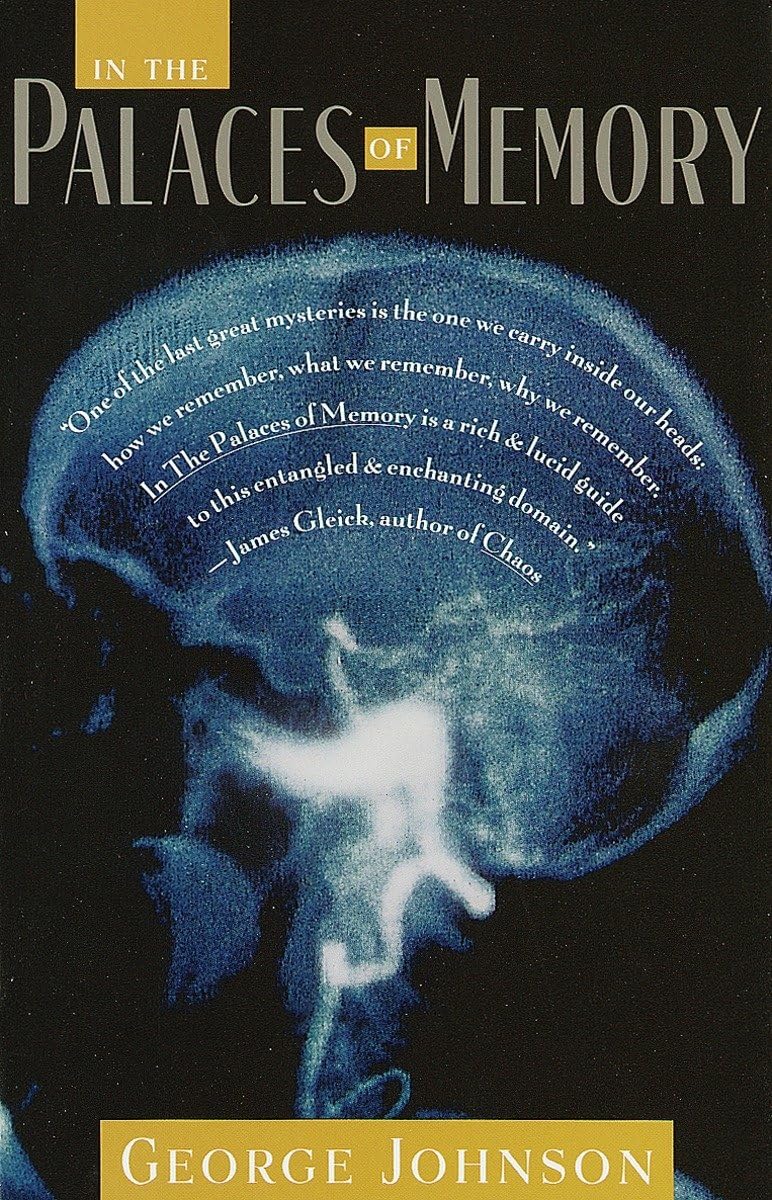
In the Palaces of Memory: How We Build the Worlds Inside Our Heads
$18.52
by George Johnson



Even as you read these words, a tiny portion of your brain is physically changing. New connections are being sprouted—a circuit that will create a stab of recognition if you encounter the words again. That is one of the theories of memory presented in this intriguing and splendidly readable book, which distills three researchers' inquiries into the processes that enable us to recognize a face that has aged ten years or remember a melody for decades. Ranging from experiments performed on the "wetware" of the brain to attempts to re-create human cognition in computers, In the Palaces of Memory is science writing at its most exciting. "An eloquent foray into how our brains convert experience into knowledge. [Written] with all the alacrity of a detective gathering clues . . . with a lucidity that at times approaches artistry." -- Thea Singer, Boston Phoenix "As a writer about the biological and human sciences, Mr. Johnson has few peers. . . . If I wanted to give readers a feel for the frontiers of cognitive neuroscience, I would send them directly to this book." -- Howard Gardner, New York Times "Johnson has achieved a rare blend of scientific and literary sophistication. Faithful to its complexities and controversies, the book is a fully dimensional portrait, a hologram of the field." -- USA Today "Johnson has written a fascinating book, which perhaps throws as much light on how science is done and on the scientists who do it as any book since 'The Double Helix." -- Stuart Sutherland, Nature "Lucid, insightful. . . . Mr. Johnson imparts a huge amount of information in his clear descriptions of how the relevant experiments were conducted and interpreted. And he makes the reader feel the excitement that drives these people to devote most of their waking hours over a number of decades to the puzzle." -- John C. Marshall. New York Times Book Review "One of the last great mysteries is the one we carry inside our heads: how we remember, what we remember, why we remember. In the Palaces of Memory is a rich and lucid guide to this entangled and enchanting domain." -- James Gleick, author of Chaos "One of those rare books that explain to the layman in clear detail what is happening in a complex branch of science without trivializing the subject . . . fascinating and thought-provoking." -- Los Angeles Times Book Review Even as you read these words, a tiny portion of your brain is physically changing. New connections are being sprouted--a circuit that will create a jab of recognition if you encounter the words again. That is one of the theories of memory presented in this intriguing and splendidly readable book, which distills three researchers' inquiries into the processes that enable us to recognize a face that has aged ten years or remember a melody for decades. George Johnson writes regularly about science for the New York Times . He has also written for National Geographic , Slate , Discover , Scientific American , Wired , and the Atlantic , and his work has been included in The Best American Science Writing . A former Alicia Patterson fellow, he has received awards from PEN and the American Association for the Advancement of Science, and his books were twice finalists for the Royal Society’s book prize. He lives in Santa Fe, New Mexico.