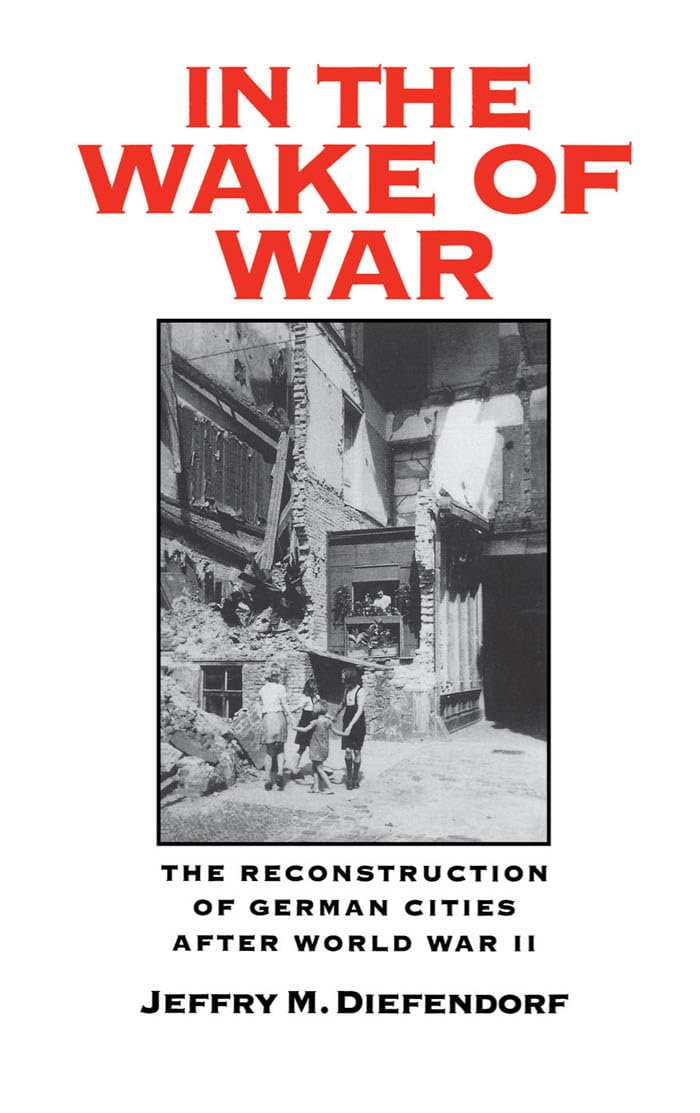
In the Wake of War: The Reconstruction of German Cities after World War II
$167.49
by Jeffry M. Diefendorf



In 1945 Germany's cities lay in ruins, destroyed by Allied bombers `hat left major architectural monuments badly damaged and much of the housing stock reduced to rubble. At the war's end, observers thought that it would take forty years to rebuild, but by the late 1950s West Germany's cities had risen anew. The housing crisis had been overcome and virtually all important monuments reconstructed, and the cities had reclaimed their characteristic identities. Everywhere there was a mixture of old and new: historic churches and town halls stood alongside new housing and department stores; ancient street layouts were crossed or encircled by wide arteries; old city centers were balanced by garden suburbs laid out according to modern planning principles. In this book, Diefendorf examines the questions raised by this remarkable feat of urban reconstruction. He explains who was primarily responsible, what accounted for the speed of rebuilding, and how priorities were set and decisions acted upon. He argues that in such crucial areas as architectural style, urban planning, historic preservation, and housing policy, the Germans drew upon personnel, ideas, institutions, and practical experiences from the Nazi and pre-Nazi periods. Diefendorf shows how the rebuilding of West Germany's cities after 1945 can only be understood in terms of long-term continuities in urban development. "Diefendorf's book is excellent history, thorough, documented, well organized, and readably written."-- Journal of Interdisciplinary History "Far-ranging....An extremely valuable contribution to planning history and to postwar German history."-- Journal of Modern History "Not only historians but students of architecture, urban planning, and historic preservation, as well as lawyers, environmentalists, and communitarians, will find much of absorbing interest in this dense but well-written history. Highly recommended."-- CHOICE "A fascinating account of the reconstruction of German cities following the end of World War II...Diefendorf suggests that by learning from the German experience of revitalizing its devastated cities, the United States can be more efficient in attacking urban blight in its own cities."-- History: Reviews of New Books "[A] major contribution to the subject."-- American Historical Review "In his introduction to this detailed, fascinating study of rebuilding in the German Federal Republic, the author reminds us that urban reconstruction is a very complex and emotionally charged subject, since so many concerns, both practical and psychological, need to be satisfied."-- German Studies Review "Diefendorf's text is both thorough and illuminating....A welcome contribution to the English-language literature on post-war German urbanism."-- The Times Literary Supplement "This impressive study is supported by a wide range of maps, diagrams, tables, photographs and sources culled by the author from over thirty archives. All this is woven into a detailed and fascinating analysis."-- History Today "The book not only offers something to specialists and historians, but also it attempts to reach a broader public through its explanations."-- Die alte Stadt "Diefendorf's analysis will be particularly valuable because of its breadth and depth. That is, he looks at the reconstruction from the perspectives of all the major participants of the rebuilding process and he places his analysis fully into the historical context of the culture and politics of German planning traditions since the late nineteenth century."--Diethelm Prowe, Carleton College "On the basis of research that took him to twenty-five libraries and archives in ten German cities, Diefendorf has written a thorough and absorbing study of city planning and rebuilding in West Germany and West Berlin in the early and mid-twentieth century. Paying attention to over twenty cities that had populations in excess of 100,000 in 1939, he has succeeded in encompassing local developments within a analytic framework that is both comprehensive and illuminating."--Andrew Lees, Rutgers University, Camden In 1945, Germany's cities lay in ruins, destroyed by Allied bombers that left major architectural monuments badly damaged and much of the housing stock reduced to rubble. At the war's end, observers thought that it would take forty years to rebuild, but by the late 1950s West Germany's cities had risen anew. The housing crisis had been overcome and virtually all important monuments reconstructed, and the cities had reclaimed their characteristic identities. Everywhere there was a mixture of old and new: historic churches and town halls stood alongside new housing and department stores; ancient street layouts were crossed or circled by wide arteries; old city centers were balanced by garden suburbs laid out according to modern planning principles. In the Wake of War examines the questions raised by this remarkable feat of urban reconstruction. Jeffry M. Diefendorf explains who was primar