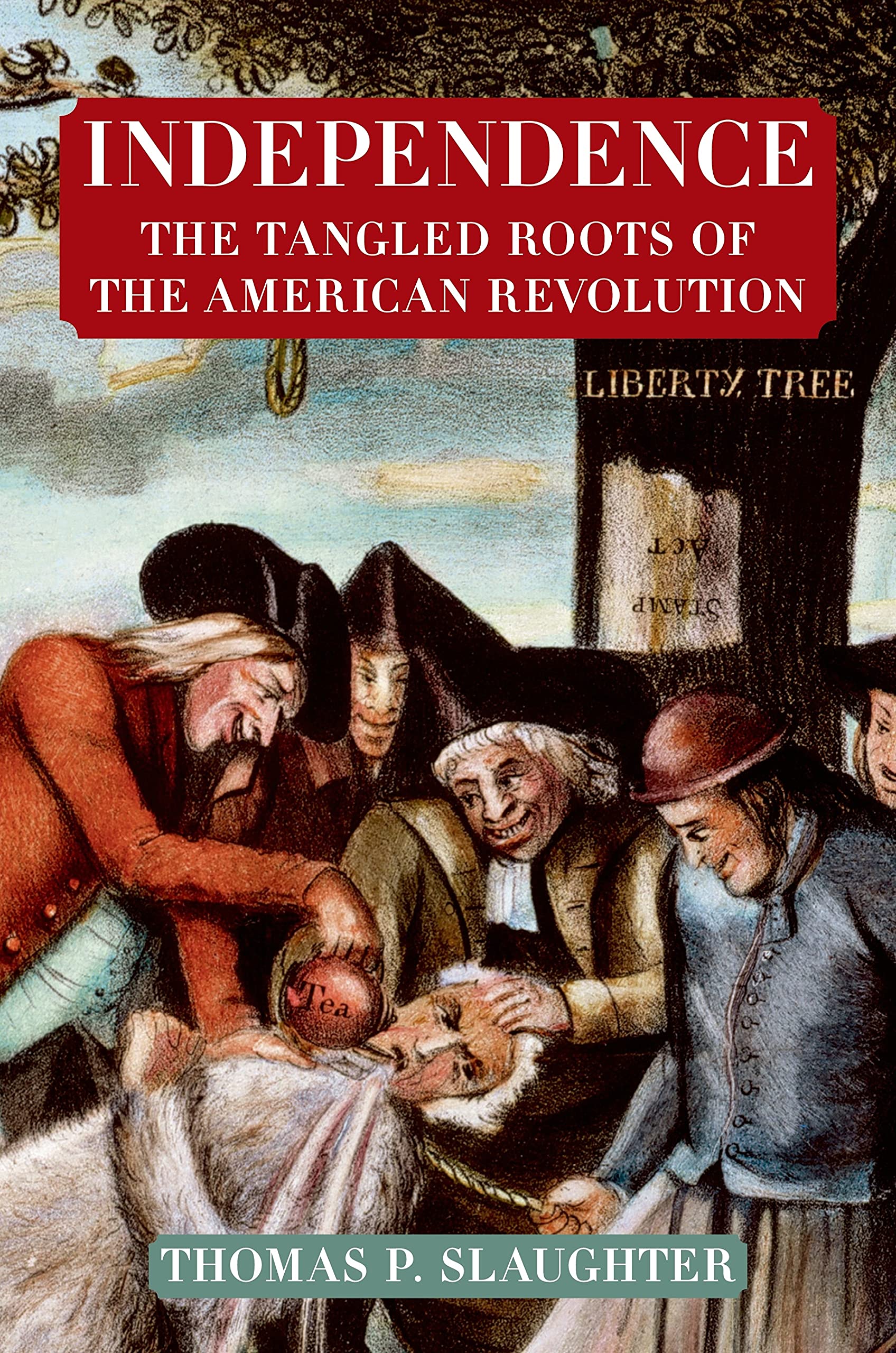



An important new interpretation of the American colonists' 150-year struggle to achieve independence "What do we mean by the Revolution?" John Adams asked Thomas Jefferson in 1815. "The war? That was no part of the Revolution. It was only an effect and consequence of it." As the distinguished historian Thomas P. Slaughter shows in this landmark book, the long process of revolution reached back more than a century before 1776, and it touched on virtually every aspect of the colonies' laws, commerce, social structures, religious sentiments, family ties, and political interests. And Slaughter's comprehensive work makes clear that the British who chose to go to North America chafed under imperial rule from the start, vigorously disputing many of the colonies' founding charters. When the British said the Americans were typically "independent," they meant to disparage them as lawless and disloyal. But the Americans insisted on their moral courage and political principles, and regarded their independence as a great virtue, as they regarded their love of freedom and their loyalty to local institutions. Over the years, their struggles to define this independence took many forms, and Slaughter's compelling narrative takes us from New England and Nova Scotia to New York and Pennsylvania, and south to the Carolinas, as colonists resisted unsympathetic royal governors, smuggled to evade British duties on imported goods (tea was only one of many), and, eventually, began to organize for armed uprisings. Britain, especially after its victories over France in the 1750s, was eager to crush these rebellions, but the Americans' opposition only intensified, as did dark conspiracy theories about their enemies―whether British, Native American, or French. In Independence , Slaughter resets and clarifies the terms in which we may understand this remarkable evolution, showing how and why a critical mass of colonists determined that they could not be both independent and subject to the British Crown. By 1775–76, they had become revolutionaries―going to war only reluctantly, as a last-ditch means to preserve the independence that they cherished as a birthright. Most accounts of the American Revolution view 1763 as a critical year. With the end of the French and Indian War and of so-called salutary neglect, Parliament was determined to govern the colonies more directly; it did so by levying taxes and firmly enforcing the Navigation Laws controlling aspects of American commerce. The following dozen years saw an escalating cycle of resistance and repression culminating in the Revolutionary War. Slaughter, a professor at the University of Rochester, places the roots of rebellion against British authority much earlier. Even in the early seventeenth century, observers from Britain described colonists in New England as rebellious and fervent defenders of their independence from British interference. Slaughter describes a series of disturbances and uprisings against British imperial control over two centuries. He stresses that sheer distance from Britain, the vastness of British North America, and a variety of local resentments of imperial officials were factors. This well-written and well-researched study offers an interesting perspective that merits serious consideration. --Jay Freeman “Thomas P. Slaughter has done a magnificent job in reinterpreting how the United States was born, and he ably shows us how inflamed the American colonists were by the British Crown from the seventeenth century on. His scholarship is impeccable. I highly recommend his book.” ― Douglas Brinkley, professor of history at Rice University and historian for CBS News “Part of the task of the historian is to navigate the reader through the mists of the past and arrive at a new place of understanding. Thomas Slaughter has done just that with his new interpretation of the American Revolution, Independence: The Tangled Roots of the American Revolution . The book takes the reader beyond the familiar area of what happened in the revolution and instead focuses on the less familiar areas of why . . . Slaughter's book provides a wealth of research that is fastened together into a coherent, brisk narrative. Anyone interested in learning about the roots of conflict that help explain the American Revolution should make sure to read this book.” ― Kasey S. Pipes, The Dallas Morning News “Slaughter's achievement, bringing together an enormous amount of material in a readable . . . narrative, is formidable.” ― Andrew Cayton, The Chronicle of Higher Education “Only bold historians will attempt one-volume histories of the American Revolution's origins; Slaughter brings his off brilliantly. Rarely, if ever, has this history been told with such graceful readability, freshness, and clarity. It's mostly narrative history, with Slaughter, a biographer and historian of American naturalists and the early republic, avoiding academic arguments while introducing some of the latest