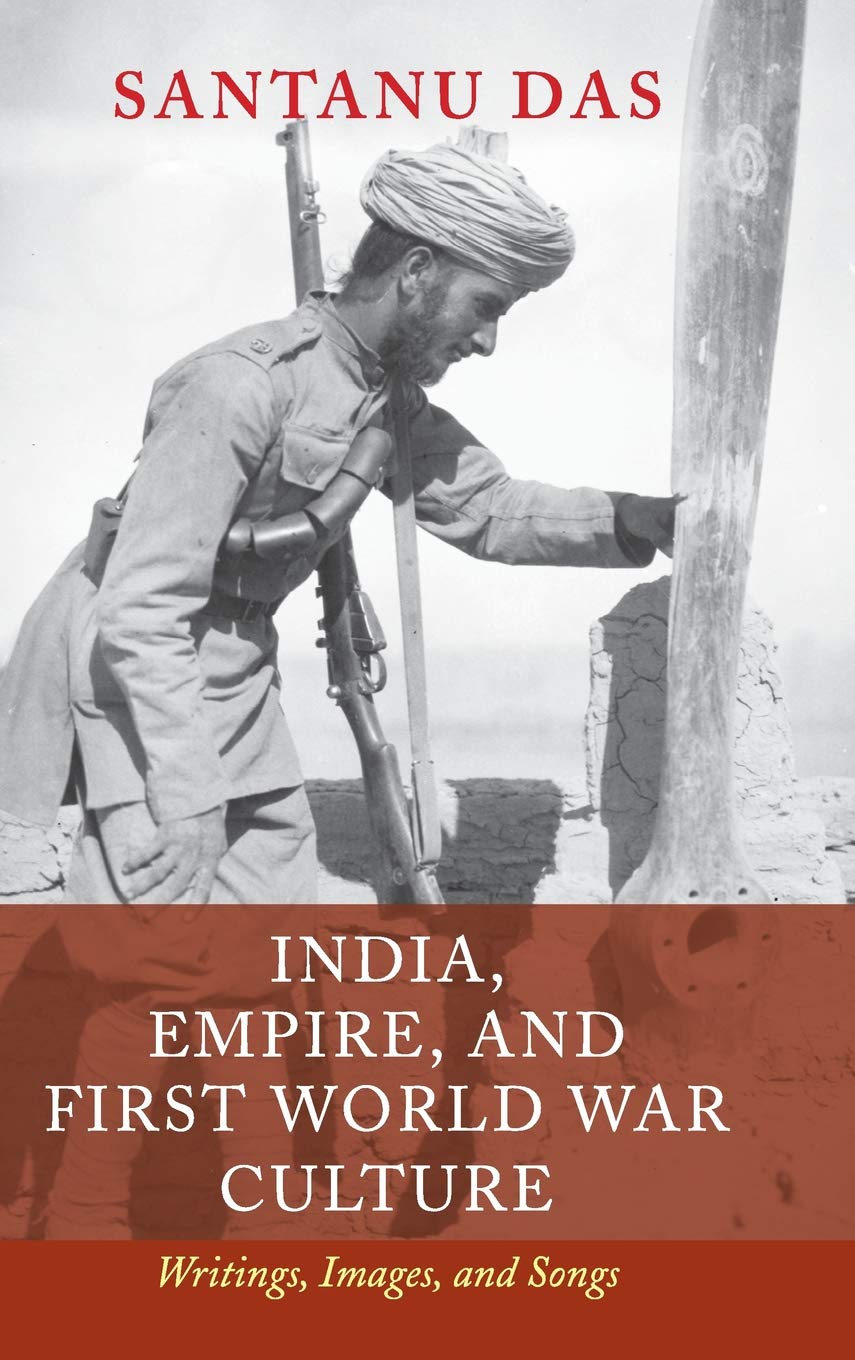
India, Empire, and First World War Culture: Writings, Images, and Songs
$53.89
by Santanu Das



Based on ten years of research, Santanu Das's India, Empire, and First World War Culture: Writings, Images, and Songs recovers the sensuous experience of combatants, non-combatants and civilians from undivided India in the 1914–1918 conflict and their socio-cultural, visual, and literary worlds. Around 1.5 million Indians were recruited, of whom over a million served abroad. Das draws on a variety of fresh, unusual sources - objects, images, rumours, streetpamphlets, letters, diaries, sound-recordings, folksongs, testimonies, poetry, essays, and fiction - to produce the first cultural and literary history, moving from recruitment tactics in villages through sepoy traces and feelings in battlefields, hospitals, and POW camps to post-war reflections on Europe and empire. Combining archival excavation in different countries across several continents with investigative readings of Gandhi, Kipling, Iqbal, Naidu, Nazrul, Tagore, and Anand, this imaginative study opens up the worlds of sepoys and labourers, men and women, nationalists, artists, and intellectuals, trying to make sense of home and the world in times of war. 'India, Empire and First World War Culture is an astonishing achievement, an amazing feat of scholarship that unearths an extraordinary range of sources and fragments. Through close and sensitive readings of poems, songs, paintings, photographs and a diverse range of objects, Santanu Das succeeds in unmuting a vast host of voices that have for far too long been silenced or forgotten. Rarely have the skills of the literary critic and historian been as imaginatively fused as in India, Empire and First World War Culture.' Amitav Ghosh, author of The Great Derangement 'In Santanu Das’s brilliant book, we can feel the real bodies of the men from India mobilised during the Great War through the traces of touch and intimacy they left behind. His beautiful and moving study brings to us what he terms echoes of the Sepoy’s heart. To do so, he uses an astonishing array of sources, moving with grace from the textual and the testimonial to the visual, the tactile, and the oral. Here is a book that not only adds substantially to what we know about the 1914–18 conflict, but brings out as well with affection and wit the sheer humanity of these soldiers and the world they left behind.' Jay Winter, Charles J. Stille Professor of History (Emeritus), Yale University, Connecticut 'Das brilliantly combines two approaches - ‘a redefinition of the archive’ and close, attentive reading … Das proves that detective work pays off but it is how he reads these treasures that is compelling. Thrillingly, this close reading elevates some of Das’s protagonists to a form of equality with the traditional First World War canon, to a kind of parity with Owen and Sassoon.' Yasmin Khan, The Times Literary Supplement ‘In the deluge of books, articles, exhibits, films, and commemorative events during and around the years of the centenary of the Great War, Das’s book stands out as one of the most important, exhaustively researched, and exquisitely rendered interventions. It will instantly become, and will remain, a classic in the field of First World War studies. But more, it is an important contribution to the history of modern South Asia, and an inspiring example of how historians may attempt to recover, present, and understand the histories of colonized peoples even in the absence of plentiful sources of the kinds historians usually use to do their work’ Richard Fogarty, American Historical Review 'Monumental … Those interested in First World War history and literature will find in Das’s narrative a beauty and sensitivity, drawing as it does on stories of compassion in the midst of the shelling. Combined with meticulous research and scholarship, it makes this densely printed 417-page book a compelling read.’ Shrabani Basu, H-Net: Humanities and Social Sciences Online 'Remarkable, compendious … Das’s capacity to read into the finest interstices of lost, buried, and misplaced war archives mean that his book is already being recognized - and justly so - as one of the most important interventions in both fields that we have yet seen.’ Elleke Boehmer, Modern Philology ‘[A] rewarding [account] of one of the empire's most remarkable institutions …’ Ian Jack, The Guardian ‘Santanu Das’s book is remarkable for lacking regional loci - its cosmopolitanism and liberalism in choosing multi-lingual and regional sources is one of its strongest features. The book’s signal contribution has been its success in reminding readers that legacies of wars reside in the social and cultural, and not always in the political or constitutional hallways of history … Das has written a book of immense significance … It will encourage the next generation of scholars to abandon the crutches of disciplinary certainties … [for] the promise of a dazzling array of new scholarship that knits visual, textual and literary sources together to produce stirring accounts o