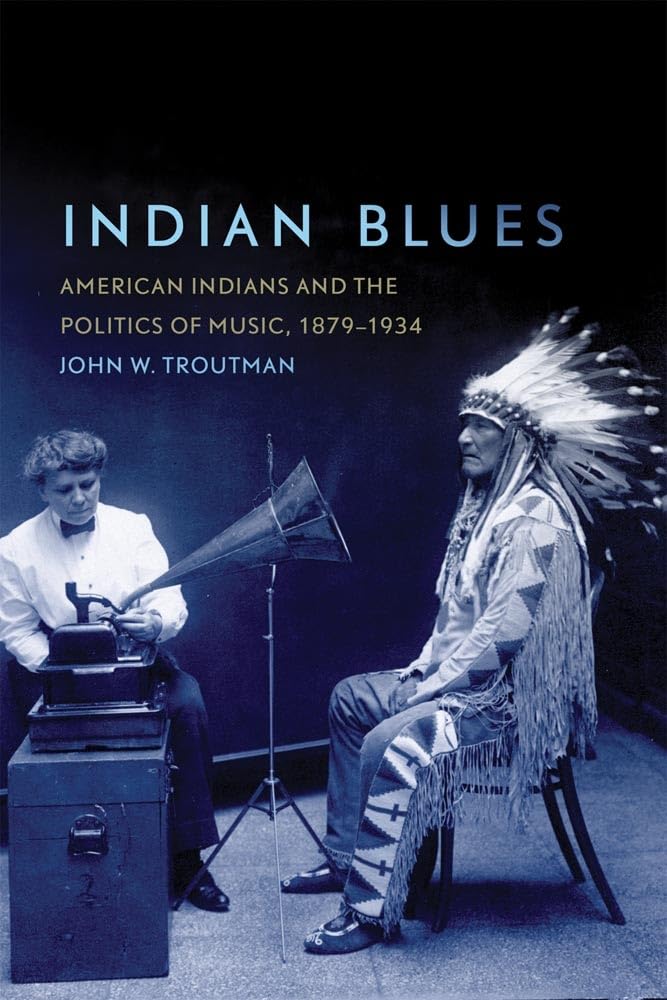



From the late nineteenth century through the 1920s, the U.S. government sought to control practices of music on reservations and in Indian boarding schools. At the same time, Native singers, dancers, and musicians created new opportunities through musical performance to resist and manipulate those same policy initiatives. Why did the practice of music generate fear among government officials and opportunity for Native peoples? In this innovative study, John W. Troutman explores the politics of music at the turn of the twentieth century in three spheres: reservations, off-reservation boarding schools, and public venues such as concert halls and Chautauqua circuits. On their reservations, the Lakotas manipulated concepts of U.S. citizenship and patriotism to reinvigorate and adapt social dances, even while the federal government stepped up efforts to suppress them. At Carlisle Indian School, teachers and bandmasters taught music in hopes of imposing their “civilization” agenda, but students made their own meaning of their music. Finally, many former students, armed with saxophones, violins, or operatic vocal training, formed their own “all-Indian” and tribal bands and quartets and traversed the country, engaging the market economy and federal Indian policy initiatives on their own terms. While recent scholarship has offered new insights into the experiences of “show Indians” and evolving powwow traditions, Indian Blues is the first book to explore the polyphony of Native musical practices and their relationship to federal Indian policy in this important period of American Indian history. While it is incredibly rare for an author's first published work to be of great significance, Troutman (Univ. of Louisiana, Lafayette) has done exactly that with this most imaginative and intellectually original book...[Troutman] enlightens and engages readers with great storytelling buttressed by a masterful command of subject... [He] delivers a riveting analysis of the interplay between the complex politics of powwows and the powerful forms of performance art that are the centerpieces of the gatherings...Summing Up: Highly recommended.— Choice John Troutman's Indian Blues is a thoroughly engaging and masterfully researched book that considers the myriad ways in which music and dance operate as expressions of resistance...It opens a new window onto how music practice tied into the politics of race, citizenship, and cultural agency in a period when Native Americans were being written out of history by politicians, composers and historians. Indian Blues attests to the moral and logical failure of that narrative, and sets a high standard for future scholarship on the historical study of Native American music in the early twentieth century.— Notes John W. Troutman argues in Indian Blues that historians ‘have traditionally . . . ignored the relationship of music to change over time’. Troutman ably challenges this deficiency with a well-researched, accessible book that “explores how the deployment of musical practice, by American Indians, OIA officials, and the non-Indian public alike, shaped the implementation of federal Indian policy" ... Indian Blues is a key work for readers interested in Native American history and the complex relationship between politics and culture.— Western Historical Quarterly For Troutman, music is more than sound; it is contested cultural terrain, the discursive product of a ‘cacophony of voices’ that ‘encompasses not only singers, dancers, and musicians but audience members,’ including the policymakers who attempt to regulate performances...[W]hat Troutman offers is a way to reconceive U.S. politics. Despite being largely excluded from congress, the courts, or the media, Native Americans were and are a part of U.S. political discourse and fully capable of steering this discourse in their favor.— American Quarterly John W. Troutman's Indian Blues is an in-depth exploration of a period too often neglected in Native American histories: from the beginnings of the reservation system through the early twentieth century and the 1934 Wheeler-Howard Act (often known as the Indian Reorganization Act or the Indian New Deal). It also focuses on a form of cultural expression that is too often unexamined by historians who feel they lack the technical expertise to engage in a sophisticated discussion: musical and choreographic expression. The result is a lovely volume that adds important insights about the new forms of community building and intercultural communication that emerged under the bureaucracy of administrative regimentation.— The Journal of American History Many historians have tackled the question of American Indian relations with the federal government and the associated issues of ethnic identity and educational policies but John Troutman has the distinction of being the first to do so from the perspective of music. His study is at once innovative, informative, and significan