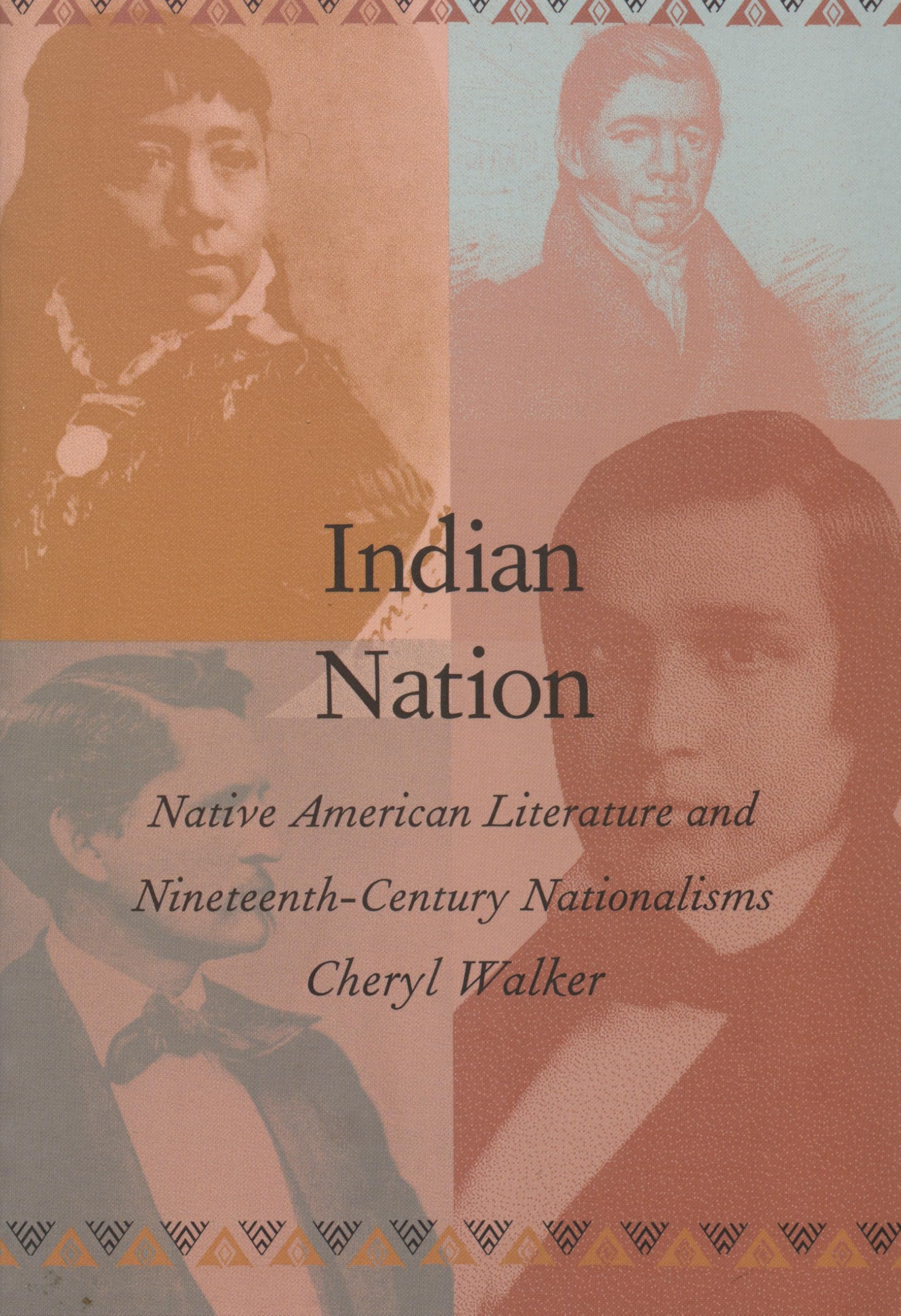
Indian Nation: Native American Literature and Nineteenth-Century Nationalisms (New Americanists)
$34.95
by Cheryl Walker



Indian Nation documents the contributions of Native Americans to the notion of American nationhood and to concepts of American identity at a crucial, defining time in U.S. history. Departing from previous scholarship, Cheryl Walker turns the "usual" questions on their heads, asking not how whites experienced indigenous peoples, but how Native Americans envisioned the United States as a nation. This project unfolds a narrative of participatory resistance in which Indians themselves sought to transform the discourse of nationhood. Walker examines the rhetoric and writings of nineteenth-century Native Americans, including William Apess, Black Hawk, George Copway, John Rollin Ridge, and Sarah Winnemucca. Demonstrating with unique detail how these authors worked to transform venerable myths and icons of American identity, Indian Nation chronicles Native American participation in the forming of an American nationalism in both published texts and speeches that were delivered throughout the United States. Pottawattomie Chief Simon Pokagon’s "The Red Man’s Rebuke," an important document of Indian oratory, is published here in its entirety for the first time since 1893. By looking at this writing through the lens of the best theoretical work on nationality, postcoloniality, and the subaltern, Walker creates a new and encompassing picture of the relationship between Native Americans and whites. She shows that, contrary to previous studies, America in the nineteenth century was intercultural in significant ways. “ Indian Nation offers thorough scholarship, good sense, and a clear style. The insightful overviews and fine brief accounts of Pearce, Slotkin, and Rogin are particularly valuable.”—Arnold Krupat, Sarah Lawrence College “Cheryl Walker demonstrates the integral parts played by native Americans in the development of the nineteenth-century American discourse about nationality. Not only does this important scholarly work remind us how fundamentally democratic institutions are indebted to native American cultures, it also teaches us that native Americans have been actively and complexly involved in the crucial political debates of our modernity. Indian Nation helps dismantle the odious but persistent myth of the ‘Vanishing American.’”—John Carlos Rowe, University of California, Irvine ""Indian Nation" offers thorough scholarship, good sense, and a clear style. The insightful overviews and fine brief accounts of Pearce, Slotkin, and Rogin are particularly valuable."--Arnold Krupat, Sarah Lawrence College Cheryl Walker is Richard Armour Professor of Modern Languages and Director of the Humanities Institute at Scripps College. She is the author of The Nightingale’s Burden: Women Poets and American Culture Before 1900. Indian Nation Native American Literature and Nineteenth-Century Nationalisms By Cheryl Walker Duke University Press Copyright © 1997 Duke University Press All rights reserved. ISBN: 978-0-8223-1944-3 Contents Preface and Acknowledgments, 1. The Subject of America The Outsider Inside, 2. Writing Indians, 3. The Irony and Mimicry of William Apess, 4. Black Hawk and the Moral Force of Transposition, 5. The Terms of George Copway's Surrender, 6. John Rollin Ridge and the Law, 7. Sarah Winnemucca's Mediations Gender, Race, and Nation, 8. Personifying America Apess's "Eulogy on King Philip", 9. Native American Literature and Nineteenth-Century Nationalisms, Appendix "The Red Man's Rebuke", Notes, Works Cited, Index, CHAPTER 1 The Subject of America The Outsider Inside American character is a particularly vexed subject, vexed because, on the one hand, we no longer wish to define Americans in terms of certain character traits, modes of behavior, physical types, and yet, on the other, we have never lost the desire to puzzle over the implications of ideas of the nation for a certain conception of the human being understood to represent those ideas. Whether or not we think of ourselves as "typical Americans"—and most of us don't—many of us have had the experience of being so labeled when we travel abroad, causing us to ponder our own understandings of what America is and how we are affected by it. Black Americans find that in Africa they are often considered more "American" than "African American." The children of immigrants, or even those who have themselves emigrated from other parts of the world, discover that they cannot easily shrug off the buffalo robe of "Americanization" when they visit friends and relations from their past. One never feels quite so American as when one is not in the United States. But what does it mean to be an American subject, the representative of certain conceptions about the nation? What aspects of one's identity and one's politics are not simply personal but national? At home we are all exiles. Abroad we seem, strangely, to be heard speaking only of "home." Even those for whom life in America has been far from ideal, those sub