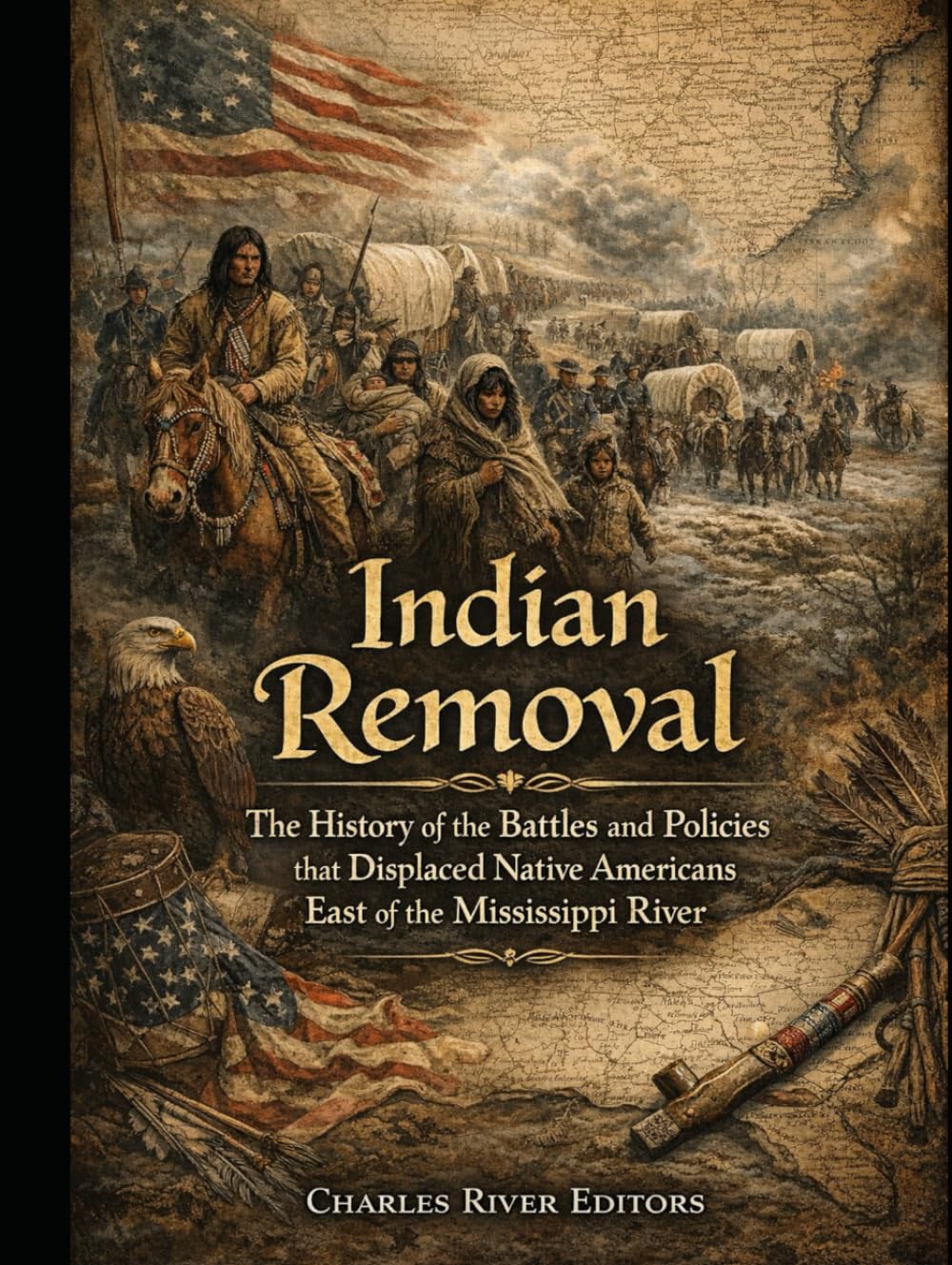
Indian Removal: The History of the Battles and Policies that Displaced Native Americans East of the Mississippi River
$22.99
by Charles River Editors



The new United States was faced with a fundamental problem: to expand, it had to settle lands to the west of the Appalachian Mountains, ceded to it by the British. However, the mountains were occupied by Native American groups who had no desire to make way for white settlers. The treaty had created a vast frontier for the fledgling nation, and any American settlers pushing west along it were bound to encounter hostile natives. For the most part, the conflicts that followed consisted mostly of the Native Americans suffering defeat in the face of a better-equipped adversary, interspersed with binding treaties, which, on the side of the federal government, proved not very binding at all. Occasionally, however, there arose a Native American leader of such ability that such defeats were temporarily reversed. From the American Revolution up through the Battle of Tippecanoe, Native Americans in the Old Northwest (today’s Midwestern states) had been putting up stout resistance to that region’s settlement by white land speculators and settlers. Things came to a head when Tecumseh and his brother, the Prophet Tenskwatawa, spearheaded a movement in the region that greatly influenced the area’s Native Americans. In 1806, Harrison began to publicly denounce Tenskwatawa to other tribal leaders, calling him a fraud and charlatan, but the Shawnee Prophet responded by accurately predicting a solar eclipse, which embarrassed Governor Harrison, and after this event, which tribal leaders took as a sign of Tenskwatawa’s authenticity, his movement grew even more rapidly. While Tippecanoe was clearly not a total victory, and Native American resistance would continue through the War of 1812, the battle is widely considered the end of Tecumseh’s War and did help bring about the decline of Native American ascendance in the region. Though the Trail of Tears applied to several different tribes, it is most commonly associated today with the Cherokee. The Cherokee began the process of assimilation into European America very early, even before the establishment of the Unites States, but it is unclear what benefits that brought the tribe. Throughout the colonial period and after the American Revolution, the Cherokee struggled to satisfy the whims and desires of American government officials and settlers, often suffering injustices after complying with their desires. Nevertheless, the Cherokee continued to endure, and after being pushed west, they rose from humble origins as refugees new to the southeastern United States to build themselves back up into a powerhouse both economically and militarily. The Cherokee ultimately became the first people of non-European descent to become U.S. citizens en masse, and today the Cherokee Nation is the largest federally recognized tribe in the United States, boasting over 300,000 members. The Creek became known as one of the Five Civilized Tribes for quickly assimilating aspects of European culture, but in response to early European contact, the Muscogee established one of the strongest confederacies in the region. Despite becoming a dominant regional force, however, infighting brought about civil war in the early 19th century, and they were quickly wrapped up in the War of 1812 as well. By the end of that fighting, the Creek were compelled to cede millions of acres of land to the expanding United States, ushering in a new era that found the Creek occupying only a small strip of Alabama by the 1830s. Given the limited amount of fighting, the Black Hawk War was hardly a war in the traditional sense, but it is still well-known among Americans today, and it was truly a seminal moment in American history. Black Hawk’s defeat essentially ended all Native American resistance east of the Mississippi River and opened up the rest of Illinois and Wisconsin to white settlement.