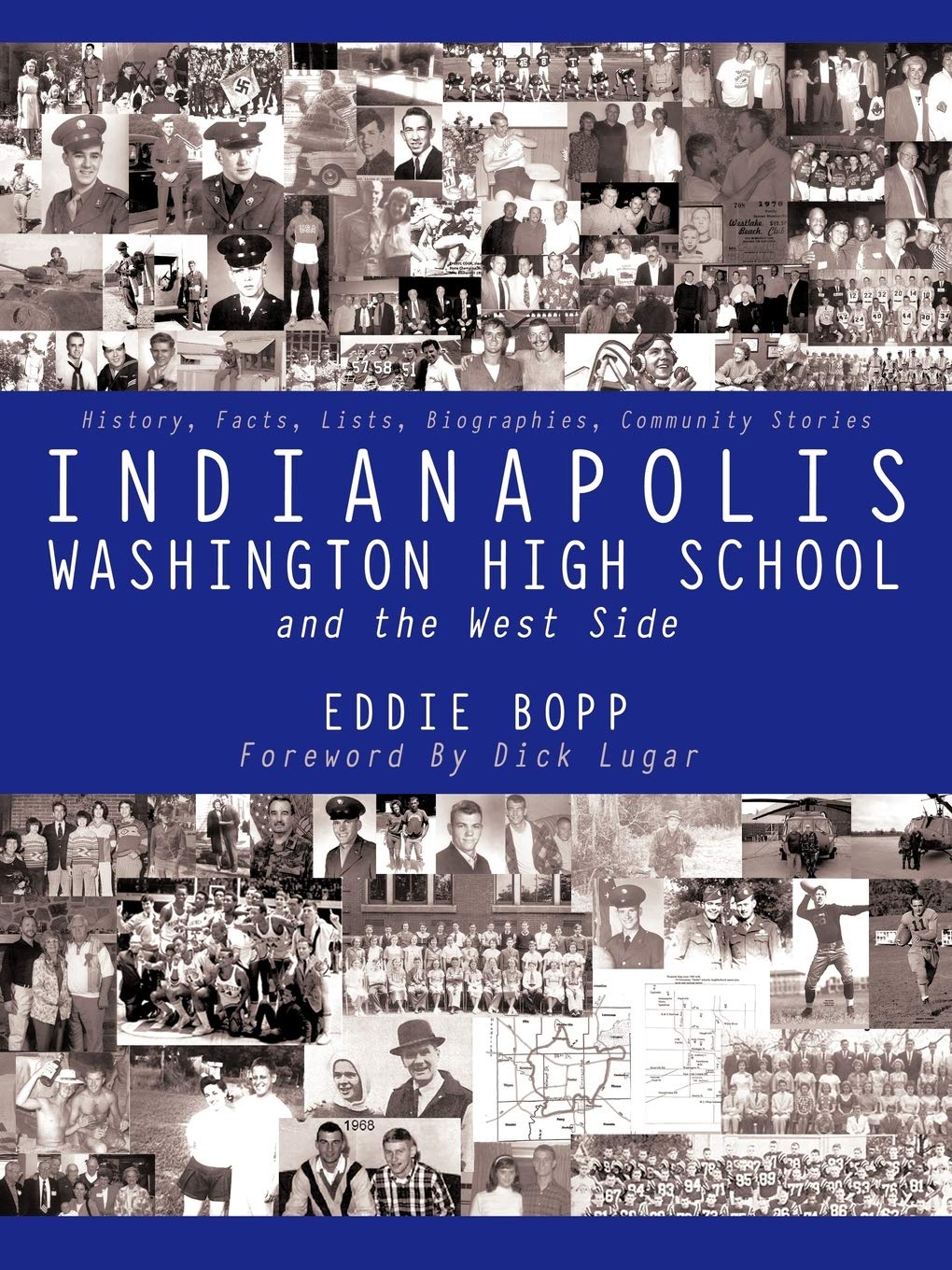
Indianapolis Washington High School And The West Side: History, Facts, Lists, Biographies, Community Stories
$24.99
by Eddie Bopp



The 68 year existence of Indianapolis Washington High School is described in a decade-by-decade history with an emphasis on people and athletics as well as focusing on individuals from the World War II and Vietnam eras. The varied lists of both a factual and subjective nature will be of interest to many in central Indiana. Indianapolis Washington High School and the West Side History, Facts, Lists, Biographies, Community Stories By Eddie Bopp AuthorHouse Copyright © 2010 Eddie Bopp All right reserved. ISBN: 978-1-4520-7226-5 Contents Foreword by Senator Richard G Lugar........................xiIntroduction...............................................xiiiI. The Near Westside.......................................1II. School History by Decades..............................7III. Biographies...........................................25Pictures...................................................119IV. World War II...........................................141Pictures...................................................154V. Washington Boys Killed In Action........................159VI. Community Stories......................................161VII. Scores, Records & State Champions.....................197VIII. Special Distinction..................................217IX. Odds & End.............................................231X. Faculty Over the Years..................................263XI. Epilogue...............................................269XII. Quiz Answers..........................................271Index......................................................275 Chapter One The Near Westside The near Westside of Indianapolis can be described physically by referencing American means of transportation which were built or improved in the 19th & 20th centuries. The National Road (known as Washington Street or Road 40 to westsiders), White River, Eagle Creek, and the railroads (known during most of the 20th century as the B & O, New York Central, and Pennsylvania) helped describe our area. Street names, community names, and the state government's township system all help define the area name designations. The nine townships in Marion County (one of 92 Indiana counties) can be seen as a tic-tac-toe board. From the northwest (going from left to right) the township names are Pike, Washington, and Lawrence; then Wayne, Center, and Warren; and, completed along the southern border by Decatur, Perry, and Franklin. There are a number of small, incorporated towns with Speedway and Beech Grove as the two largest which have their own school and police systems. Mayor Dick Lugar's Unigov proposal, which was passed by our state's General Assembly in 1969 and went into effect the first day of 1970, made the nine townships the new Indianapolis in most ways. But the school systems were still basically independent. As the boundaries of Indianapolis grew in increments via state law, the city's public schools paralleled its growth. Indianapolis had become the state capital in 1825. The Indianapolis Public Schools first emerged in the early 1850's. Reformers of the era both before and immediately after the Civil War saw public education as the great equalizer as well as the view that private, European and slave state type schools helped perpetuate antagonism between the rich and the poor. Indianapolis High School opened in 1863. Protestant ministers had implemented Sunday schools which taught morals, an idea that was first introduced in England. Public schools were the natural extension with the school year expanding from 110 to 180 days after the war. An early superintendent noted that children from the "lower walks of life" were most susceptible to the immoral temptations and most in need of academic and moral teachings. His approach was similar to the "Old Deluder Satan Act" of 1639 in colonial Massachusetts which became the first Public School Act 137 years before the Declaration of Independence. "An idle mind is the devil's playground" was a premise that most people accepted as one big reason for public schools; so, public schools were created to exhibit the democracy theory upon which our great nation was founded. Manual Training High School became the second IPS secondary school in 1888 (moving into a permanent home near Meridian and South Street within the Mile Square area), so Indianapolis High School became Shortridge. Broad Ripple High School emerged circa 1890 but the Broad Ripple community didn't become part of Indianapolis until 1923 so Arsenal Technical became the third high school in 1912 with its campus located on the Civil War arsenal on the eastside. In 1927 when our school was reluctantly accepted by the school board (West Park minister Rev. Baker personally noted that a near-northside school board member stated that "those kids west of the river won't go to school anyway") the segregated Crispus Attucks school also opened. The tract of land upon which Washington H