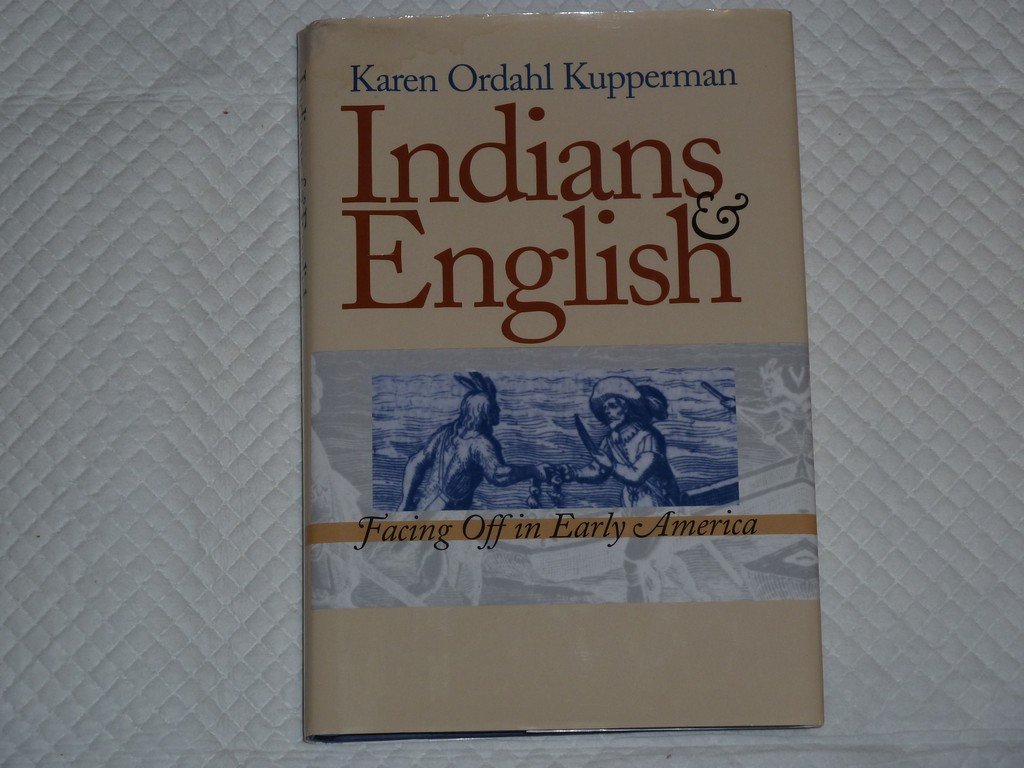



In this vividly written book, prize-winning author Karen Ordahl Kupperman refocuses our understanding of encounters between English venturers and Algonquians all along the East Coast of North America in the early years of contact and settlement. All parties in these dramas were uncertain―hopeful and fearful―about the opportunity and challenge presented by new realities. Indians and English both believed they could control the developing relationship. Each group was curious about the other, and interpreted through their own standards and traditions. At the same time both came from societies in the process of unsettling change and hoped to derive important lessons by studying a profoundly different culture.These meetings and early relationships are recorded in a wide variety of sources. Native people maintained oral traditions about the encounters, and these were written down by English recorders at the time of contact and since; many are maintained to this day. English venturers, desperate to make readers at home understand how difficult and potentially rewarding their enterprise was, wrote constantly of their own experiences and observations and transmitted native lore. Kupperman analyzes all these sources in order to understand the true nature of these early years, when English venturers were so fearful and dependent on native aid and the shape of the future was uncertain.Building on the research in her highly regarded book Settling with the Indians, Kupperman argues convincingly that we must see both Indians and English as active participants in this unfolding drama. In Settling with the Indians: The Meeting of English and Indian Cultures in America, 1580-1640, Kupperman contended that the confrontation was considerably more complex than scholars previously thought and urged them to examine how English colonists and Indians learned from one another's cultures and technologies. In her new book, Kupperman synthesizes two decades of research to strengthen her argument that the encounters were not simply a matter of a stronger, more complex culture acting upon a weaker, simpler one. On the contrary, in her view the otherwise self-confident English became somewhat more tentative in approaching the Indians, desperate to obtain stories and other information to explain the need for continued colonial settlement to a curious and skeptical audience back home. One drawback of this wide-ranging book is that it lacks a focus on a single region of America (although the Virginia colony provides many specific examples), but this exceedingly well-argued and well-presented work, with many interdisciplinary insights, will be an essential addition to major public libraries and academic libraries interested in maintaining research collections on cultural encounters. -Charles K. Piehl, Minnesota State Univ., Mankato Copyright 2000 Reed Business Information, Inc. "There is much of interest in this book. . . . Kupperman offers fascinating reinterpretations of people who bridged the two cultures― such as the Pilgrims' self-serving friend Squanto― and the tensions they experienced as a result. . . . her emphasis on cultural contexts and the recovery of Indian agency and endurance make her book representative of much recent work in this field."―Michael P. Winship, Times Literary Supplement. September 22, 2000. ". . . this exceedingly well-argued and well-presented work, with many interdisciplinary insights, will be an essential addition to major public libraries and academic libraries interested in maintaining research collections on cultural encounters."―Library Journal. May, 2000. "Kupperman has dramatically reconstructed her description of the interface between America's native residents and the English newcomers. . . . she humanizes both cultures as fully cognizant, social, and responsive. . . . The author has resilvered the mirror, reflecting images that will pique scholarly curiosity at every level."―Choice. October, 2000. "In this book, Kupperman boldly attempts to rescue English colonization in late sixteenth- and early seventeenth-century North America from its still familiar place in the national history of the United States. . . She brings us substantially closer to complexity in the earliest encounters between English colonists and Native Americans. . . Indians and English contributes significantly to rethinking about the discursive nature of identity in early America."―Daniel H. Usner, Jr., Cornell University. William and Mary Quarterly, July 2001 "Indians and English provides a hard look at precolonial stereotypic sources and propaganda, and counters myth in many instances. . . . Recommended reading for American studies students and others interested in this period of American history."―James A. Cox, Midwest Book Review, Sept., 2000. "Kupperman is illuminating on the subject of acculturation. Her gracefully written book should be well received. . . ."―David Sloan, University of Arkansas at Fayetteville. Histor