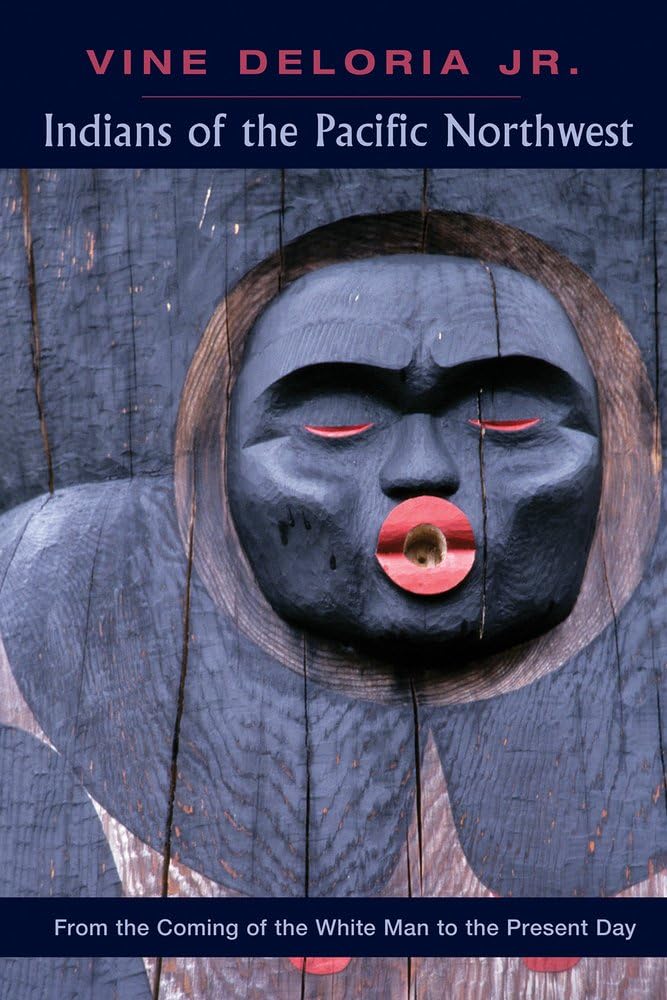
Indians of the Pacific Northwest: From the Coming of the White Man to the Present Day
$12.98
by Vine Deloria



Prior to the onslaught of the Europeans, the Puget Sound area was one of the most heavily populated regions north of Mexico City. The Native Americans who lived there enjoyed a bounty of seafood, waterfowl, and berries, which they expertly collected and preserved. Detailing the associated culture, technologies, and techniques, Vine Deloria Jr. explains in depth this veritable paradise and its ultimate demise. Raising the possibility that the utopian lifestyle enjoyed by the Indians of the Pacific Northwest might have continued in perpetuity had Europeans not sought a Northwest Passage. Deloria describes in devastating detail the ramifications of the Europeans' migration into the territory. With more than two thousand American settlers in the Pacific Northwest by 1852, and with many more to come, the outbreak of disease and the encroachment of land speculators, railroad capitalists, and logging and mining interests forced the Native Americans to give up their ancestral lands and move to reservations. Deloria speaks with a measure of sadness, outrage, and hope, writing a moving account of the Pacific Northwest Indians' struggle that began with the arrival of the white settlers and continues today. TIME magazine named Vine Deloria Jr. as one of the greatest religious thinkers of the twentieth century, and his research, writings, and teachings on history, law, religion, and political science changed the face of Indian Country, influencing future generations of Native and non-Native Americans alike. In addition to God Is Red, He authored many other acclaimed books, including Evolution, Creationism, and Other Modern Myths; Red Earth, White Lies; Spirit and Reason; and Custer Died for Your Sins. Indians of the Pacific Northwest From the Coming of the White Man to the Present Day By Vine Deloria Jr. Fulcrum Publishing Copyright © 2012 Vine Deloria Jr. All rights reserved. ISBN: 978-1-55591-688-6 CHAPTER 1 When I was first elected to the directorship of the National Congress of American Indians, I was introduced to the tribes of the Pacific Northwest, particularly those tribes that live in and around the Puget Sound area. The Makahs, who live on Cape Flattery, one of the northern peninsulas of Washington State, told me how a Spanish expedition in the late 1700s had invaded their lands and built a fort. The Makahs bided their time, cleverly captured the fort one morning, and sent the Spanish fleeing for their boats, leaving behind cannons, guns, and all manner of goods. While the name of Juan de Fuca was given to the strait between the lands of the Makahs and Vancouver Island, the lands and waters remained in the hands of the Indians for some time afterward. The chief complaint of the Indians of the Pacific Northwest when they would come to the national Indian political conventions would be that the whites, particularly the officials of the fish and game departments of Washington State, were violating their treaties and harassing the Indian fishermen. I grew up in South Dakota, a member of the Sioux tribe, and when we talked about fish in that country we were talking about something approximately six inches long that you were sometimes lucky to get out of a creek in midsummer. So I could never figure out just what the problem was in Washington State, and the idea of people complaining because they couldn't go fishing seemed a little absurd to me at the time. But the coastal tribes kept after the rest of us. They would compare the salmon with the buffalo, telling us how the salmon was to them what the buffalo had been to the Plains tribes. It was, we all agreed, ridiculous to compare a tiny fish with the magnificent animal that had provided us with food, clothing, weapons, and other articles of our culture. We were polite but firm and tried to press on to larger and more important topics of discussion that affected Indians all over the nation. Finally, perhaps in some despair over the stupidity of this Plains Indian they were trying to educate, the Pacific Northwest tribes invited me to come to Washington State and attend a meeting on Indian problems. I was eager to get out and meet the people of the different tribes, and so I accepted and flew to Seattle. A car picked me up, and we went to the state capital, Olympia, where the Indians were having a banquet with their congressman, Lloyd Meeds, who has spent his time in Congress working hard with the tribes to resolve some of their problems. There were nearly fifty Indians at the banquet, and, of course, salmon was served. Everyone ate his fill of the delicious meal, and after the ceremonies and speeches one of the Indians took me to the kitchen to see the remains of the salmon that had provided us with our meal. I was confronted with the skeletal remains of a gigantic fish, far surpassing in size the tiny catfish of my youth. When I learned that this one salmon had fed the entire banquet, I came to understand why the salmon was so important to the