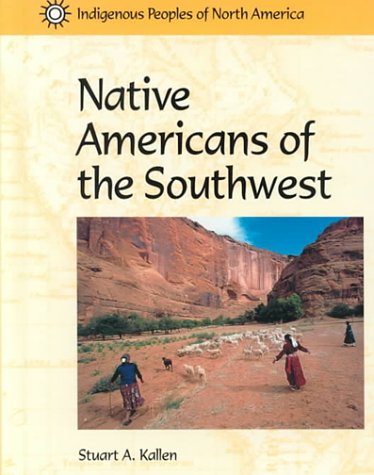
Indigenous Peoples of North America - Native Americans of the Southwest
$28.70
by Stuart A. Kallen



Native American tribes such as the Hopi, Navajo, Zuni and others continue to influence politics, history, and culture in the southwestern United States as they have for millennia. They were and continue to be individual farmers, hunters, warriors, artisans, and healers. Native Americans of the Southwest details the real daily lives past and present of the tribes who have made the southwest's grand mesas, canyons, desert, and mountains their home. Grade 7 Up-A foreword states that this series "strives to present a complex, realistic picture of the many and varied Native American cultures-[offering] historical perspectives as well as a view of contemporary life-." Since this volume covers an entire region rather than a specific nation or cultural group, Kallen highlights features and history of the various cultures, often comparing and contrasting them. This method makes for an interesting survey of Native Southwestern cultures, but does not present an integrated picture of any individual tribe. Throughout the book, the author quotes extensively from primary and secondary sources, ranging from Geronimo's autobiography to the Pueblo Cultural Center Web site, but there is no mention of personal consultation with members of any of the cultures discussed. While the perspective is definitely that of an outsider looking in, there are overt attempts to balance popular non-Native ideology with Native perspectives, such as the Navajo Tribe's stance that the Bering Strait land-bridge theory is a fabrication used to justify westward expansion. For a more focused look at any of these individual cultures, the "Indians of North America" series (Chelsea) is a better choice. This regional overview is a serviceable introduction for most students. Black-and-white photos and reproductions appear throughout. Sean George, St. Charles Parish Library, Luling, LA Copyright 2000 Reed Business Information, Inc. "Every heavily-illustrated book in the series includes similar chapters on family life, spirituality, interactions with white men and the environment, and existence in today's world. All include histories of broken treaties, inhumane conditions, and restrictive, poverty-ridden reservations. Nevertheless, each has a unique story to tell. All books in the series are attractive, affordable, and written on a level appropriate for upper elementary to high school. The photos and interesting sidenotes complement well-written text." -- VOYA (June 2001) ( VOYA 20010601) "This is a useful resource for classrooms studying American history and native peoples." -- School Library Journal (August 2002) ( School Library Journal 20020801) Used Book in Good Condition