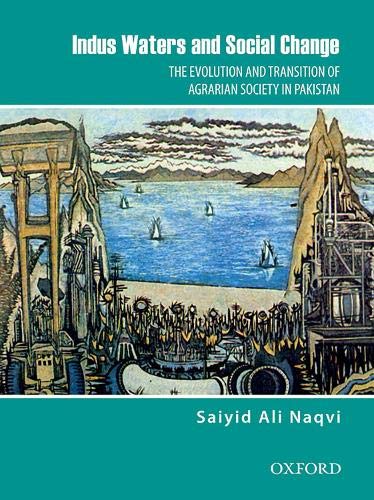
Indus Waters and Social Change: The Evolution and Transition of Agrarian Society in Pakistan
$85.00
by Saiyid Ali Naqvi



Saiyid Ali Naqvi has brought a wealth of knowledge in water resources development, acquired over a 58-year career, to this study of the impact of the harnessing of the Indus waters on the evolution and development of the fabric of society in the region. He follows the Indus in its journey from around 7000 bc to present times, as he develops his thesis that the processes of social change in the region that now constitutes Pakistan are inextricably linked to the harnessing of the Indus waters. At its inception in 1947, Pakistan, with 85 percent of its population dependent on agriculture, was an agrarian country. Today, with two-thirds of its population still living in villages, the country remains dependent on agriculture. Despite the use of machinery by big landowners, the agrarian social structure remains fettered by quasi-feudal and tribal customs. The book makes a critical assessment of the pace of the social change process in Pakistan and finds that it has reached a phase which could at best be characterized as 'quasi-industrial'. This disappointing situation is due to the slow pace of industrialization of the agriculture sector. The book provides the research, historical facts, and insights for an informed public debate on the policy measures for overcoming impediments and accelerating the social change process. Surveys the socio-economic history of the Indus region from the earliest times to the present and argues that the social change process in Pakistan is inextricably linked to the harnessing of the Indus Waters Saiyid Ali Naqvi commenced his career with the Pakistan government's Central Engineering Authority (CEA). In 1956, he was appointed as Deputy Pakistan Irrigation Commissioner in the office of the Pakistan Irrigation Commission at Lahore. He was subsequently transferred to the Water Development Organization, established by the government to provide back up support to the Pakistan delegation at the Indus Basin Treaty negotiations, in progress under the aegis of the World Bank. Following the signing of the Treaty in 1960, Saiyid Ali Naqvi began a nearly nineteen-year period of his career devoted to large dams. In 1980, he joined the Asian Development Bank (ADB) at Manila where he worked on a number of water resources and rural development projects in the Philippines, Sri Lanka, Nepal, Laos, Vietnam, China, Indonesia, and Pakistan. He has been a Member of the American Society of Civil Engineers. Used Book in Good Condition