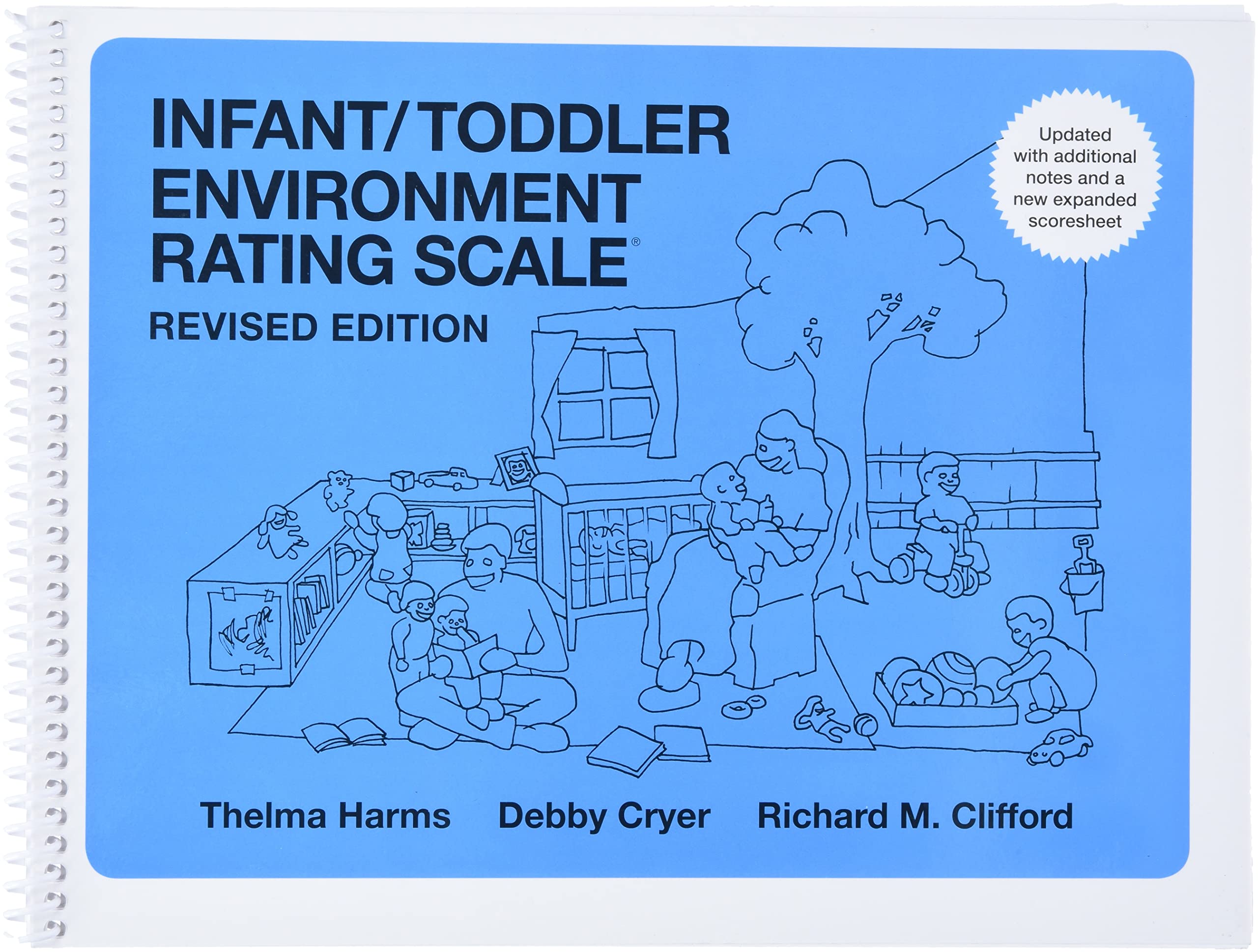



This title is in the Environment Rating Scale ® Family of Products―the leading research-based tools to optimize the quality of children’s early learning. Designed for use in center-based child care programs for infants and toddlers up to 30 months of age, the Infant/Toddler Environment Rating Scale ® , ITERS-R, can be used by program directors for supervision and program improvement, by teaching staff for self-assessment, by agency staff for monitoring, and in teacher training programs. The established reliability and validity of the scale make it particularly useful for research and program evaluation. Featuring a spiral binding, the updated ITERS-R offers more practical assistance in the form of additional notes for clarification and an Expanded Scoresheet, which incorporates notes and tables to assist in scoring. However, the items and indicators remain the same as in the original ITERS-R. Convenient organization in seven subscales: Space and Furnishings - Personal Care Routines - Listening and Talking - Activities - Interaction - Program Structure - Parents and Staff Each of the 39 Items is expressed as a 7‑point scale with indicators for 1 (inadequate), 3 (minimal), 5 (good), and 7 (excellent). Notes for clarification and questions are included for selected Items. An introductory section gives detailed information about the rationale of the ITERS-R, the process of revision, and the reliability and validity of the scale. Full instructions for administration and scoring, as well as a Scoresheet and Profile that may be photocopied, are included with the scale. Thelma Harms, Director of Curriculum Development, FPG Child Development Institute, and Research Professor, UNC-CH School of Education, is recognized internationally for her work on creating high quality early childhood environments and assessing educational settings. For 15 years she served as Head Teacher at the Harold E. Jones Child Study Center, UC Berkeley. She has developed a variety of curriculum materials and staff training resources. Much of her recent training and consultation has focused on the use of the scales in technical assistance, and on helping government agencies to develop accountable systems for recognizing and rewarding high quality programs. Debby Cryer, Scientist, FPG Child Development Institute, University of North Carolina at Chapel Hill, has taught in and directed a variety of early childhood programs. She has written about early childhood program quality for more than 20 years. She is the lead author of the Active Learning Series curriculum books and has extensive experience assessing early childhood programs in varied settings. She is currently studying the effects of continuity of caregiver on childrenÂs development, and directs various projects that provide guidance in assessing and improving child care quality. Richard M. Clifford, Senior Scientist, FPG Child Development Institute Research Associate Professor,UNC-CH School of Education, has written and consulted extensively on child and family policy issues with special emphasis on the role of government in the provision of early childhood services. In addition, he has done research on early learning environments and their impact on young children. He currently is co-director of both the National Center for Early Development and Learning and the National Prekindergarden Center. Dr. Clifford is a past president of the National Association for the Education of Young Children (NAEYC). Infant / Toddler Environment Rating Scale (Revised Edition) by Thelma Harms, Debby Cryer, Richard M. Clifford
Teachers College
2006
Teachers College
2006