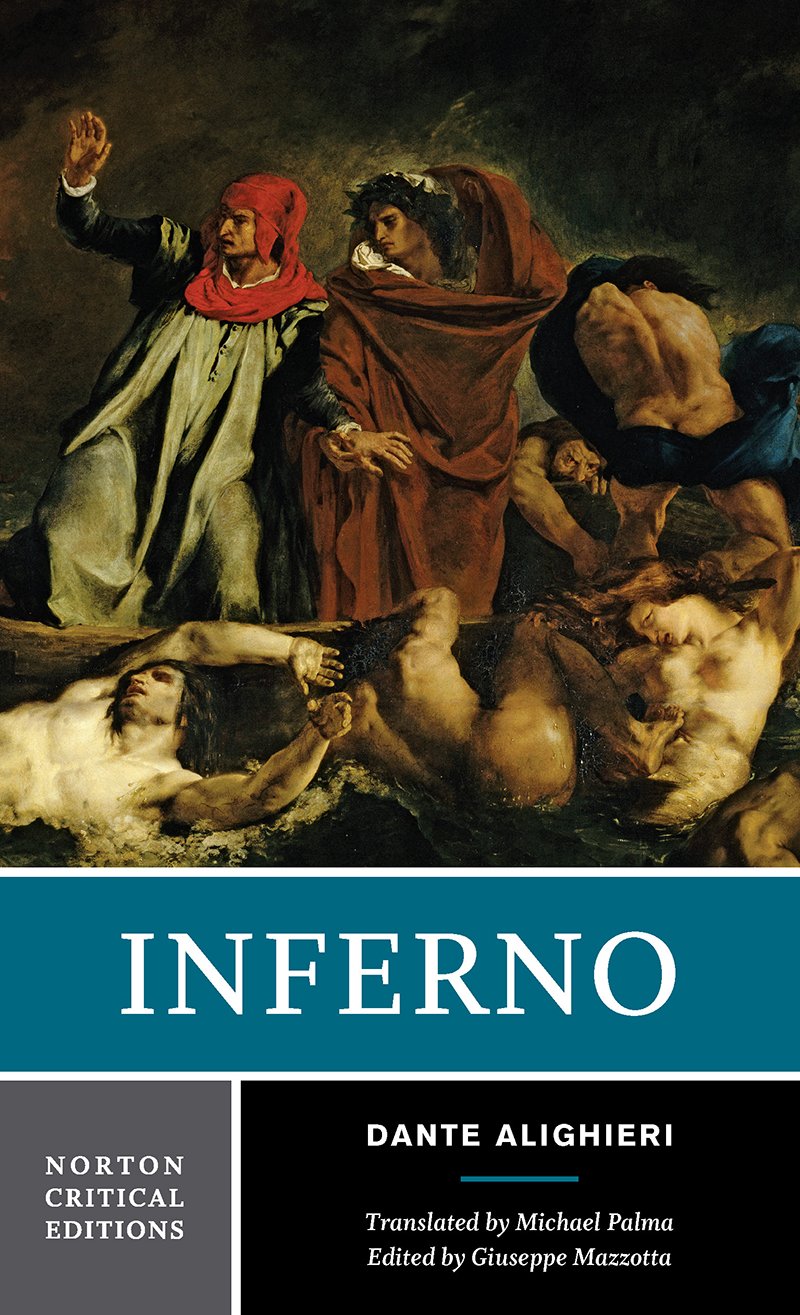



Richard Wilbur praises Palma’s translation as “accurate as to sense, fully rhymed, and easy, as a rule, in its movement through the tercets. Readers will find it admirably clear and readable.” The text is accompanied by detailed explanatory annotations.Also included in this edition are an illuminating introduction by Giuseppe Mazzotta, a Translator’s Note, The Plan of Dante’s Hell, and six maps and illustrations.“Criticism” provides twelve interpretations by, among others, John Freccero, Robert M. Durling, Alison Cornish, Teodolinda Barolini, Giuseppe Mazzotta, and Robert Hollander.A Chronology and Selected Bibliography are also included. "Dante's conversations with his mentor Virgil and the doomed shades are by turns assertive and abashed, irritated and pitying and inquisitive, and Anthony Esolen's new translation renders them so sensitively that they seem to take place in the same room with us. It follows Dante through all his spectacular range, commanding where he is commanding, wrestling, as he does, with the density and darkness in language and in the soul. This "Inferno gives us Dante's vivid drama and his verbal inventiveness. It is living writing." --James Richardson, Princeton University "Professor Esolen's translation of Dante's "Inferno is the best one I have seen, for two reasons. His decision to use unrhymed blank verse allows him to come nearly as close to the meaning of the original as any prose reading could do, and allows him also to avoid the harrowing sacrifices that the demand for rhyme imposes on any translator. And his endnotes and other additions provoke answers to almost any question that could arise about the work." --A. Kent Hieatt, professor emeritus, University of Western Ontario "Esolen's brilliant translation captures the power and the spirit of a poem that does not easily give up its secrets. The notes and appendices provide exactly the kind of help that most readers will need." --Robert Royal, president, Faith and Reason Institute "From the Hardcover edition. Dante Alighieri was born in 1265 in Florence to a family of minor nobility. He entered into Florentine politics in 1295, but he and his party were forced into exile in a hostile political climate in 1301. Taking asylum in Ravenna late in life, Dante completed his Divine Commedia, considered one of the most important works of Western literature, before his death in 1321. Giuseppe Mazzotta is Sterling Professor of the Humanities for Italian at Yale University. He is president of the Dante Society of America (2003-2009). He is the author of Dante: Poet of the Desert and Dante's Vision and the Circle of Knowledge . Michael Palma has published six collections of original poetry and nearly twenty books of translations of modern and contemporary poets. He has received numerous awards, including the Italo Calvino Award from the Translation Center of Columbia University. His most recent book is Faithful in My Fashion: Essays on the Translation of Poetry . He lives in Vermont.