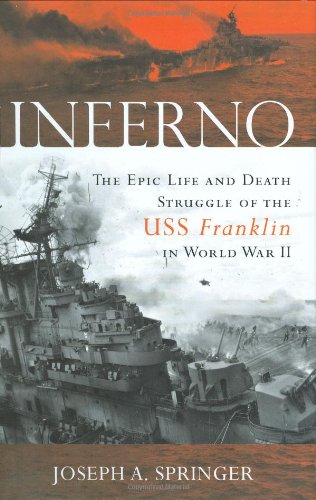
Inferno: The Epic Life and Death Struggle of the USS Franklin in World War II
$96.93
by Joseph A. Springer



Known throughout the fleet as "Big Ben," the USS Franklin was christened for the legacy of the four prior U.S. Navy ships named after Benjamin Franklin. The Franklin was a creation of World War II, one of twenty-four Essex-class fast carriers built during the conflict, forming the backbone of the U.S. Navy's war against Japan. By the time the war had moved to Okinawa in the spring of 1945, "Big Ben" had already seen substantial combat, having participated in the island campaigns of the central and western Pacific and the Battle for Leyte Gulf in the Philippines, where she sustained heavy damage from the new and deadly Japanese kamikaze . On March 19, 1945, the Franklin was launching her aircraft against Honshu, the Japanese mainland, including the shipping industry in Kobe Harbor. Suddenly, a single enemy aircraft pierced the cloud cover and made a low level run on the ship, striking it with a 250kg bomb which pierced the deck and set off a chain reaction of exploding ordnance and aviation fuel. The aircraft carrier, now on fire, listing heavily to starboard, and with over 1,000 casualties, appeared to be mortally wounded. Inferno tells the heroic tale of the efforts that saved "Big Ben." It is a tremendous story of endurance and seamanship, told in harrowing detail in the survivors own words. Inferno makes for gripping reading. Midwest Book Review, December 2007 “A gripping true story of bravery and sacrifice, featuring the words of the men who served aboard ‘Big Ben’ as well as a handful of black and white photographs. A welcome addition to naval and World War II history shelves.” Naval History, December 2007 (circ.: 60,000) “Joseph Springer brings to life one of the most exciting stories of World War II as seen and told from the perspective of officers and Sailors who served on board the Essex- class aircraft carrier USS Franklin . The author has crafted a well-researched and easy-to-read oral history that not only pays tribute to the men who sailed in the Franklin but to the legacy of naval service and its values of honor, courage, and commitment … This book is a fitting tribute to the crew members of the Franklin and all the Sailors who fought during World War II.” World War II Database, November 2007 (vpm: 30,000) “I was immediately impressed by Springer's writing style, which was straight-forward but was done without sacrificing detail. He professed that his interest in the history of USS Franklin had been nearly life-long, and it showed. The book delivered in clear detail everything encompassing the ship's history, configuration throughout the war, and the environments she had been in. Springer also succeeded in providing just enough information about the Pacific War so to shine light on why Franklin engaged in actions that she did … With this book, the men of Franklin, along with their courage in the face of disaster and their accomplishment of bringing the devastated ship back home on her own power, were made known. I highly recommend Inferno , a history told with harrowing and gripping detail.” Midwest Book Review, November 2007 “A gripping true story of bravery and sacrifice, featuring the words of men who served aboard ‘Big Ben’ as well as a handful of black and white photographs. A welcome addition to naval and World War II history shelves.” Author's Note In writing oral histories, it is inevitable that events are recalled differently--memories are informed by the personal views of witnesses and by where those witnesses were during an engagement. An eighteen-year-old enlisted man down in the bowels of a ship saw the war differently than a gunnery officer stationed on an island, while that very same officer saw events differently than a Hellcat fighter pilot who, as a flyer, seemed to exist in another dimension altogether. Though there may be glaring discrepancies among the three accounts, their views can all be totally honest. None are necessarily wrong. They just saw things differently. Certainly every crewman aboard the Franklin has his own personal experience. As you will see, some of their stories illustrate the contrasts in fate along the spectrum of human behavior in times of crisis. Perhaps it seems easy to judge the actions of personnel involved in distant or half-century-old events, but the reader must remember that America and her armed forces were in their third year of a bloody war, the ranks filled with seventeen-and eighteen-year-old kids to augment losses. No written narrative can adequately convey the horrors experienced by these young men who were, in many cases, just a few months out of high school. Therefore I ask the reader--and those who served aboard Franklin--to show the sailors, marines, and aircrewmen leniency for variations in memories that were forged in fire all those years ago. The hectic nature of combat aboard a huge vessel, especially of the type witnessed during the attack on March 19, 1945, makes it complicated to break d