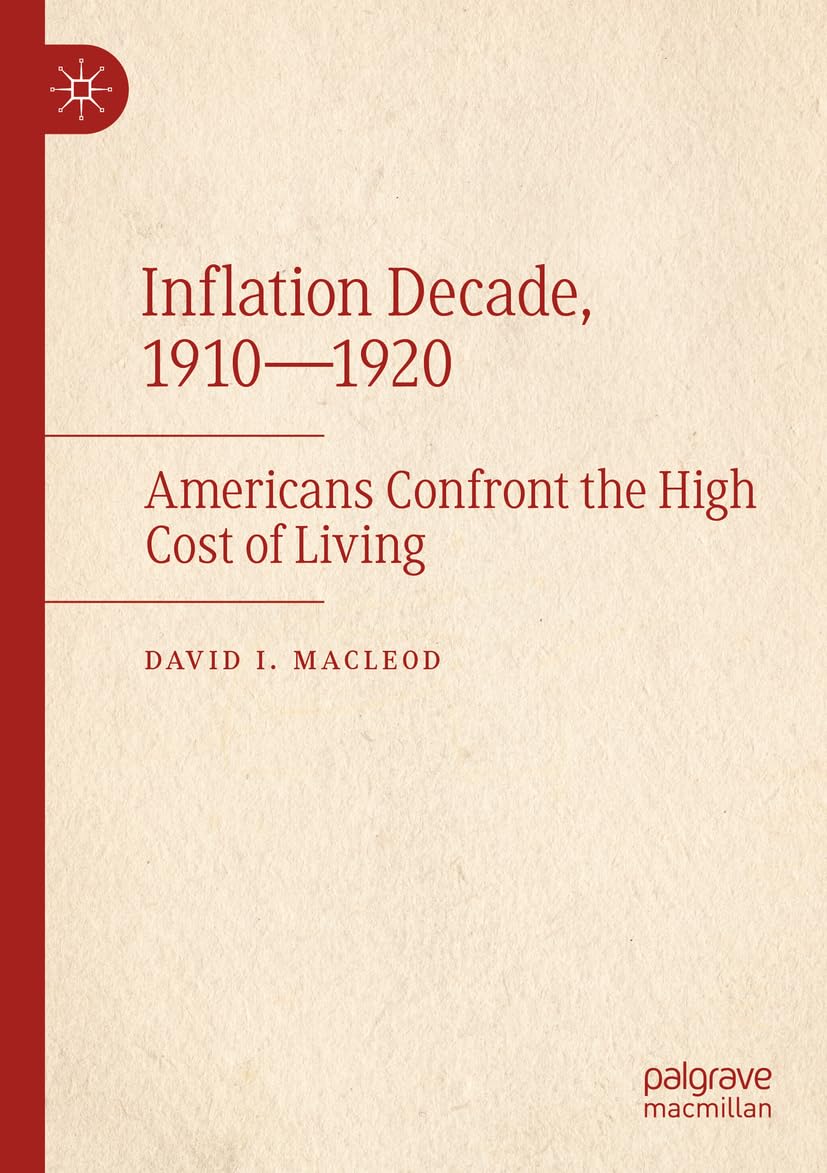
Inflation Decade, 1910—1920: Americans Confront the High Cost of Living
$159.99
by David I. Macleod



This book shows how inflation can disrupt politics and society. With no recent precedent, mild inflation spurred mass protests, myriad remedial schemes, and partisan political reversals between 1910 and 1914. Then wartime demand and inflationary fiscal policy doubled consumer prices from 1915 to 1920, triggering waves of strikes, food riots by immigrant housewives, class conflict, and elite fears of revolution. Middle-class households resented falling real incomes. Even more than today, food prices dominated consumer concerns. Yet farmers wanted high commodity prices. Accordingly, both sides blamed and attacked meatpackers, wholesalers, and retailers. Then as now, inflation hurt whichever party held the White House. Fumbling responses by Wilson’s administration and the Federal Reserve led to hesitant price controls, punitive raids and prosecutions, and a now-familiar fallback―high interest rates in 1920 and subsequent recession. An epilogue traces continuing popular and politicalresponses to changes in the consumer price index down to 2020. "Inflation Decade serves as an excellent reference on the topic and should be in the library of any academic interested in this period or American inflation more broadly." (Gabriel P. Mathy, The Journal of the Gilded Age and Progressive Era, April 8, 2025) “This book will be equally valuable to economic history novices and researchers, as well as anyone looking to expand the scope of their understanding of the era in question, or gain a better way of understanding the American public’s reactions to a meaningful and increasingly inevitable phenomenon.” (S. K. Allen , Choice, Vol. 62 (4), 2024) This book shows how inflation can disrupt politics and society. With no recent precedent, mild inflation spurred mass protests, myriad remedial schemes, and partisan political reversals between 1910 and 1914. Then wartime demand and inflationary fiscal policy doubled consumer prices from 1915 to 1920, triggering waves of strikes, food riots by immigrant housewives, class conflict, and elite fears of revolution. Middle-class households resented falling real incomes. Even more than today, food prices dominated consumer concerns. Yet farmers wanted high commodity prices. Accordingly, both sides blamed and attacked meatpackers, wholesalers, and retailers. Then as now, inflation hurt whichever party held the White House. Fumbling responses by Wilson’s administration and the Federal Reserve led to hesitant price controls, punitive raids and prosecutions, and a now-familiar fallback―high interest rates in 1920 and subsequent recession. An epilogue traces continuing popular and political responses to changes in the consumer price index down to 2020. David I. Macleod is Professor Emeritus of History at Central Michigan University, where he taught American social and political history. His publications include Building Character in the American Boy: The Boy Scouts, YMCA, and Their Forerunners, 1870-1920 and The Age of the Child: Children in America, 1890-1920. David I. Macleod is Professor Emeritus of History at Central Michigan University, where he taught American social and political history. His publications include Building Character in the American Boy: The Boy Scouts, YMCA, and Their Forerunners, 1870-1920 and The Age of the Child: Children in America, 1890-1920 .