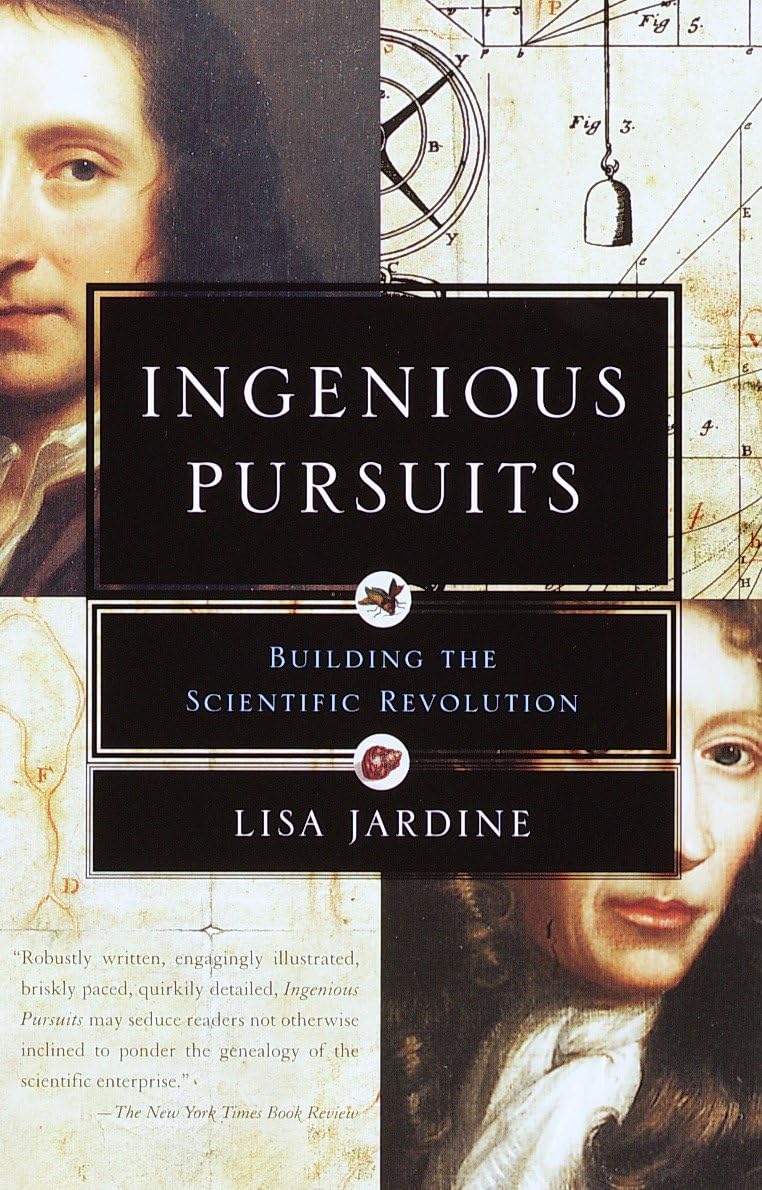



In this fascinating look at the European scientific advances of the seventeenth and early eighteenth centuries, historian Lisa Jardine demonstrates that the pursuit of knowledge occurs not in isolation, but rather in the lively interplay and frequently cutthroat competition between creative minds. The great thinkers of that extraordinary age, including Isaac Newton, Johannes Kepler, and Christopher Wren, are shown in the context in which they lived and worked. We learn of the correspondences they kept with their equally passionate colleagues and come to understand the unique collaborative climate that fostered virtuoso discoveries in the areas of medicine, astronomy, mathematics, biology, chemistry, botany, geography, and engineering. Ingenious Pursuits brilliantly chronicles the true intellectual revolution that continues to shape our very understanding of ourselves, and of the world around us. "Robustly written, engagingly illustrated, briskly paced, quirkily detailed, Ingenious Pursuits may seduce readers not otherwise inclined to ponder the genealogy of the scientific enterprise." -- The New York Times Book Review "Jardine's enthusiasm for her subject enlivens the portraits of a diverse assembly of thinkers and their remarkable contributions to modern science." -- Science News "Fascinating. . . . Jardine never loses sight of the immediacy and excitement of scientific discovery." -- The New Statesman inating look at the European scientific advances of the seventeenth and early eighteenth centuries, historian Lisa Jardine demonstrates that the pursuit of knowledge occurs not in isolation, but rather in the lively interplay and frequently cutthroat competition between creative minds. The great thinkers of that extraordinary age, including Isaac Newton, Johannes Kepler, and Christopher Wren, are shown in the context in which they lived and worked. We learn of the correspondences they kept with their equally passionate colleagues and come to understand the unique collaborative climate that fostered virtuoso discoveries in the areas of medicine, astronomy, mathematics, biology, chemistry, botany, geography, and engineering. Ingenious Pursuits brilliantly chronicles the true intellectual revolution that continues to shape our very understanding of ourselves, and of the world around us. In this fascinating look at the European scientific advances of the seventeenth and early eighteenth centuries, historian Lisa Jardine demonstrates that the pursuit of knowledge occurs not in isolation, but rather in the lively interplay and frequently cutthroat competition between creative minds. The great thinkers of that extraordinary age, including Isaac Newton, Johannes Kepler, and Christopher Wren, are shown in the context in which they lived and worked. We learn of the correspondences they kept with their equally passionate colleagues and come to understand the unique collaborative climate that fostered virtuoso discoveries in the areas of medicine, astronomy, mathematics, biology, chemistry, botany, geography, and engineering. Ingenious Pursuits brilliantly chronicles the true intellectual revolution that continues to shape our very understanding of ourselves, and of the world around us. Lisa Jardine is Professor of Renaissance Studies at Queen Mary and Westfield College, University of London, and Honorary Fellow of King's College, Cambridge. Introduction In 1997, scientists working at the Roslin Institute in Edinburgh announced a remarkable breakthrough in biological research, in the journal Nature. Ian Wilmot and his team had successfully cloned a living sheep using genetic material from cells in an adult sheep's udder.1 The impetus for this piece of research had come from the rapidly developing field of biotechnology: genetic engineering had already been used to breed sheep whose milk contained vital human proteins used in the medical treatment of cystic fibrosis. Cloning would allow the commercial company, with some of whose funding the research was associated, to produce entire flocks of such sheep, facilitating the production of these new-type medical materials. Ultimately, according to the company's spokesman, Wilmot's cloning technique might be used to 'farm' the human blood clotting factors needed to treat haemophiliacs. But Dolly the cloned sheep was not heralded as a glorious piece of innovative science. Aghast, the newspapers of the world responded to this sensational scientific advance with a clamour of moral outrage. Driven blindly by the search for the new, we were told, the Scottish scientists were careering towards disaster along that sinister path to damnation notoriously embarked upon by the demonic hero of Mary Shelley's famous novel, Dr Frankenstein. In no time at all we would face the nightmare scenario of genetically engineered armies of identical soldiers, bred to exterminate with ruthless efficiency. Parents would shortly decide exactly what mental and physical