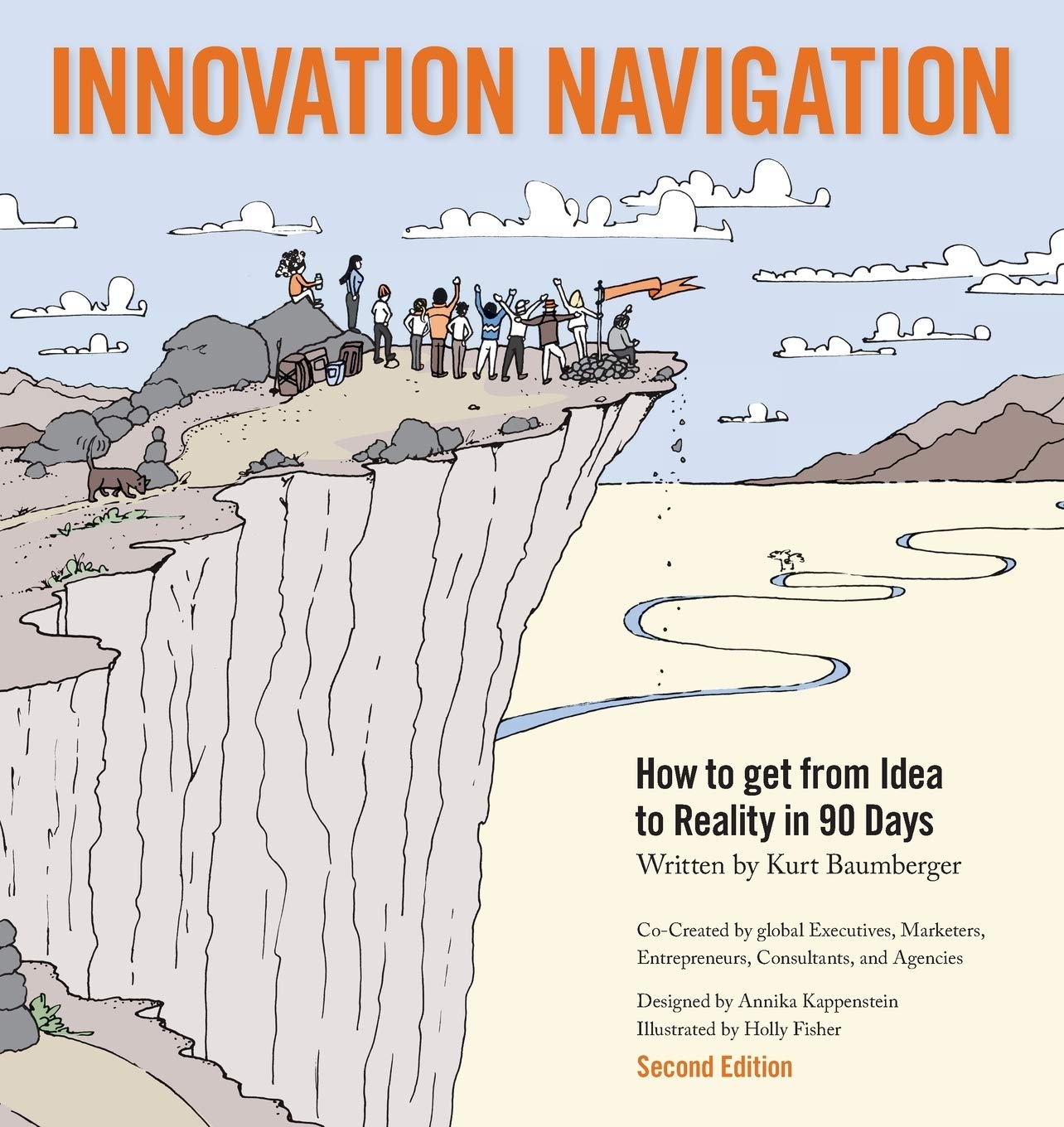
Innovation Navigation: How To Get From Idea To Reality In 90 Days
$29.95
by Kurt Baumberger



Innovation Navigation offers a new step-by-step approach to systematically move from a fuzzy thought to firm reality in 90 days. You will learn how to use an innovation framework coupled with agile methodology to create rapid prototypes of products and services customers actually want. Innovation Navigation features mapping exercises, illustrations, and one-page summary tools used by startups, marketing agencies, consultancies, and companies worldwide, including Google, Apple, Nissan, Hospital Corporation of America, P&G, and The Coca-Cola Company. Discover how to build support for your innovation while inoculating against "organizational antibodies" bent on destroying anything new. Innovation Navigation is for those ready to stop talking and start building. If you want to create a breakthrough innovation and not just an incremental improvement, you need this guide. And you need it now. "Every executive needs to read this book or risk losing business overnight!" - Scott McNabb , Oracle VP " A process clients can embrace while letting agencies be creative." - Gary Steele , Publicis Managing Director "These teamwork principles will put you in a position to win." - Mike Krzyzewski , Team USA and Duke Basketball Head Coach "A must-read guide on how to lead innovation teams under time pressure." - Lee Caraher , Author of Millenials and Management "We hired Kurt to break down barriers over 100 years old. If we can do it, you can too!" - Gerrard Killeen , Senior Manager Nissan North America This book took me thirty years to write. I've launched innovations from Advil and USA TODAY to mobile phone applications and electric cars. Through all of these efforts, I've learned that there's only one thing that consistently works - a time-tested, battle-hardened regimen that turns your idea to reality in 90 days. Why does this work? Well, first of all, if you're not done in 90 days, then your idea is probably already dead. Harvard Business Review looked at innovation projects over the last ten years and found that if you haven't gotten strong customer feedback and gone through a couple of prototype iterations in 90 days, then your project only has a 10 percent chance of survival. So speed matters, but so does the magnitude of the idea. Today, organizations desperately need breakthrough innovations to create new revenue streams or solve complex problems. Small incremental improvements won't cut it. You need to learn how to protect your BIG IDEA from the organizational "antibodies" (often posing as the Devil's Advocate) that seem to kill innovations before they even have a chance to germinate and grow. And you've heard the "Devil's Advocate" speak before. The Devil's Advocate sounds like this: How are you going to get (insert name here) to agree to this? Who is actually going to do this work? You know your assumptions are way to aggressive, don't you? Have you passed this by Legal, Purchasing, and IS? In this environment, you're probably wondering how you can create innovation that changes the game? How can you produce value that inspires customers to act? How can you prove your idea has merit to those people seemingly bent on destroying anything that is new, different, and special?That's where the regimen is so valuable. The regimen puts structure and process around the messy nature of innovation. You'll learn how to get everyone on board to take a journey into the unknown. You'll discover how to make change (and all innovation involves change) a welcome process rather than one that makes people nervous and scared. You'll also learn how to build rapid prototypes to get customer feedback. You'll see that you get the greatest benefit when customers tell you what's wrong with your idea. That's right, you're going to look for why your idea doesn't work rather than go out to validate your brilliance. But the payoff is grand. Your credibility will skyrocket when you can say, "I've seen what people do. I've observed them in their own environment. I know what they really need, and it's not what we thought." I wrote this book because I've seen too many good ideas die or bad ideas live. More important, I wrote the book because I believe most people want to work on great ideas because they are personally fulfilling and inspirational. It won't be an easy journey, but what worthwhile journey is easy? Just remember what Andy Warhol said, "They always say time changes things, but you actually have to change them yourself." I hope this book will help you get started.