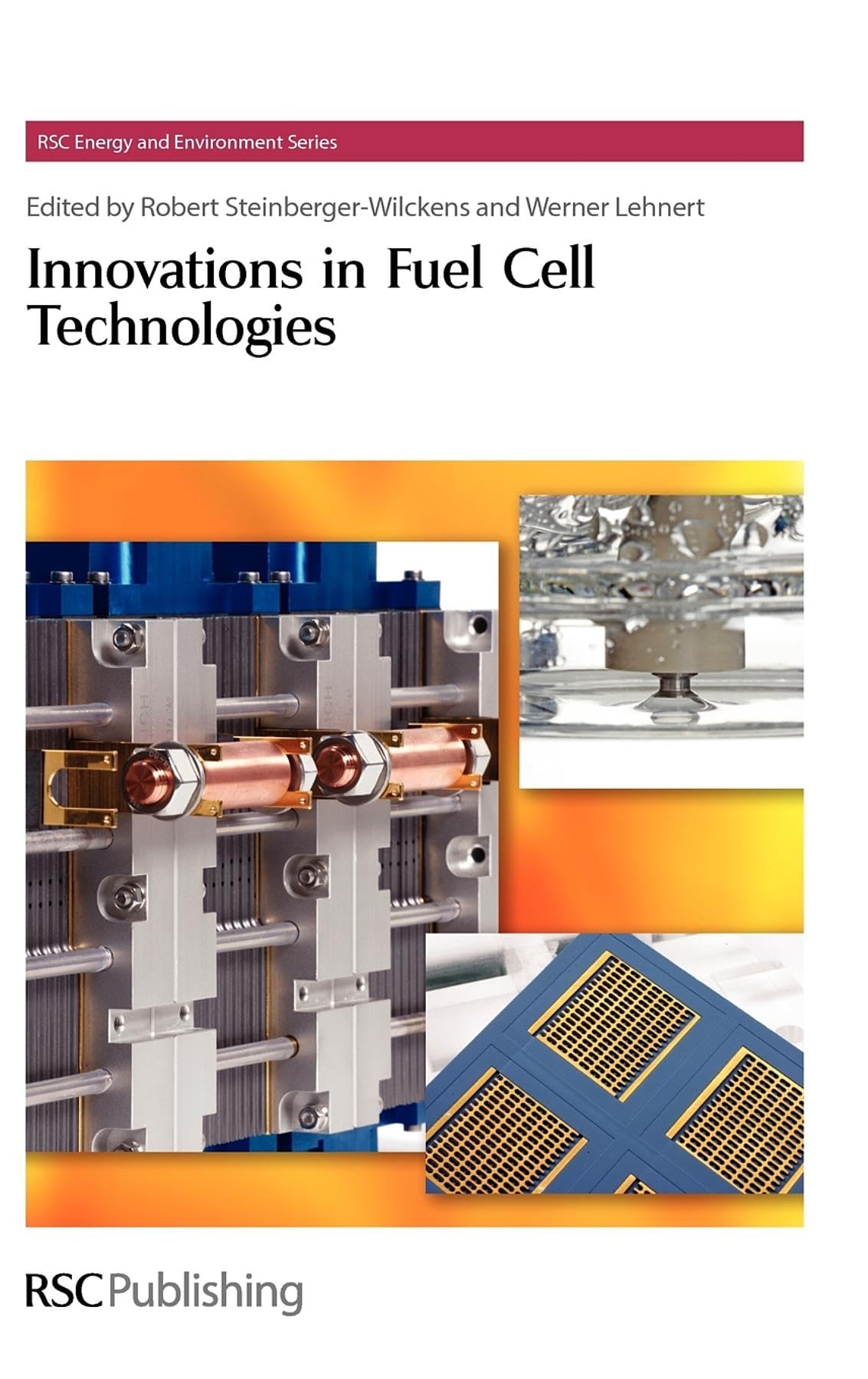
Innovations in Fuel Cell Technologies (Energy and Environment Series, Volume 2)
$56.31
by Robert Steinberger-Wilckens



This book reviews the state-of-the-art in fuel cells (low and high temperature) across all the types applied in the field today and assesses current trends in development. The main technology problems are discussed and current gaps to market success identified. The innovations covered in the book deliver new answers to pertinent problems and/or offer new opportunities, be it in operating conditions, application area, extension of lifetime, new fuels, exciting new diagnosis and analysis methods. The volume gives an insight not only to the key developments within the next few years, but also shows perspectives in the mid-term. Readers receive an overview of cutting edge, challenging research and development that can be used in future developments, both of personal careers, as well as in company technology planning. Fuels Cells have evolved from an exotic technology only feasible under the constraints of space flight into a product addressing the 'everyman' consumer, although at first, in niche markets only. The considerable level of technological readiness that has been reached today finally gives rise to hopes that fuel cells will eventually make it to larger markets within the decade leading up to the year 2020. The potential in fuel cell technologies is tremendous and their commercial success is necessary in tailoring the worldwide energy supply systems towards efficiencies and emission levels that allow a long-term stable and sustainable development for the world economy and the environment. Innovations in Fuel Cell Technologies provides a state-of-the-art review on new fields of research that have high potential and interest for the fuel cell community. The main technology problems are discussed and current gaps to market success identified. The innovations covered in the book deliver new answers to pertinent problems and/or offer new opportunities, be it in operating conditions, application area, extension of lifetime, new fuels, exciting new diagnosis or analysis methods. Key issues discussed are the prospects for miniaturising fuel cells, high-temperature polymer membrane fuel cells and their application as an on-board electricity supply in large vehicles, non-standard fuels like pure carbon and the handling of fuel impurities, degradation issues and accelerated lifetime testing, the prospects of reversing the fuel cell reactions towards producing instead of consuming hydrogen and the pitfalls in bringing a technology from demonstration to technical maturity. Innovations in Fuel Cell Technologies directs the reader's attention to the developments of tomorrow. The chapters serve as an early warning to technology developers of the rewarding prospects on the horizon as well as orientation to students and young researchers in guiding their future studies. Innovations in Fuel Cell Technologies By Robert Steinberger-Wilckens, Werner Lehnert The Royal Society of Chemistry Copyright © 2010 Royal Society of Chemistry All rights reserved. ISBN: 978-1-84973-033-4 Contents Part 1: Micro-applications and Micro-systems, Chapter 1 Printed Enzymatic Current Sources Matti Valkiainen, Saara Tuurala, Maria Smolander and Otto-Ville Kaukoniemi, 5, Chapter 2 Potential of Multilayer Ceramics for Micro Fuel Cells Michael Stelter, 28, Part 2: High-Temperature Polymer Electrolyte Fuel Cells, Chapter 3 Trends in High-Temperature Polymer Electrolyte Fuel Cells Werner Lehnert, Christoph Wannek and Roswitha Zeis, 45, Chapter 4 Large Auxiliary Power Units for Vessels and Airplanes Ralf Peters and Andreas Westenberger, 76, Part 3: Novel Fuels, Chapter 5 Going Beyond Hydrogen: Non-hydrogen Fuels, Re-oxidation and Impurity Effects on Solid Oxide Fuel Cell Anodes Mark Cassidy, Jan Pieter Ouweltjes and Nico Dekker, 153, Chapter 6 Direct Carbon Fuel Cells P. Desclaux, S. Nürnberger and U. Stimming, 190, Part 4: Modelling and Lifetime Prediction, Chapter 7 Integrating Degradation into Fuel Cell Models and Lifetime Prediction Andreas Gubner, 217, Chapter 8 Accelerated Lifetime Testing for Phosphoric Acid Fuel Cells John Donahue, Ned Cipollini and Robert Fredley, 249, Part 5: Hydrogen Generation and Reversible Fuel Cells, Chapter 9 Electrolysis Using Fuel Cell Technology A. Brisse, J. Schefold, C. Stoots and J. O'Brien, 267, Chapter 10 Hydrogen Production by Internal Reforming Fuel Cells Kas Hemmes, 287, Part 6: Outlook, Chapter 11 Products, not Technology: Some Thoughts on Market Introduction Processes Robert Steinberger-Wilckens, 311, Subject Index, 333, CHAPTER 1 Printed Enzymatic Current Sources MATTI VALKIAINEN, SAARA TUURALA, MARIA SMOLANDER AND OTTO-VILLE KAUKONIEMI VTT Technical Research Centre of Finland, Biologinkuja 5, Espoo, P.O. Box 1000, FI-02044 VTT, Finland 1.1 Introduction Biofuel cells are devices capable of transforming chemical energy directly to electrical energy via electrochemical reactions involving enzymatic catalysis replacing precious metal catalysts. Operational