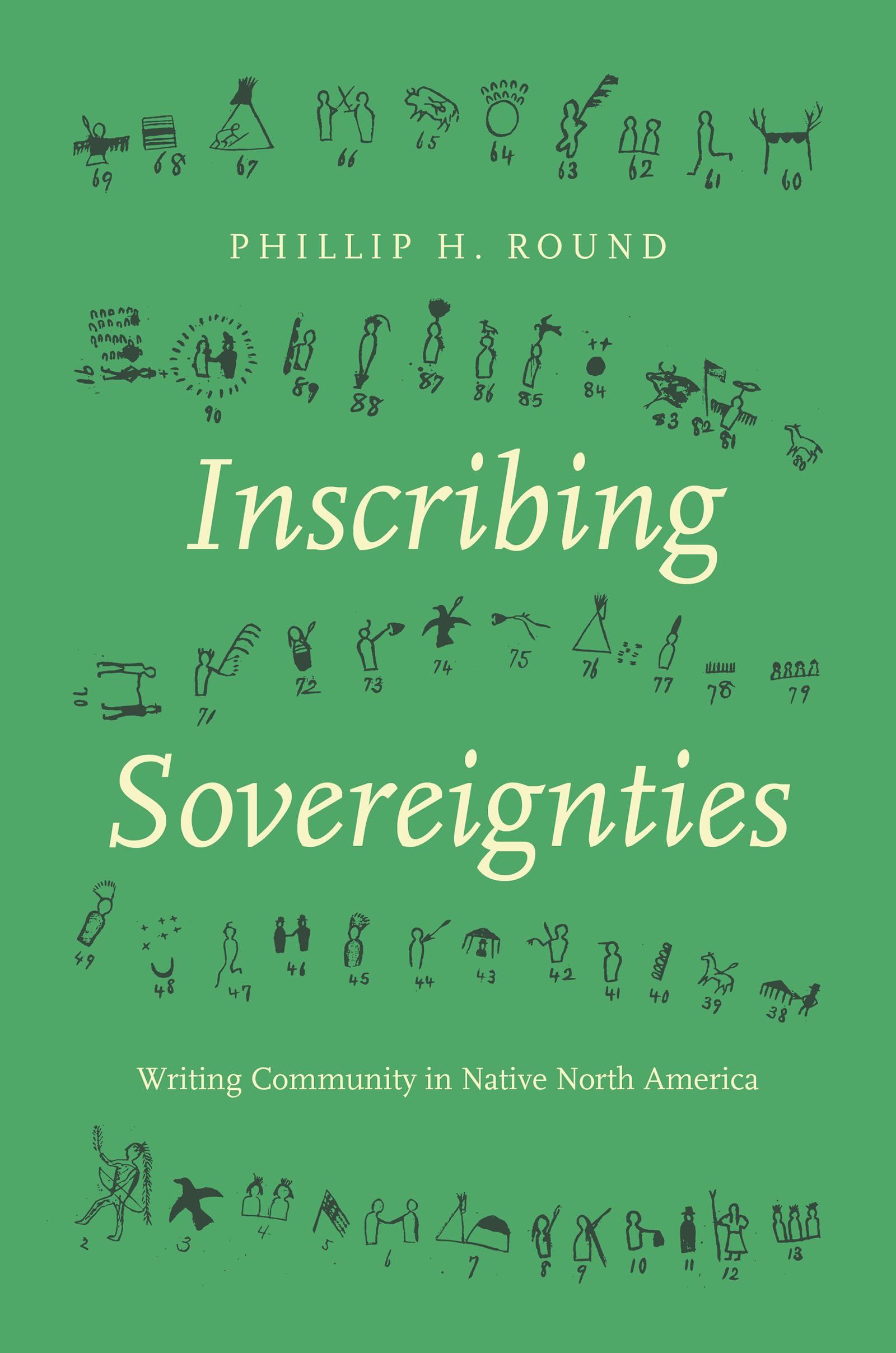
Inscribing Sovereignties: Writing Community in Native North America (Critical Indigeneities)
$32.20
by Phillip H. Round



Before European settlers arrived in North America, more than 300 distinct languages were being spoken among the continent’s Indigenous peoples. But the Euro-American emphasis on alphabetic literacy has historically hidden the power and influence of Indigenous verbal and nonverbal language diversity on encounters between Indigenous North Americans and settlers. In this pathbreaking work, Phillip H. Round reveals how Native North Americans sparked a communications revolution in their adaptation and resistance to settlers' modes of speaking and writing. Round especially focuses on communication through inscription—the physical act of making a mark, the tools involved, and the social and cultural processes that render the mark legible. Using methods from history, literary studies, media studies, linguistics, and material culture studies, Round shows how Indigenous graphic practices embodied Native epistemologies while fostering linguistic innovation. Round’s broad theory of graphogenesis—creating meaningful inscription—leads to new insights for both the past and present of Indigenous expression in a range of forms. Readers will find powerful new insights into Indigenous languages and linguistic practices, with important implications not just for scholars but for those working to support ongoing Native American self-determination. “[ Inscribing Sovereignties ] reveals just how far critical analysis has come from the days when scholars rather uncritically accepted the point of view on language use and inscription first recorded by colonizers who insisted on ‘reducing’ (5) Indigenous languages to alphabetic script. It also shows how far we have come from suspecting that Native evidence created with settler colonial tools is always apologist or just plain incoherent.”— William & Mary Quarterly “Whether discussing Haudenosaunee translation of wampum protocols, the Dakhota Iape Oaye , or the Paw-pa-pe-po of central Algonquian use, Round delves into the linguistic particularities of each language, drawing from original archival documentation, and offering fresh insights into historical characters and narratives.”— New England Quarterly “ Inscribing Sovereignties effectively demonstrates that sovereignty must be understood as both political and cultural, rooted in the very act of writing. . . . Round emphasizes the persistent presence of Indigenous sovereignty as a continuous cultural and political practice.”— North Carolina Historical Review “The scope of Round’s book is impressive, and the prose is engaging, with moments of real poetry and inspiration. But its biggest payoff is to advance the comparative study of Indigenous languages and orthographies across the Western Hemisphere and around the world. Round’s narrative of the history of Indigenous media can help lead researchers and Indigenous communities themselves not just to obscured histories but to inspirations for transformative practices.”―Matt Cohen, University of Nebraska–Lincoln “Round reveals how Native North Americans put material literacy practices to decolonizing ends, sustaining culture, building community, asserting tribal authority, and expressing individual experience. This book puts to rest any lingering narratives of a divide between oral and written culture as it traces a number of ways in which Indigenous peoples brought spoken languages and linguistic practices into writing and back out again, sustaining living, vibrant vernacular languages.”―Laura Mielke, University of Kansas “Round reveals how Native North Americans put material literacy practices to decolonizing ends, sustaining culture, building community, asserting tribal authority, and expressing individual experience. This book puts to rest any lingering narratives of a divide between oral and written culture as it traces a number of ways in which Indigenous peoples brought spoken languages and linguistic practices into writing and back out again, sustaining living, vibrant vernacular languages.”—Laura Mielke, University of Kansas Reinscribing an Indigenous epistemology of language Phillip H. Round is professor emeritus of English and Native American and Indigenous studies at the University of Iowa.