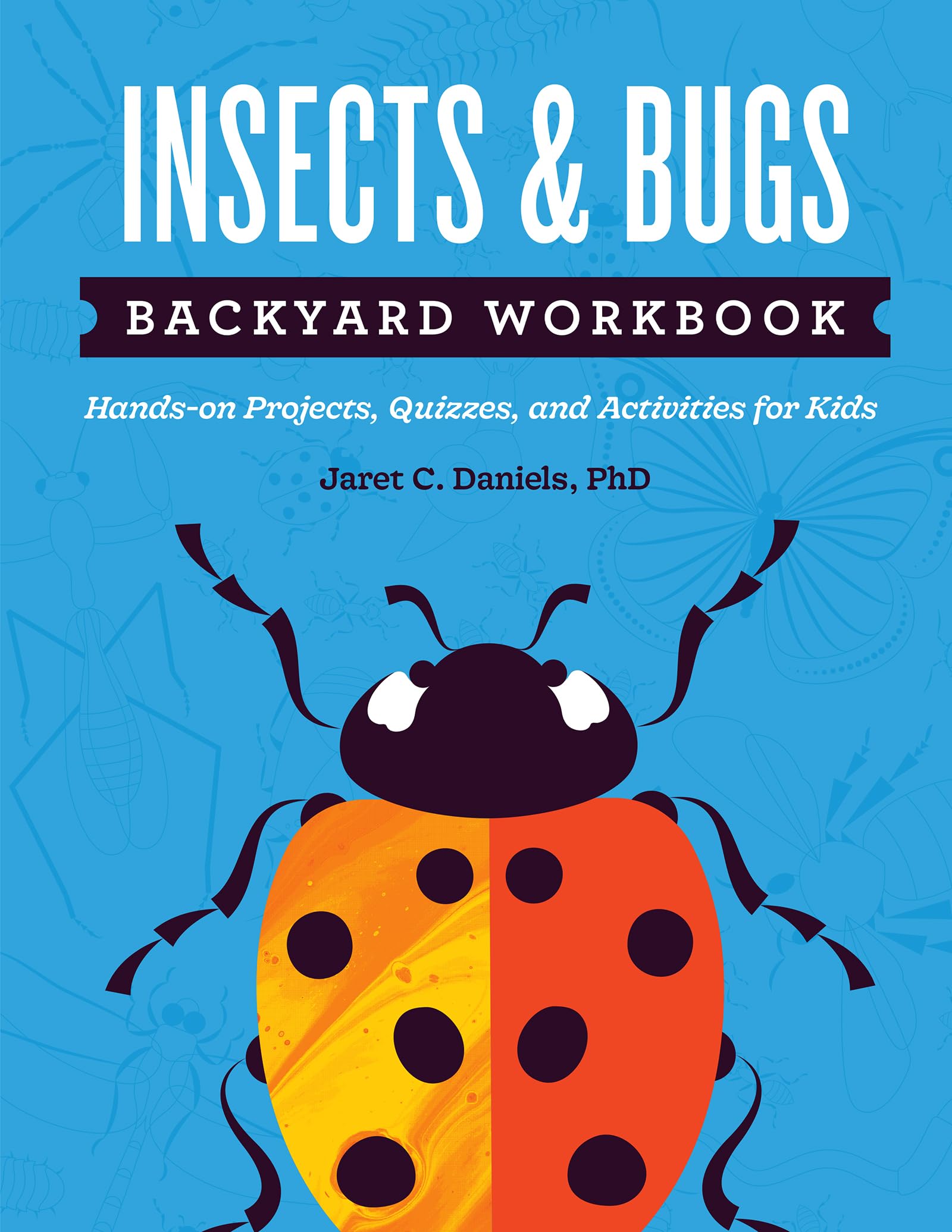
Insects & Bugs Backyard Workbook: Hands-on Projects, Quizzes, and Activities for Kids (Nature Science Workbooks for Kids)
$9.13
by Jaret C. Daniels



Introduce children to insects and bugs through fun activities and hands-on science projects. From ants and beetles to dragonflies and mosquitoes, bugs are amazing little creatures. They provide incredible opportunities for getting outside and discovering nature. There are so many kinds to see and appreciate―even in your backyard or at a nearby park. Teach your children to love and protect the great outdoors. This workbook by entomologist Jaret C. Daniels features more than 20 simple, fun introductions to a variety of creepy crawlies, including bees, butterflies, spiders, and more. Plus, over a dozen activities help kids to make hypotheses, experiment, and observe. The 19 hands-on science projects―such as raising native caterpillars and attracting moths with an ultraviolet light―put students in control of their own learning! You never know what your children will uncover in their outdoor classroom. Every day is a little treasure hunt. If they keep good records and share what they find, their observations can even help scientists learn more about nature. So get the Insects & Bugs Backyard Workbook , and get started on a lifetime of discovery. Jaret C. Daniels, Ph.D., is an Associate Professor of Entomology at the University of Florida and Director of the McGuire Center for Lepidoptera and Biodiversity at the Florida Museum of Natural History, specializing in insect ecology and conservation. He has authored numerous scientific papers, popular articles, and books on wildlife conservation, insects, and butterflies, including butterfly field guides for Florida, Georgia, the Carolinas, Ohio, and Michigan. He is also the author of Vibrant Butterflies: Our Favorite Visitors to Flowers and Gardens; Backyard Bugs: An Identification Guide to Common Insects, Spiders, and More; and Our Love of Bees. Jaret currently lives in Gainesville, Florida, with his wife, Stephanie. Raise Native Caterpillars and Release Them Finding a caterpillar is one of the highlights of spring and summer. But unless it’s a really iconic caterpillar, like a monarch, identifying caterpillars can be tricky for beginners. (Many caterpillars, including all the classic “inchworms” will end up being moths.) But you don’t need to identify your caterpillar to rear it. One of the most fun ways to identify a moth or a butterfly is after it’s turned into an adult! What You Need High-quality butterfly house - Ample supply of fresh leaves - Water source for the leaves, but one that the caterpillar can’t enter (e.g., empty pill bottle) What to Do When you find a caterpillar, immediately note what plant you find it on and, if it’s on the ground, the plants that are nearby. These are likely the caterpillar’s host plants (the ones it needs to eat to become an adult). If you’re unsure of which plants to gather, bring in a sampling of several different kinds. If you want an exact answer, post a photo of your caterpillar on a site like BugGuide.Net and ask for help on finding out what it eats. Once you have the caterpillar and the host plants, you’ll need to ready your butterfly house. Many common, commercially available houses are mesh cylinders. First, prepare your water source for the host plants. Do not provide a water dish or another water source at the bottom of a butterfly house; caterpillars drown easily. Instead, have a parent help you drill or cut a hole in a small container, like an old pill bottle, and put the plant stems into the water source. Make sure the caterpillar can’t fall into the water and drown. Over time, you’ll need to replace the leaves, and eventually, the caterpillar will begin to pupate. This is a fascinating process in its own right, but watching one emerge is even better. Of course, things can go wrong when collecting wild caterpillars. Parasitic wasps often attack/infest caterpillars. If your cage is dirty, caterpillars can get sick. And if you find a caterpillar in late summer, it might be one that overwinters as a pupa. Still, with practice and hard work, there’s a good chance that you’ll get to watch moths and butterflies all summer long.