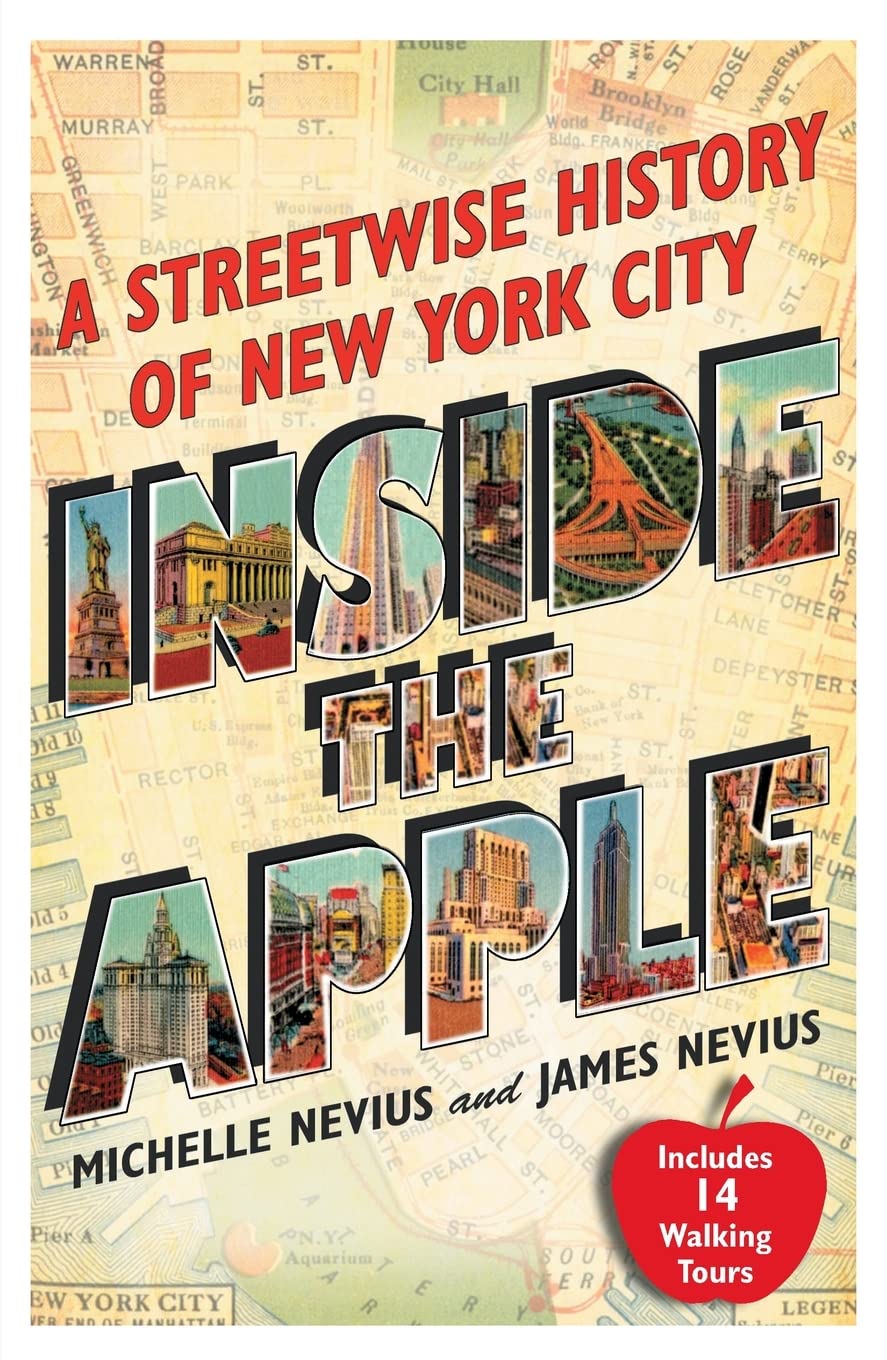



How much do you actually know about New York City? Did you know they tried to anchor Zeppelins at the top of the Empire State Building? Or that the high-rent district of Park Avenue was once so dangerous it was called “Death Avenue”? This lively and comprehensive guidebook brings New York’s fascinating past to vivid life. This narrative history of New York City is the first to offer practical walking tour know-how. Fast-paced but thorough, its bite-size chapters each focus on an event, person, or place of historical significance. Rich in anecdotes and illustrations, it whisks readers from colonial New Amsterdam through Manhattan’s past, right up to post-9/11 New York. The book also works as a historical walking tour guide, with fourteen self-guided tours, maps, and step-by-step directions. Easy to carry with you as you explore the city, Inside the Apple allows you to visit the site of every story it tells. This energetic, wide-ranging, and often humorous book covers New York’s most important historical moments, but is always anchored in the city of today, and is the perfect guide whether you’re a local or a tourist. "I was born in New York and lived there for years, but I had no idea what I was missing until I picked up Inside the Apple . It's jammed with fascinating pieces of history and great nuggets of trivia. I can't wait to walk Manhattan again with this book in hand." -- Noah D. Oppenheim, coauthor of the bestselling The Intellectual Devotional ™ series "As a longtime New Yorker, I never tire of walking the streets and uncovering something new about the world's most fascinating city, where every street has a story to tell. Inside the Apple is a gem of a book, filled with nuggets about New York's extraordinary past, from the sidewalks up. Whether you are a tourist exploring for the very first time or a seasoned walker in the city, this book is a must." -- Kenneth C. Davis, author of the bestsellers America's Hidden History and Don't Know Much About® History Michelle and James Nevius met in New York City while Michelle was studying art history and archaeology at Columbia University and James was at New York University studying English and American literature. They launched Michelle Nevius Tours in 2000 to provide in-depth tours of New York City neighborhoods, which now cover most of Manhattan and Brooklyn Heights. Their tours combine history, architecture, art, and culture, with a focus on uncovering hidden history and intriguing stories that might not be readily apparent to the casual visitor. Their guided tours have become a regular part of academic programs at The Columbia School of Journalism, The New York School of Law, Siena College in Albany, and Texas A&M's Mays School of Business as well as for non-academic clients Brown Brothers Harriman, Fordham University alumni, The Hofstra University Museum of Art, and many more. Inside the Apple 1. Manna-hata: New York Before the Europeans Walking through Times Square, surrounded by concrete, traffic, steel, and neon, it can be difficult to conjure up what this same tract of land must have looked like in 1608—a mere 400 years ago—before the arrival of Europeans. What would we see if we could strip away the generations of urbanization and return Manhattan to its pre-contact glory? New Yorkers often wonder about what was here before. It can be tempting to invoke an Eden-on-the-Hudson, where wild animals roamed freely through tall forests and verdant meadows. And Manhattan did have all those things—but for nearly 11,000 years before Henry Hudson [2] there were also people using the land and altering it for their own benefit. At the end of the last Ice Age (ca. 20,000 years ago), the Wisconsin glacier began a slow retreat, revealing the deep fjord that we now call the Hudson River. Exerting tremendous pressure as it moved, the glacier also scraped away layers of sediment, leaving parts of the island of Manhattan with exposed bedrock. This bedrock, called Manhattan schist,1 is easily seen today in Central Park and Morningside Park [73], where vast pieces of rock rise from the ground dramatically. Other remnants of glaciation can also be seen at the southern end of Central Park’s Sheep Meadow [151], where a line of boulders marches from the southwest, crossing the footpath that borders the bottom of the meadow. These are glacial erratics, non-native stones that were deposited here by the ice floe. As the glacier departed, the first Native Americans were arriving, but very little is known about these settlers. Clovis point spearheads and other stone tools found in Staten Island in the 1950s place people in the area about 11,000 years ago. Scant evidence exists of population migrations and changes over the next 10 millennia, but many archaeologists agree that Native Americans lived in and around the area continuously until the arrival of European settlers. In the 17th century, these inhabitants were part of a larger group of Algonquin speak