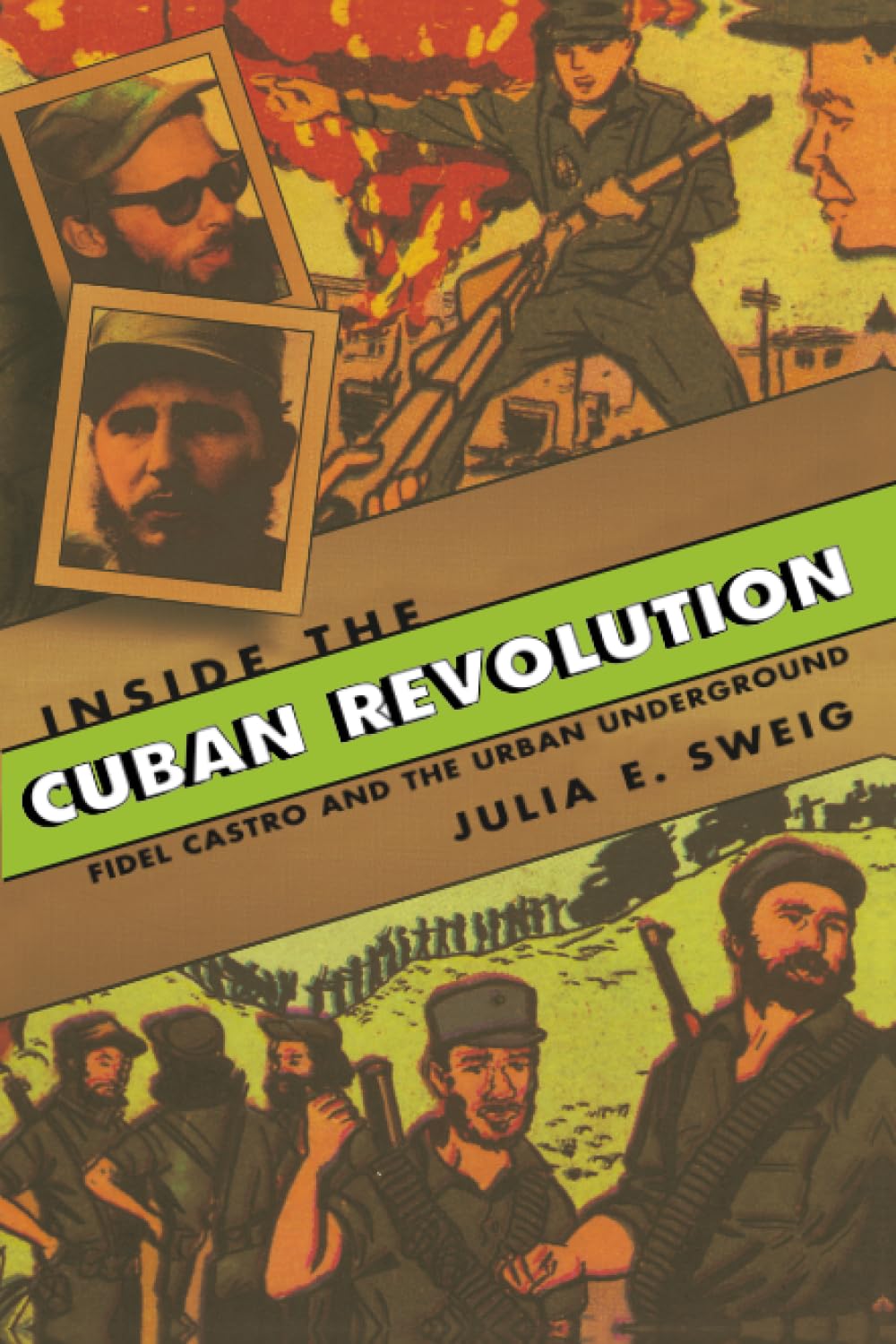



Julia Sweig shatters the mythology surrounding the Cuban Revolution in a compelling revisionist history that reconsiders the revolutionary roles of Fidel Castro and Che Guevara and restores to a central position the leadership of the Cuban urban underground, the Llano. Granted unprecedented access to the classified records of Castro's 26th of July Movement's underground operatives--the only scholar inside or outside of Cuba allowed access to the complete collection in the Cuban Council of State's Office of Historic Affairs--she details the ideological, political, and strategic debates between Castro's mountain-based guerrilla movement and the urban revolutionaries in Havana, Santiago, and other cities. In a close study of the fifteen months from November 1956 to July 1958, when the urban underground leadership was dominant, Sweig examines the debate between the two groups over whether to wage guerrilla warfare in the countryside or armed insurrection in the cities, and is the first to document the extent of Castro's cooperation with the Llano. She unveils the essential role of the urban underground, led by such figures as Frank País, Armando Hart, Haydée Santamaria, Enrique Oltuski, and Faustino Pérez, in controlling critical decisions on tactics, strategy, allocation of resources, and relations with opposition forces, political parties, Cuban exiles, even the United States--contradicting the standard view of Castro as the primary decision maker during the revolution. In revealing the true relationship between Castro and the urban underground, Sweig redefines the history of the Cuban Revolution, offering guideposts for understanding Cuban politics in the 1960s and raising intriguing questions for the future transition of power in Cuba. “After so many books on the Cuban Revolution, it might seem impossible to shed new light on one of the key moments in the twentieth century. Yet Julia Sweig manages to do so in this remarkable tour de force. Using documents only recently made available to her by the Cuban authorities, she challenges several myths about the nature of the Cuban Revolution and in the process provides a nuanced and very readable account of the rise to power of Fidel Castro.” ― Victor Bulmer-Thomas, Director, Royal Institute of International Affairs “ Inside the Cuban Revolution confirms what many had long suspected: the 'official story' of twelve bearded, daring guerrillas bringing down a hideous dictatorship never happened. Without the urban underground there would have been no victory. In this important book, Julia Sweig sets the record straight and raises fundamental questions about revolutionary movements in Latin America since 1959.” ― Jorge G. Castañeda, Secretary of Foreign Affairs, Mexico “This book is both compelling and groundbreaking. It seamlessly combines great storytelling, investigative journalism, and first-rate analysis in a work that scholars and policymakers--indeed, anyone interested in Cuba--will find must reading. With Inside the Cuban Revolution Julia Sweig guarantees the world will never look at Cuba or Fidel Castro the same way again.” ― Senator Christopher J. Dodd, Chair, Western Hemisphere Subcommittee, Committee on Foreign Relations “With meticulous research, presented in a dramatic narrative, Julia Sweig provides the real story behind the Cuban Revolution and Castro's rise to power, showing that his ascendancy was due to far more than the popular conception of a small band of guerrilla fighters toppling a corrupt regime. It is a portrait of Castro as we've never seen him. Inside the Cuban Revolution , which sheds new light on the last time there was a transition of power in Cuba, may very well give us clues to the next one.” ― Congressman Charles B. Rangel “In this brilliantly researched tour de force , Julia Sweig adds a new dimension to our understanding of the way Fidel Castro came to power in Cuba.” ― Arthur M. Schlesinger, Jr. “Using original documentary sources from Cuban government archives, Sweig shows how the largely middle-class Cubans in the urban underground laid the groundwork for Castro's Rebel Army victory...Sweig claims that the full history of the revolution has yet to be written, but her book makes an impressive contribution to this effort by painting a new and more realistic picture of the process that produced Castro's Cuba.” ― Susan Kaufman Purcell , Foreign Affairs “The recent opening of Cuban historical archives to non-Cuban scholars has changed traditionally accepted views of the Cuban revolution of 1959. Using documents housed in the Cuban Council of State's Office of Historic Affairs, Sweig...argues that in its early days the revolution was influenced more by the Cuban middle class and less by Fidel Castor or Che Guevara than historians have suggested...By giving this period context and highlighting its importance, Sweig shows that all the elements of the revolution were in place prior to 1959...[It is] convincingly argue