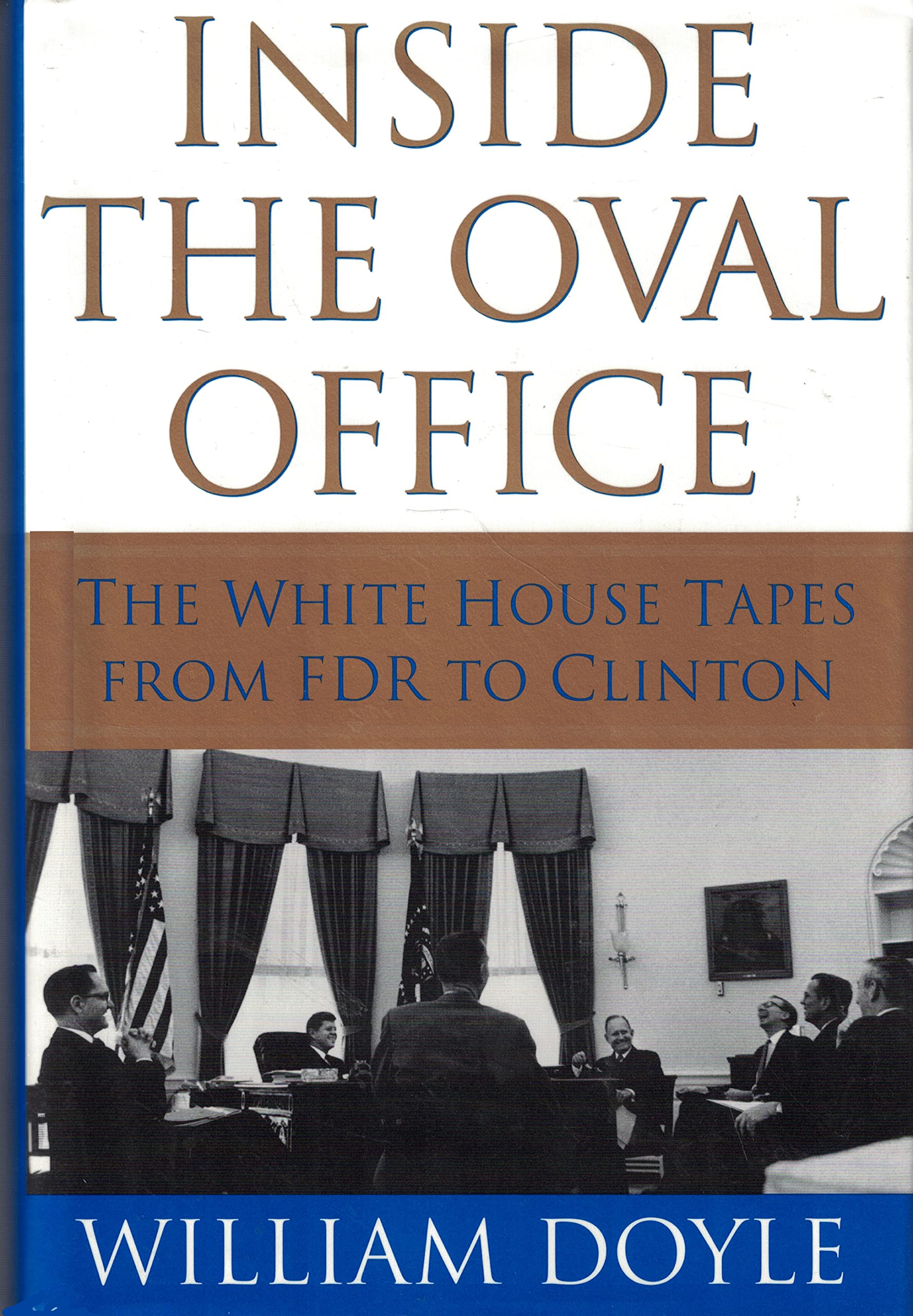



Traces taping history Richard Nixon was not the first president to tape-record conversations inside the Oval Office--that was Franklin Roosevelt. Nor was he the last, although one would think after Nixon's disastrous experience with taping that the succeeding occupants of the White House would have learned better. Since they didn't, we have Inside the Oval Office , "a cockpit voice recorder of the presidency" written and compiled by William Doyle. Doyle combines transcripts of taped Oval Office conversations--from FDR to Bill Clinton--with his assessment of each president's executive abilities. During the Cuban Missile Crisis, for example, John F. Kennedy showed what Doyle calls a pragmatic leadership style: "self-control, a call for multiple opinions, the discipline to think several steps ahead, and the ability to put himself in 'the other guy's shoes.'" Among the book's highlights: Franklin Roosevelt briefing cabinet members and congressional leaders after the bombing of Pearl Harbor; Dwight Eisenhower talking to the British prime minister during the Suez crisis; John F. Kennedy talking to Mississippi governor Ross Barnett during the fight over integration of the University of Mississippi; Lyndon Johnson meeting with military advisors about U.S. involvement in Vietnam; Richard Nixon talking with Chuck Colson about monitoring Henry Kissinger's calls to the press (and the "smoking gun" tapes in which Nixon discusses the Watergate cover-up with John Dean and H.R. Haldeman); and the transcripts of videotaped meetings held by Ronald Reagan on the Soviet Union. Anyone interested in history and the presidency will no doubt find Inside the Oval Office full of revealing and fascinating material. --Linda Killian The control and abuse of electronic surveillance began with Franklin Roosevelt, who, feeling miffed at being misquoted during White House press conferences, installed a recording machine for the Oval Office. But, according to Doyle, who won the 1998 Writers Guild Award for Best Documentary for A&Es The Secret White House Tapes, Richard Nixon debased the presidency more than any other chief executive. Doyles thoroughly researched, finely written investigation is primarily about how recordings can describe management style and show how effectively a president fulfills the constitutionally defined role as head of the Executive Branch. Presidents mostly taped to protect themselves, although Truman, Ford, Carter, and Bush did not use tapes because of personal ethical doubts, while Clinton recklessly recorded conversations describing campaign finance, law exploitation, and sex. The best safeguard, notes Doyle, is to elect honest presidents, and he sensibly recommends that only the business operations of the White House be taped for clarifying conversations and policy proposals. Strongly recommended for public and academic collections.Karl Helicher, Upper Merion Twp. Lib., King of Prussia, PA Copyright 1999 Reed Business Information, Inc. Doyle won a Writer's Guild of America Award for his A&E documentary on this subject. The focus here is on audio and videotapes maintained by recent U.S. presidents as "a real-time record of the presidents in action as they manage the business of American history." One can get a sense of Doyle's judgments from the adjectives in his chapter titles: FDR, creative; Truman, decisive; Eisenhower, organized; Kennedy, pragmatic; LBJ, controlling; Nixon, strategic; Ford, collegial; Carter, technocratic; Reagan, visionary; Bush, diplomatic; Clinton, chaotic. Though most readers are familiar with the Nixon tapes, and FDR's tapes became public in the '80s, Doyle's dogged research unearthed several resources--notably the worn dictaphone belts ignored for decades in the Eisenhower Library, the Reagan team's White House video operation, and videotapes of Clinton's fund-raising "coffees." Doyle concludes that the White House's business offices (only) should be fully wired, with tapes reviewable by the president and then sealed for 20 years before being made available to historians. An interesting sidelight on history. Mary Carroll Intermittently interesting tales from the presidential tapes. Since FDR, most but not all presidents have recorded White House meetings and telephone conversations; Reagan, not surprisingly, even videotaped many private meetings. The existence of such tapes should provide a fascinating glimpse of the real person behind the great Oz of the presidency. In fact, it does and it doesn't. Doyle (The Oxford History of the French Revolution, 1989), creator of a television documentary on the White House tapes, has put a lot of effort into compiling tapes and transcribing them, but he has had to work within limitations. Most presidents didn't tape much (such as FDR and Truman), others not at all (Bush), and of those who did tape a lot (think Nixon), what they said is already pretty well known. Also, most presidents (except Nixon, whose voice-activated system often, and fam