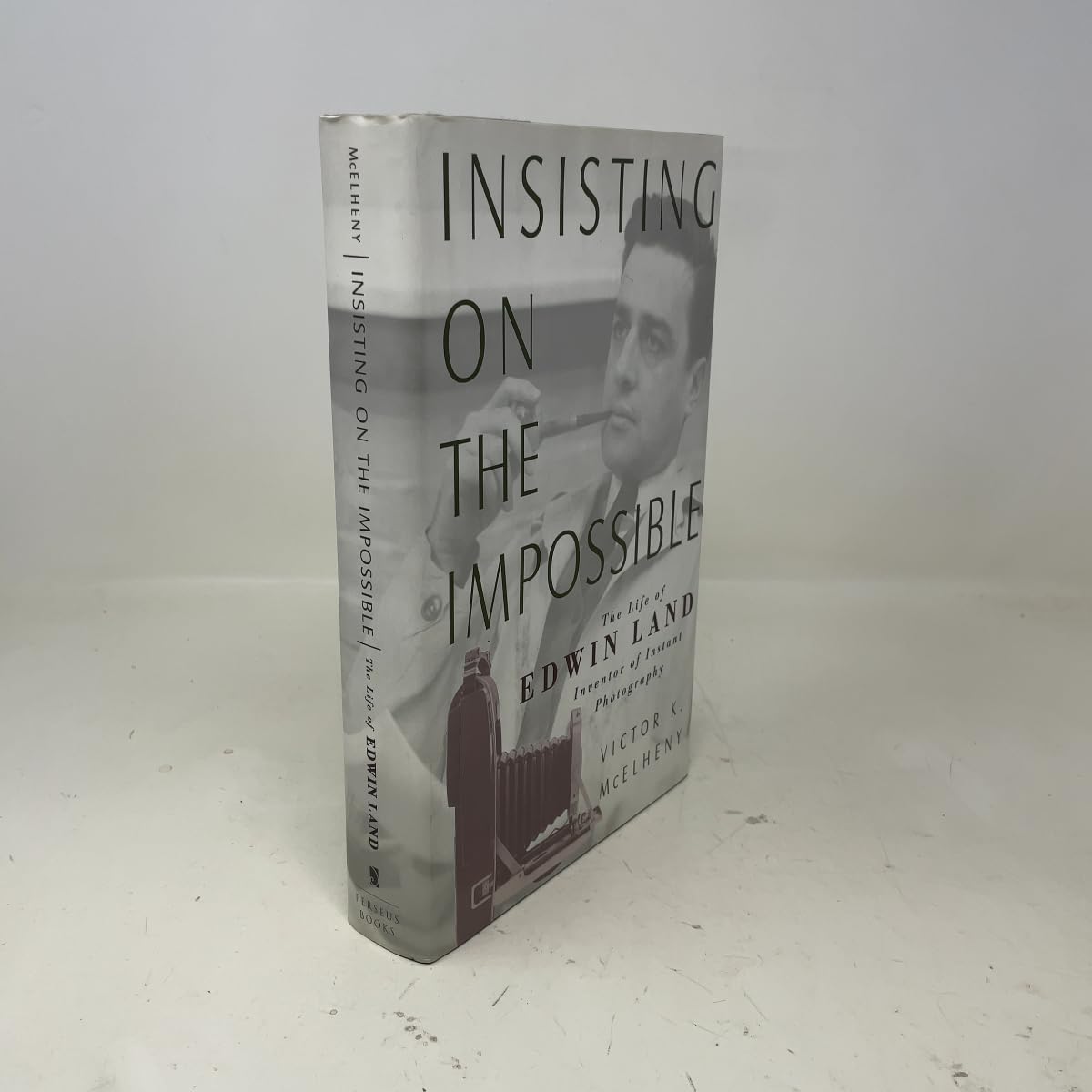
Insisting On The Impossible: The Life Of Edwin Land (Sloan Technology Series)
$37.89
by Victor K. McElheny



If a single life exemplifies the inner drive that fires a great inventor, it is the life of Edwin Land. The major innovations that he was able to achieve in photography, optics, industry, and science policy carry priceless lessons for readers today.Insisting on the Impossible is the first full-scale biography of this Magellan of modern technology. Victor McElheny reveals the startling scope and dating spirit of Land's scientific and entrepreneurial genius. Second only to Edison in the number of patents he received (535), Land build a modest enterprise into a gigantic ”invention factory,” turning out not only polarizers and the first instant cameras, but also high-speed and X-ray film, identification systems, 3-D and instant movies, and military devices for night vision and aerial reconnaissance. As a scientist, Land developed a new theory of color vision; as a science advisor to Eisenhower during the Cold War he spearheaded the development of the U-2 spyplane and helped design NASA.Behind these protean achievements was a relentless curiosity, a magical public presence, and a willful optimism that drew him again and again to conquer ”the impossible.” In an era when these qualities are needed more than ever, this masterly biography will speak to anyone involved or interested in business, science, photography, educational reform of government. The inventions of Edwin Land made Polaroid a great company--and later accelerated its decline. Insisting on the Impossible , written by former New York Times reporter Victor K. McElheny, tells the story of one of the early giants in photographic technology. McElheny follows Land's career from before the founding of Polaroid in 1937 through the release of the landmark SX-70 camera in the early '70s. Land invented instant photography and turned his company into a tremendous success and a Wall Street darling in the '60s and '70s. Land was a bulldog about patents--he trails only Thomas Edison in number of patents he received (535). But while the protection of the U.S. patent system helped Polaroid fend off attacks by its chief nemesis, Kodak, they couldn't shield Land from his own shortcomings. Land tended to lose track of business costs and he sometimes took criticism too personally. And he disdained market research. McElheny writes that Land's business philosophy boiled down to "making things that people didn't know they wanted until they were available." One of Land's final inventions--instant movies--loaded Polaroid with debt and sped his departure from the company he founded. Unlike instant photography, nobody wanted "Polavision." It lacked sound and the film was too short. It was soon overwhelmed by the more popular and practical videocassette tape. Land's instant photography also fell out of favor. It couldn't compete with Kodak Instamatics, improved 35mm cameras, and fully automatic digital cameras. Land, who died in 1991, was bitter by the time he left Polaroid. He sold all his stock and refused to show up at the company's 50th-anniversary celebration in 1987. His inventions seemed like ancient history. Maybe that's a lesson for today's technology hotshots. --Dan Ring The life of Edwin Land could easily spring from one of Horatio Alger - s stories. Son of a scrap-metal dealer, Land dropped out of Harvard to pursue the inventing bug and his dream of creating a cheap plastic sheet polarizer. He wanted to decrease auto accidents caused by headlight glare, but it was with sunglasses and photography that the polarizer and the newly founded Polaroid corporation found success. An inveterate innovator and conceptualizer, Land would eventually receive more patents than any other American, excepting Edison. His genius was both for the sudden inspiration and the organizational ability to get people behind him to fill in the details. For example, the idea for instant photography came to him in the space of an afternoon, but it would take many years and many talented individuals to work out all the details. He also developed a new theory of color vision, worked as a science advisor for President Eisenhower, and helped design NASA. He drove Polaroid relentlessly to create new refinements and inventions such as color film and the SX-70 camera. He was motivated by the belief that ``the bottom line - s in heaven. The real business of business is building things.'' His magic touch held right until the end when he developed instant color movie film just as video recorders were coming on the market. The costs to Polaroid were enormous and led to a gradual severing of ties between Land and his company. Former New York Times science reporter McElheny has done a formidable research job, but he can - t seem to decide whether this is a popular account or one for specialists. There are long descriptions of technology and processes that are almost unintelligible to the layperson. The organization throughout is also appalling, with frequent, inexplicable shifts back and forth in time. Fi