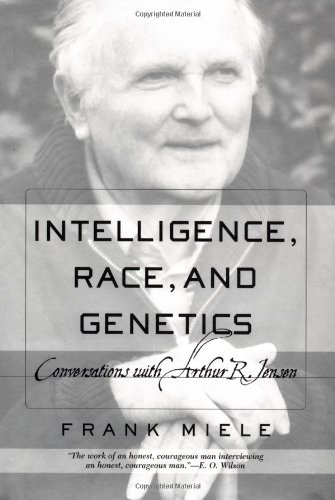
Intelligence, Race, And Genetics: Conversations With Arthur R. Jensen
$29.01
by Frank Miele



In a series of provocative conversations with Skeptic magazine Ssenior editor Frank Miele, renowned University of California-Berkeley psychologist Arthur R. Jensen details the evolution of his thoughts on the nature of intelligence, tracing an intellectual odyssey that leads from the programs of the Great Society to the Bell Curve Wars and beyond. Miele cross-examines Jensen's views on general intelligence (the g factor), racial differences in IQ, cultural bias in IQ tests, and whether differences in IQ are due primarily to heredity or to remediable factors such as poverty and discrimination. With characteristic frankness, Jensen also presents his view of the proper role of scientific facts in establishing public policy, such as Affirmative Action.Jensenism,” the assertion that heredity plays an undeniably greater role than environmental factors in racial (and other) IQ differences, has entered the dictionary and also made Jensen a bitterly controversial figure. Nevertheless, Intelligence, Race, and Genetics carefully underscores the dedicated lifetime of scrupulously scientific research that supports Jensen's conclusions. Arthur R. Jensen is the psychologist who set off an enduring controversy with his 1969 article in the Harvard Educational Review holding that an individual's IQ is largely attributed to heredity, including racial heritage, and that efforts to boost IQ educationally do not achieve much. Miele, senior editor of Skeptic magazine, set out to "skeptically cross-examine" Jensen on his views. The questions and answers traveled by e-mail, but they read like a conversation. Jensen, now professor emeritus of educational psychology at the University of California at Berkeley, holds that the scientific evidence is stronger now than it was in 1969 that IQ is highly genetic, that race is a biological reality rather than a social construct, and that the cause of the 15-point average IQ difference between blacks and whites in the U.S. is partly genetic. Miele hopes the exchange will enable the reader "to decide for yourself whether Jensenism represents one man's search for provisional, not metaphysical, truth through the continuous and vigorous application of the methods of science ...or a dangerous diversion back down a blind alley of old and disproven ideas, deceptively dressed up in modern scientific jargon." Editors of Scientific American Research psychologist Arthur R. Jensen, once a staunch advocate of compensatory education, gained instant infamy when the media discovered his 1969 professional essay "How Much Can We Boost IQ and School Achievement?" with its three conclusions: compensatory education of disadvantaged children had failed, genetic rather than cultural differences explained more about differences in IQ, and genetics probably accounted for the 15-point difference in average IQ between whites and blacks. The last point was construed as supportive of white racial superiority, and all hell broke loose. Jensen continued his research, however, and now enjoys his colleagues' near-unanimous support. Indeed, in these interviews with Miele, he says his contentions, which he still regards as provisional, were never controversial among his peers. The main topics of conversation besides "Jensenism" and Jensen's motivations are intelligence per se, the heritability of intelligence, the nature of race (whether biological or cultural), science and politics, and science and policy. This makes fascinating but often demanding reading and confirms that Jensen is no racist: exogamy, he says, facilitates higher intelligence. Ray Olson Copyright © American Library Association. All rights reserved "A chance...to learn [Jensen's] mature views in easily accessible, question and answer form." -- James Crow, University of Wisconsin-Madison "An excellent introduction...about the man and the science behind the 'ism' of Jensenism." -- Professor Robert Plomin, King's College London "Miele asks the hard questions and Jensen answers without blinking." -- Thomas J. Bouchard, Jr.,University of Minnesota "Miele set out to 'skeptically cross-examine' Jensen on his views. The questions and answers...read like a conversation." -- Scientific American "The work of an honest, courageous man, interviewing an honest, courageous man" -- E. O. Wilson "This is science at its best: cautious and audacious, gripping and timely." -- Jon Entine, author of Taboo "You will learn a lot about the man and his work." -- Douglas K. Detterman, editor, "Intelligence" Frank Miele's highly regarded Skeptic interviews include conversations with evolutionists Richard Dawkins and E. O. Wilson, anthropologists Donald Johanson, Lionel Tiger, and Robin Fox, ecologist Garrett Hardin, and psychologist Robert Sternberg. His articles have appeared on many web pages, including those of the Human Behavior and Evolution Society. He lives in Sunnyvale, California, with his Great Dane, Payce Used Book in Good Condition