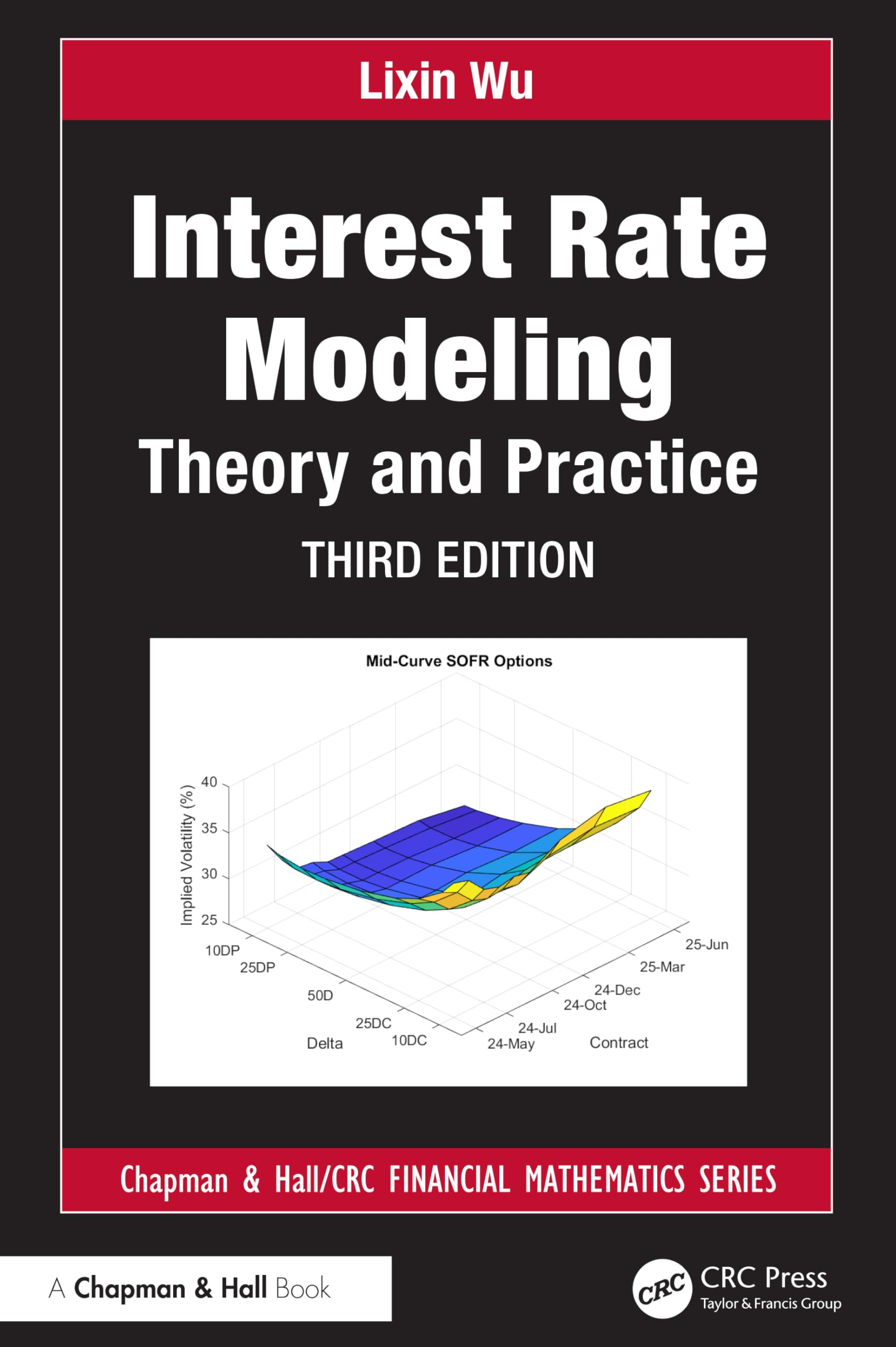



Containing many results that are new, or which exist only in recent research articles, this thoroughly revised third edition of Interest Rate Modeling: Theory and Practice, Third Edition portrays the theory of interest rate modeling as a three-dimensional object of finance, mathematics, and computation. It introduces all models with financial-economical justifications, develops options along the martingale approach, and handles option evaluations with precise numerical methods. Features Presents a complete cycle of model construction and applications, showing readers how to build and use models - Provides a systematic treatment of intriguing industrial issues, such as volatility smiles and correlation adjustments - Contains exercise sets and a number of examples, with many based on real market data - Includes comments on cutting-edge research, such as volatility-smile, positive interest-rate models, and convexity adjustment New to the Third edition Introduction of Fed fund market and Fed fund futures - Replacement of the forward-looking USD LIBOR by the backward-looking SOFR term rates in the market model, and the deletion of dual-curve market model developed especially for the post-crisis derivatives markets - New chapters on LIBOR Transition and SOFR Derivatives Markets “A part of the Chapman & Hall/CRC Financial Mathematics series, Professor Lixin Wu's "Interest Rate Modeling: Theory and Practice, third edition" is a premier and solidly recommended acquisitions choice for corporate and college/university library Economics/Mathematics collections and as a supplemental Economics curriculum textbook.” ―Midwest Book Review Lixin Wu earned his PhD in applied mathematics from UCLA in 1991. Originally a specialist in numerical analysis, he switched his area of focus to financial mathematics in 1996. Since then, he has made notable contributions to the area. He co-developed the PDE model for soft barrier options and the finitestate Markov chain model for credit contagion. He is, perhaps, best known in the financial engineering community for a series of works on market models, including an optimal calibration methodology for the standard market model, a market model with square-root volatility, a market model for credit derivatives, a market model for in inflation derivatives, and a dual-curve SABR market model for post-crisis derivatives markets. He also has made valuable contributions to the topic of xVA. Over the years, Dr. Wu has been a consultant for financial institutions and a lecturer for Risk Euromoney and Marco Evans, two professional education agencies. He is currently a full professor at the Hong Kong University of Science and Technology.