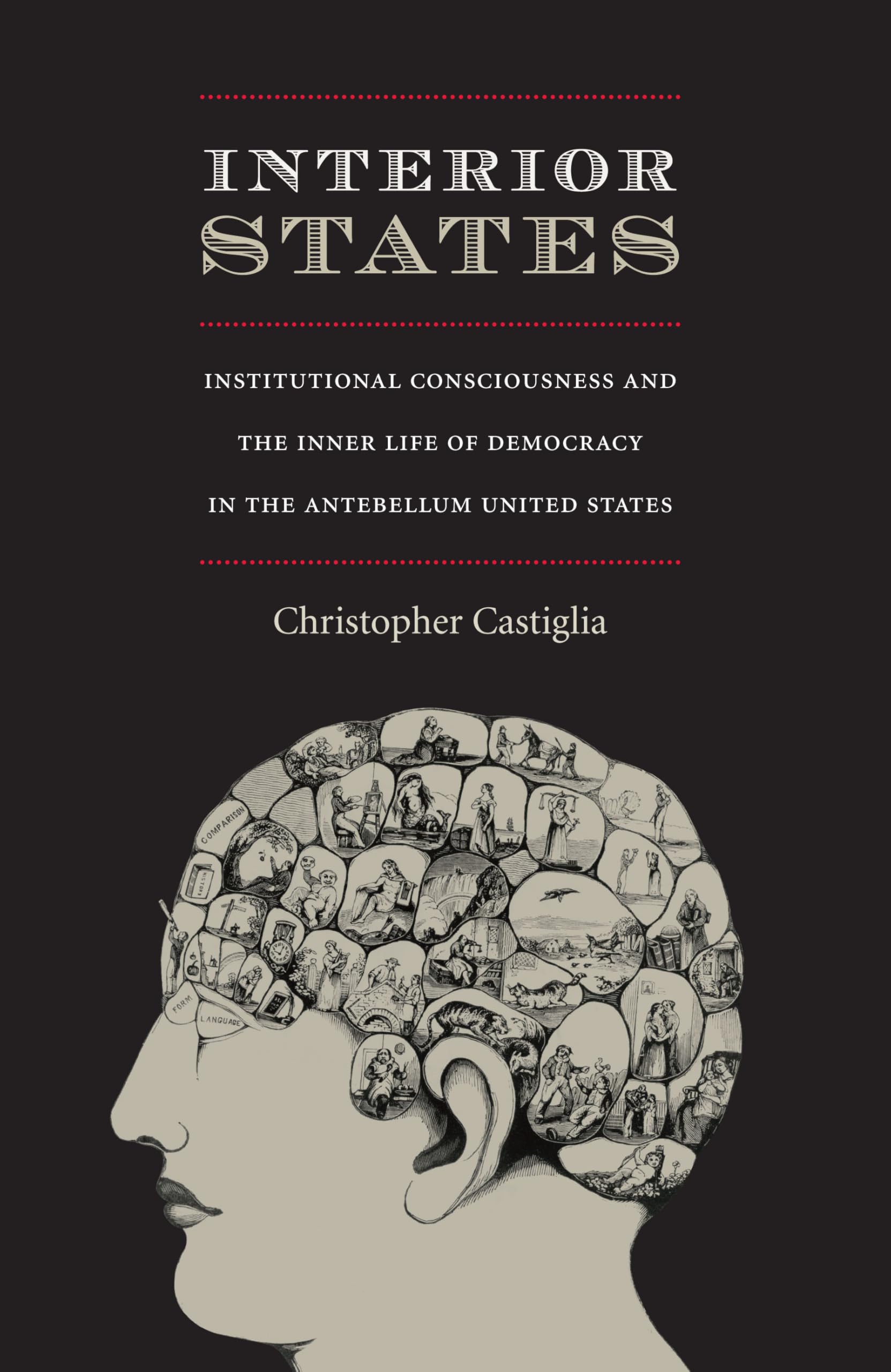
Interior States: Institutional Consciousness and the Inner Life of Democracy in the Antebellum United States (New Americanists)
$9.85
by Christopher Castiglia



In Interior States Christopher Castiglia focuses on U.S. citizens’ democratic impulse: their ability to work with others to imagine genuinely democratic publics while taking divergent views into account. Castiglia contends that citizens of the early United States were encouraged to locate this social impulse not in associations with others but in the turbulent and conflicted interiors of their own bodies. He describes how the human interior—with its battles between appetite and restraint, desire and deferral—became a displacement of the divided sociality of nineteenth-century America’s public sphere and contributed to the vanishing of that sphere in the twentieth century and the twenty-first. Drawing insightful connections between political structures, social relations, and cultural forms, he explains that as the interior came to reflect the ideological conflicts of the social world, citizens were encouraged to (mis)understand vigilant self-scrutiny and self-management as effective democratic action. In the late eighteenth century and early nineteenth, as discourses of interiority gained prominence, so did powerful counter-narratives. Castiglia reveals the flamboyant pages of antebellum popular fiction to be an archive of unruly democratic aspirations. Through close readings of works by Maria Monk and George Lippard, Walt Whitman and Timothy Shay Arthur, Hannah Webster Foster and Hannah Crafts, and Nathaniel Hawthorne and Herman Melville, Castiglia highlights a refusal to be reformed or self-contained. In antebellum authors’ representations of nervousness, desire, appetite, fantasy, and imagination, he finds democratic strivings that refused to disappear. Taking inspiration from those writers and turning to the present, Castiglia advocates a humanism-without-humans that, denied the adjudicative power of interiority, promises to release democracy from its inner life and to return it to the public sphere where U.S. citizens may yet create unprecedented possibilities for social action. “ Interior States rethinks the relation of identity and democracy in a dazzling exercise of literary criticism, social history, and political theory. Christopher Castiglia shows how the federal practice of democracy, in combination with developing institutions, did not squash so much as misplace democracy, relocating its performance from the sociality of exchange between citizens into the personal, bodily interior. Our nervous management of our own discordant identities sidetracks us from a richer, more inventively dissensual democratic practice. Castiglia explores a rich, interdisciplinary nineteenth-century archive that imagines alternative democracies and challenges readers to unfetter their imaginations in the service of more pleasurable, ‘post-interior’ democratic association.”— Dana D. Nelson , co-editor of Materializing Democracy: Toward a Revitalized Cultural Politics “This book combines scope and depth in a way that will remind readers of some of the classics—F. O. Matthiessen, Leo Marx, Ann Douglas, Jane Tompkins. In a book propelled by wonderful writing, Christopher Castiglia illuminates the extent to which the self-declared greatest democracy of world history has struggled to be democratic institutionally. His call for a ‘post-interior humanism’ gains real urgency from an account of a centuries-old impasse in American life that readers will remember long after they have finished the book.”— Christopher Newfield , author of The Emerson Effect: Individualism and Submission in America "This book combines scope and depth in a way that will remind readers of some of the classics--F. O. Matthiessen, Leo Marx, Ann Douglas, Jane Tompkins. In a book propelled by wonderful writing, Christopher Castiglia illuminates the extent to which the self-declared greatest democracy of world history has struggled to be democratic institutionally. His call for a 'post-interior humanism' gains real urgency from an account of a centuries-old impasse in American life that readers will remember long after they have finished the book."--Christopher Newfield, author of "The Emerson Effect: Individualism and Submission in America" Christopher Castiglia is Professor of English at the Pennsylvania State University. He is the author of Bound and Determined: Captivity, Culture-Crossing, and White Womanhood from Mary Rowlandson to Patty Hearst and a co-editor of Walt Whitman’s temperance novel Franklin Evans; or, the Inebriate , also published by Duke University Press. INTERIOR STATES INSTITUTIONAL CONSCIOUSNESS AND THE INNER LIFE OF DEMOCRACY IN THE ANTEBELLUM UNITED STATES By Christopher Castiglia DUKE UNIVERSITY PRESS Copyright © 2008 DUKE UNIVERSITY PRESS All right reserved. ISBN: 978-0-8223-4267-0 Contents Acknowledgments..........................................................................................................................ixIntroduction. Interiority and the Problem of Misplaced Democracy..............