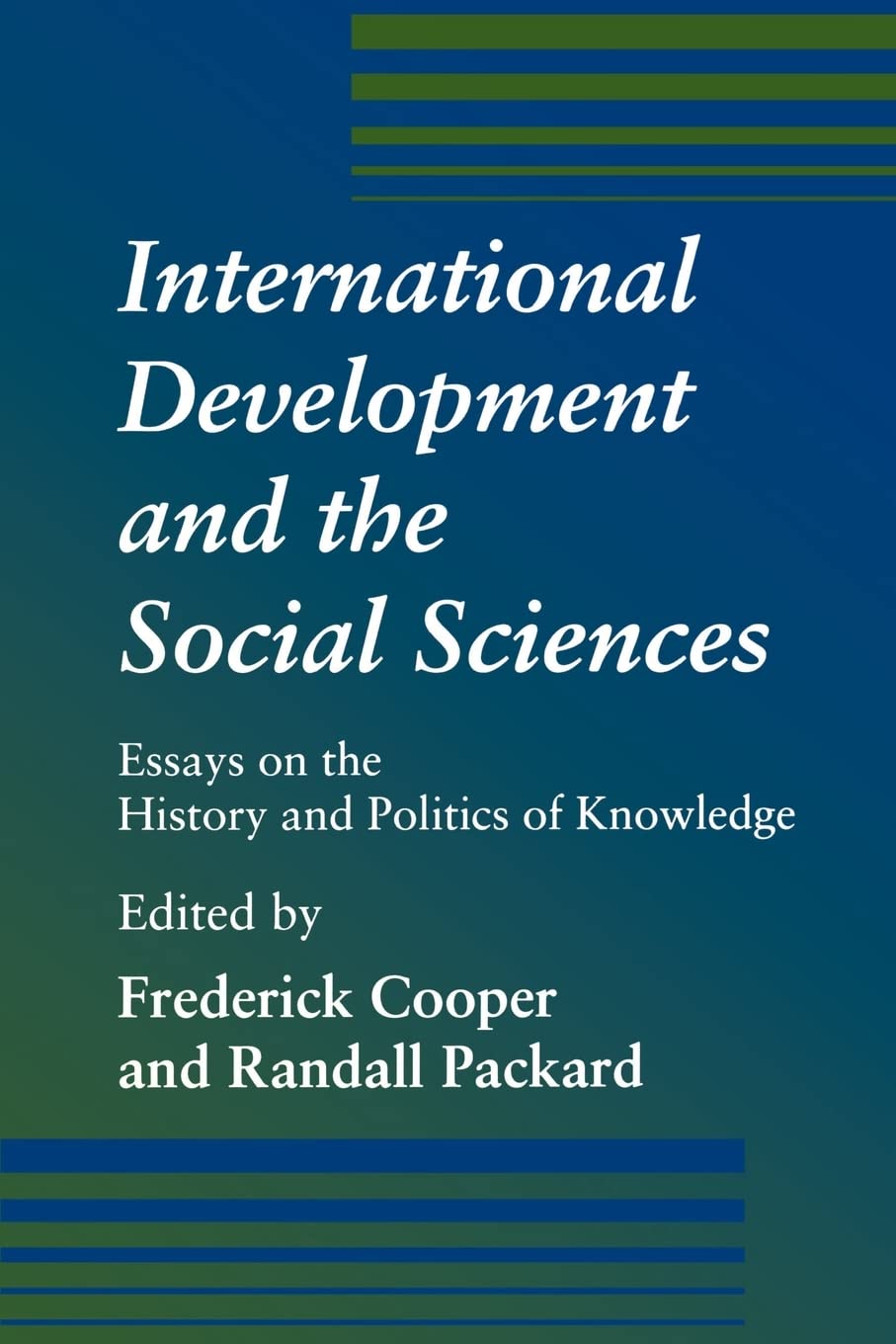
International Development and the Social Sciences: Essays on the History and Politics of Knowledge
$19.63
by Frederick Cooper



During the past fifty years, colonial empires around the world have collapsed and vast areas that were once known as "colonies" have become known as "less developed countries" or "the third world." The idea of development―and the relationship it implies between industrialized, affluent nations and poor, emerging nations―has become the key to a new conceptual framework. Development has also become a vast industry, involving billions of dollars and a worldwide community of experts. These essays―written by scholars in many fields―examine the production, transmission, and implementation of ideas about development within historical, political, and intellectual contexts, emphasizing the changing meanings of development over the past fifty years. The concept of development has come under attack in recent years both from those who see development as the imperialism of knowledge, imposing on the world a modernity that it does not necessarily want, and those who see development efforts as a distortion of the world market. These essays look beyond the polemics and focus on the diverse, contested, and changing meanings of development among social movements, national governments, international agencies, foundations, and scholars. "This superb collection assembles a number of stimulating and theoretically current contributions by outstanding scholars." Angelique Haugerud, author of The Culture of Politics in Modern Kenya "This superb collection assembles a number of stimulating and theoretically current contributions by outstanding scholars."―Angelique Haugerud, author of The Culture of Politics in Modern Kenya Frederick Cooper is Charles Gibson Collegiate Professor of History at the University of Michigan. He is the author of Tensions of Empire: Colonial Cultures in a Bourgeois World (California, 1997) and Decolonization and African Society: The Labor Question in French and British Africa (1996). Randall Packard is Asa Griggs Candler Professor of History and International Health at Emory University. He is the author of White Plague, Black Labor: Tuberculosis and the Political Economy of Health and Disease in South Africa (California, 1989). Internatiional Develoopment and the Social Sciences By Frederick Cooper University of California Press Copyright © 1998 Frederick Cooper All right reserved. ISBN: 9780520209572 One Instruments and Idioms of Colonial and National Development: India's Historical Experience in Comparative Perspective Sugata Bose An elephant with its feet unchained was the chosen motif on the government's publicity handouts advertising its new "liberalization" policies in 1991 as India seemed poised to make a U-turn from the course it had set since the end of colonial rule in the quest for "national development."1 Unimpressed by the image of a plodding elephant, a popular and influential western mouthpiece championing robust economic growth likened the Indian economy to a tiger caged and proclaimed that "[t]his tiger, set free, can be as healthy and vigorous as any in Asia" (Economist 1991: 5).2 Whatever the preferred metaphor from the animal kingdom, many Indian commentators and outside observers were wondering aloud whether India had not in the process of freeing itself from British chains unwittingly tied up its development potential in a tangled web of self-imposed constraints. India at any rate did not seem to offer a developing "third world" model to the ex-communist "second world" that was about to taste the mixed treats of first world-directed development efforts. As Vaclav Klaus, the freest of Eastern Europe's free-marketeer politicians exclaimed, "I have read everything about Indian planning from Mahalanobis onwards. It's wrong, all wrong."3 This must have sounded a trifle ironic to those who knew something of the history of development. In the halcyon days of development planning in the 1950s and early 1960s, Nehruvian India had "appeared to theorists of reformed capitalism as an answer to the challenge posed by the model of growth presented by Mao's China" (Chakravarty 1987). Now India was being asked to unlearn its long-cherished dogmas of development and be tutored in the lessons of stabilization and structural adjustment by those international paragons of virtuous economic discipline based in Washington. India's failings in its developmental efforts are many and the disenchantments and disillusionments among its own populace deep and widespread. All but the most churlish would acknowledge that there have been some successes to report as well. What is truly remarkable about the current convergence of criticisms of India's postindependence development efforts is that the volleys have come from diverse and occasionally conflicting sources and premises. The critics range from "neoclassical" and liberal advocates of the "free market" to "postmodern" votaries of the "fragment" and "antidevelopment." In order to make a measured assessment of India's devel