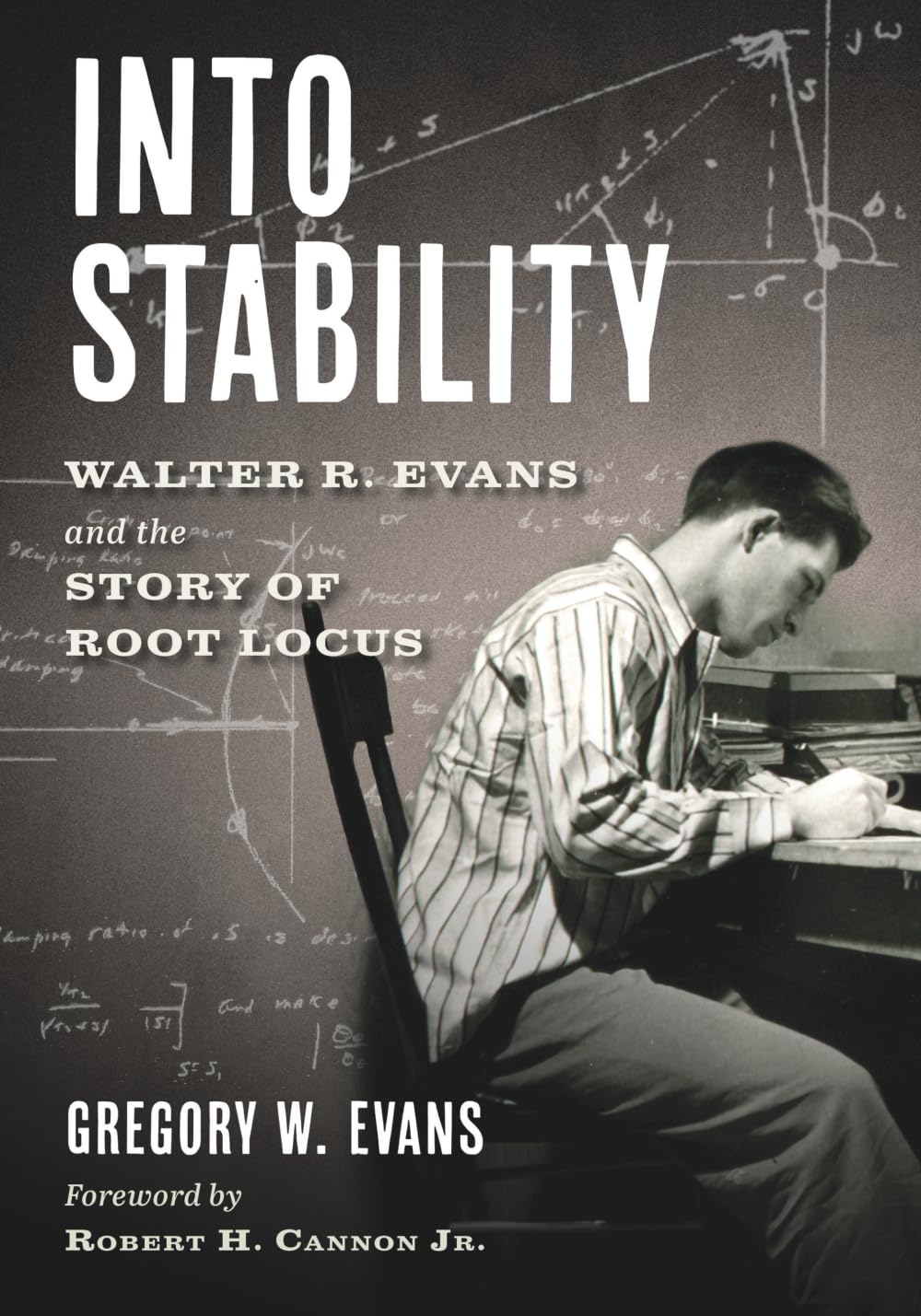



Into Stability: Walter R. Evans and the Story of Root Locus The paperback edition has a Black and White Interior like the $33.95 hardback edition and unlike the Kindle and $49.95 hardback editions, both of whose interiors are color.) In 1950, a young engineer named Walter R. Evans introduced a revolutionary graphical method for analyzing feedback control systems. His paper, "Control System Synthesis by Root Locus Method," transformed the practice of control engineering and became one of the most influential contributions in the history of the field. In Into Stability , Walter's son, Gregory Walter Evans-himself an engineer-tells the untold story behind that breakthrough. Drawing on family archives, correspondence, and rare photos from aerospace history, Evans reconstructs the inventive process that led from wartime analog computers to the elegant logic of Root Locus. He reveals how his father's inventive spirit was shaped by mentors at Washington University in St. Louis, by the entrepenurial environment at North American Aviation, and by a lifetime devoted to clarity, precision, and education. The book follows Walter Evans through the founding of The Spirule Company , the enterprise that brought his invention into classrooms and laboratories worldwide, and explores how the Root Locus method continues to guide modern control design-from aircraft and missiles to robotics and medical systems. Part biography, part history of technology, and part personal memoir, Into Stability captures the human side of engineering creativity-the curiosity, discipline, and humility that define real innovation. More than a chronicle of one man's achievement, it is a portrait of a generation of engineers who shaped the modern world through insight and perseverance. “A wonderful book about a giant of classical control. Reading this book reminds me of what I missed in knowing his method but not the man.” — John Doyle, California Institute of Technology “A fascinating story of Walt Evans, the man whose Root Locus method changed the world. We would not have made it to the moon without it.” — David A. Peters, Washington University in St. Louis “Fueled by a passion for teaching and love of country, Uncle Walter—a humble and brilliant soul—was one of America’s most impactful engineers.” — Don Evans Into Stability tells the story of an engineer whose inventive mind bridged the gap between theory and practice. Drawing from correspondence, aerospace archives, and classroom notes, his son Greg Evans offers an intimate account of innovation at the dawn of the modern age. More than a technological chronicle, Into Stability explores engineering’s human side—creativity, persistence, and the pursuit of deep understanding. It captures the stories and friendships that gave rise to one of the most enduring advances in postwar engineering. Endorsed by leading professors from Caltech, Harvey Mudd, and Washington University in St. Louis , Into Stability is a landmark biography for engineers, educators, historians of technology, and anyone fascinated by how great ideas take shape. Discover the untold story behind Root Locus—and the engineer who brought stability to the modern world. John Doyle, Control and Dynamical Systems, Caltech "A wonderful book about a giant of classical control who inspired me as an undergrad at MIT. Reading this book reminds me of what I missed in knowing the methods but not the man." David A. Peters, , Washington University in St. Louis "This is a fascinating story of Walt Evans, the man who invented the Root Locus design tool for the rest of the world. We would not have made it to the moon without this methodology." Qimin Yang, Harvey Mudd College "This book provides an intimate memory of Evans' life and his invention, his deep connections to people in academia and industry, and the critical impact of his work in aerospace engineering." Shalom Ruben University of Colorado "The son of Walter Evans weaves a compelling story of a 1948 transformation in control engineering that remains a cornerstone of modern practice today."