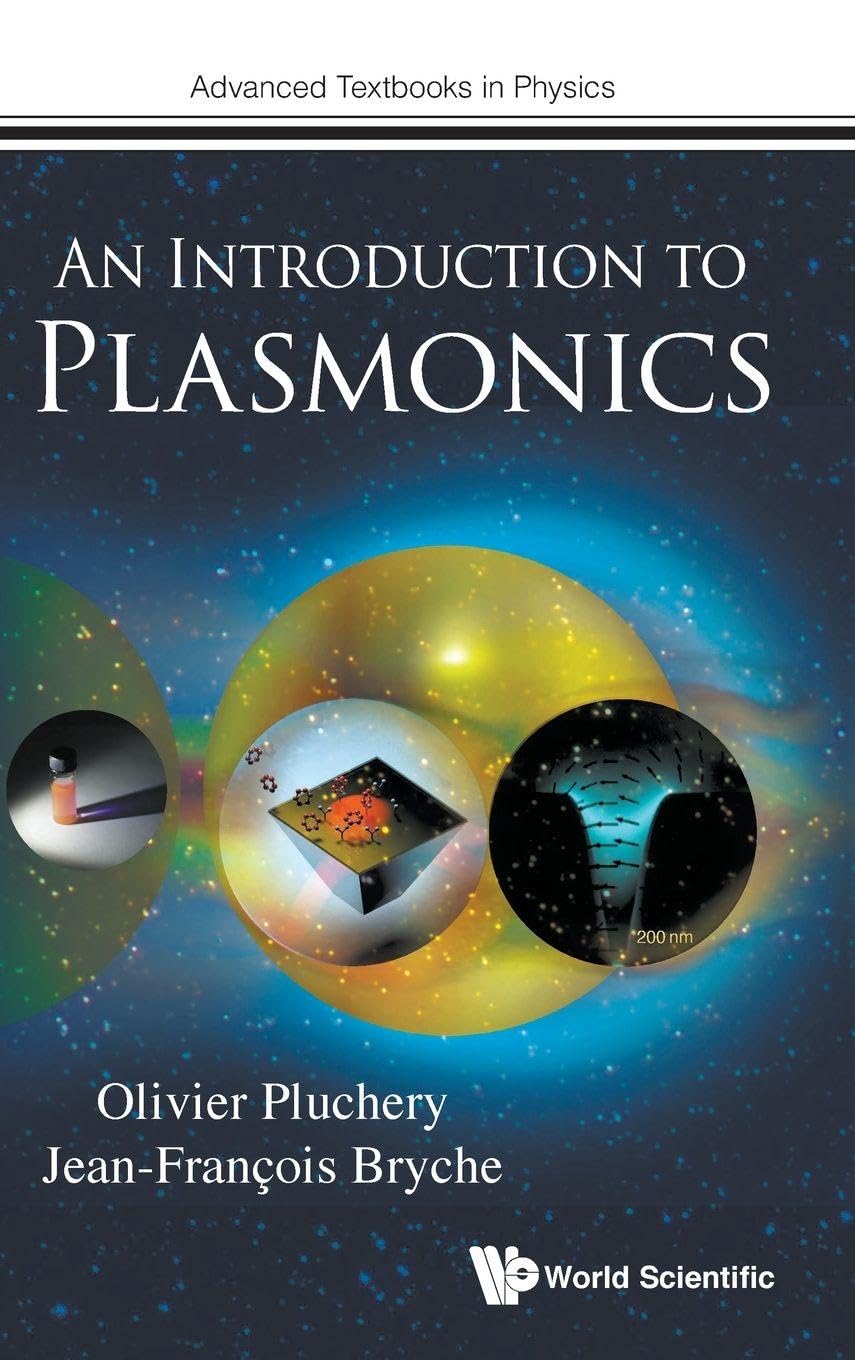



What is a plasmon? Is it a particle, like a photon or a wave? Plasmonics stands at the frontier of condensed matter physics, which is the world of electrons, optics and of photons. Plasmonics is one of the most active fields in nanophotonics. This book begins by exploring the concepts behind waves, and the electromagnetic description of light when it interacts with metals; it dedicates every chapter thereafter to all aspects of plasmonics. In particular, the surface plasmon polariton wave is explained in full detail, as well as the localized surface plasmon resonance of metallic nanoparticles. The active research area opened by plasmonics, as well as its applications, are also briefly explained, such as advanced biosensing, subwavelength waveguiding, quantum plasmonics, nanoparticle-based cancer therapies, optical nano-antenna and high-efficiency photovoltaic cells. The book is adapted for graduate students and places a special emphasis on providing complete explanations of the fundamental concepts of plasmonics. Further, each of these concepts is illustrated with examples drawn from the most recent scientific literature. Each chapter ends with a set of exercises that will help the reader revise the concepts and go deeper into the world of plasmonics. More than 70 exercises are included. Olivier Pluchery is currently University Professor of Physics at Sorbonne University in Paris where he has been teaching optics, electromagnetism and plasmonics since 2002. He leads a research group at the Institute for NanoScience in Paris and focuses on the understanding of the singular properties of gold nanoparticles studied at the single objects level: charge transfer induced by molecular layers, conductivity, plasmonic properties. He spent sabbaticals at UC Berkeley and at University of Texas at Dallas. He is the director of the national research network Or-Nano dealing with the many applications of gold nanoparticles. He co-edits with Professor C Louis the book Gold Nanoparticles for Physics, Chemistry and Biology (second edition). He has authored more than 60 research articles. He received his PhD from University of Paris-Saclay in 2000 in laser physics and did a postdoctoral research stay at Bell-Labs (New Jersey). Jean-François Bryche is CNRS researcher since 2021 at the Laboratoire de Nanotechnologies et Nanosystèmes (LN2), an international research laboratory between France and Canada, at the University of Sherbrooke. Before, he was Research Assistant Professor at Sherbrooke University where he taught optics, electronics and plasmonics. He obtained his PhD in 2016 at the Université Paris-Saclay in France in the field of nanostructured plasmonic biosensors. During a first postdoctoral stay at the University of Sherbrooke he contributes to the field of thermoplasmonics. Then he focused on electrically driven nanosources of light during a second postdoc at the Institute for Molecular Science of Orsay (France). His research interests include plasmonics, nanophotonics, surface enhanced Raman scattering, biosensors, near field optics, biophotonics, nanofabrication and thermoplasmonics. He has authored more than 20 research articles.