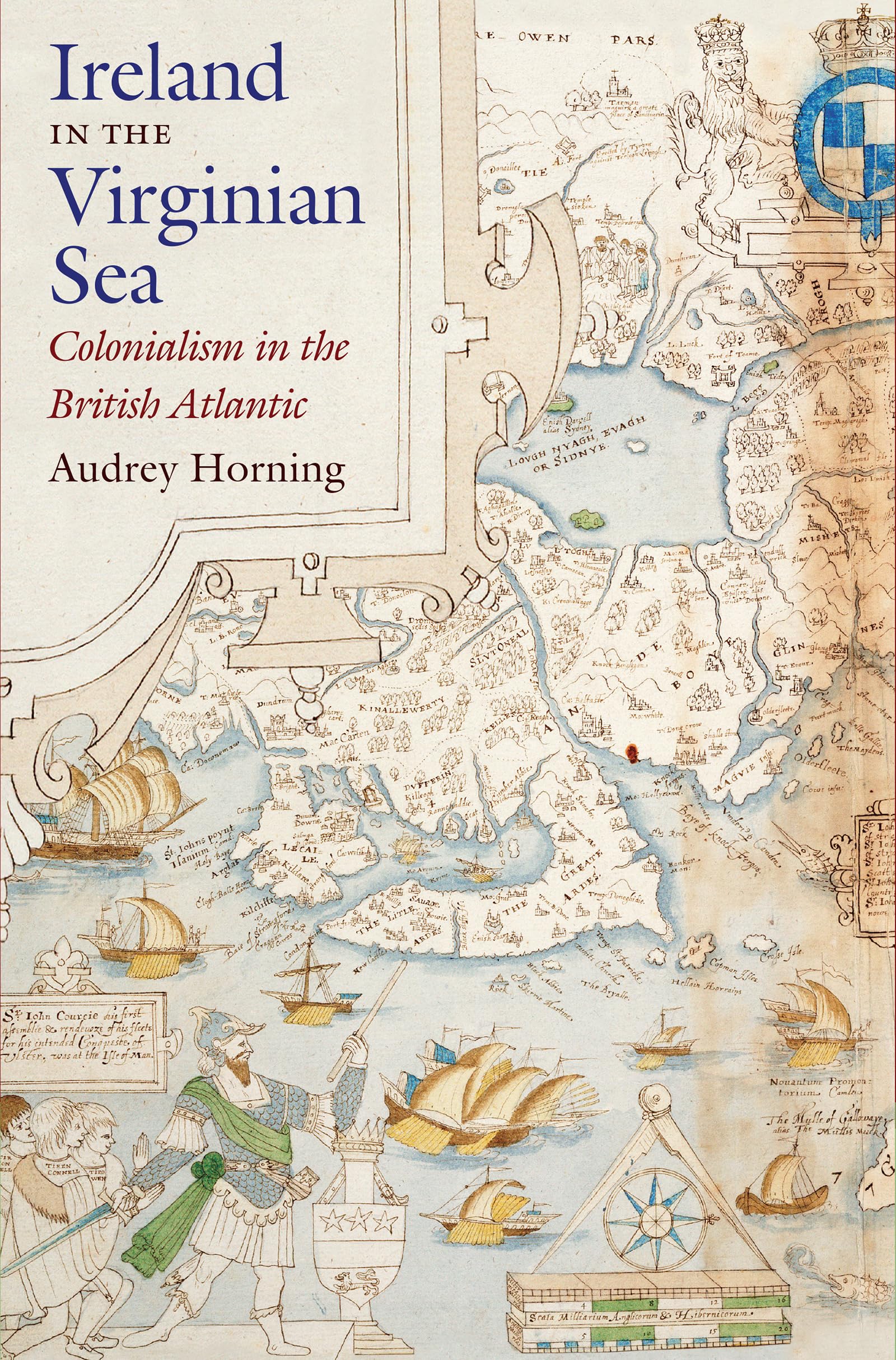
Ireland in the Virginian Sea: Colonialism in the British Atlantic (Published by the Omohundro Institute of Early American History and Culture and the
$30.00
by Audrey Horning



In the late sixteenth century, the English started expanding westward, establishing control over parts of neighboring Ireland as well as exploring and later colonizing distant North America. Audrey Horning deftly examines the relationship between British colonization efforts in both locales, depicting their close interconnection as fields for colonial experimentation. Focusing on the Ulster Plantation in the north of Ireland and the Jamestown settlement in the Chesapeake, she challenges the notion that Ireland merely served as a testing ground for British expansion into North America. Horning instead analyzes the people, financial networks, and information that circulated through and connected English plantations on either side of the Atlantic. In addition, Horning explores English colonialism from the perspective of the Gaelic Irish and Algonquian societies and traces the political and material impact of contact. The focus on the material culture of both locales yields a textured specificity to the complex relationships between natives and newcomers while exposing the lack of a determining vision or organization in early English colonial projects. “A remarkable, creative work that uncovers and illumines. . . . Essential. Upper-division undergraduates and above.” — CHOICE “In producing this accessible yet sophisticated account of two overlapping but distinct colonial enterprises, Horning offers a subtle interpretation of the complex early modern English plantation experience.” — American Historical Review “Usefully encourages us to add complexity to often-simplified understandings of cultural conflict.” — Journal of Interdisciplinary History “Horning’s larger conclusions will surely generate productive study and debate.” — Journal of British Studies “Bold and challenging.” — Journal of Southern History “Generate[s] a provocative, new perspective on the old debate of Ireland as a colonial model for developing Jamestown.” — Southern Historian “[A] wide-ranging and illuminating study of colonialism in the British Atlantic.” — Journal of Colonialism and Colonial History “Meticulous, thoughtful, and a welcome contribution.” ― H-War “A compelling, nuanced, richly detailed and solidly documented investigation of colonialism, colonizers, and the colonized.” — Journal of the North Carolina Association of Historians “An account both theoretically sophisticated and attentive to detail and context. Every historical archaeologist must read and digest this book; Horning tells us not just about Ireland and Virginia, but instructs us in how we should practice a more sensitive and nuanced historical archaeology.” ― Matthew H. Johnson, Northwestern University “An account both theoretically sophisticated and attentive to detail and context. Every historical archaeologist must read and digest this book; Horning tells us not just about Ireland and Virginia, but instructs us in how we should practice a more sensitive and nuanced historical archaeology.” — Matthew H. Johnson, Northwestern University Extending British control in Ireland and Virginia In the late sixteenth century, the English started expanding westward, establishing control over parts of neighboring Ireland as well as exploring and later colonizing distant North America. Audrey Horning deftly examines the relationship between British colonization efforts in both locales, depicting their close interconnection as fields for colonial experimentation. Focusing on the Ulster Plantation in the north of Ireland and the Jamestown settlement in the Chesapeake, she challenges the notion that Ireland merely served as a testing ground for British expansion into North America. Horning instead analyzes the people, financial networks, and information that circulated through and connected English plantations on either side of the Atlantic. Audrey Horning is Distinguished Professor of Arts and Sciences, College of William and Mary, and Professor of Archaeology, Queen’s University Belfast. This is her fifth book.