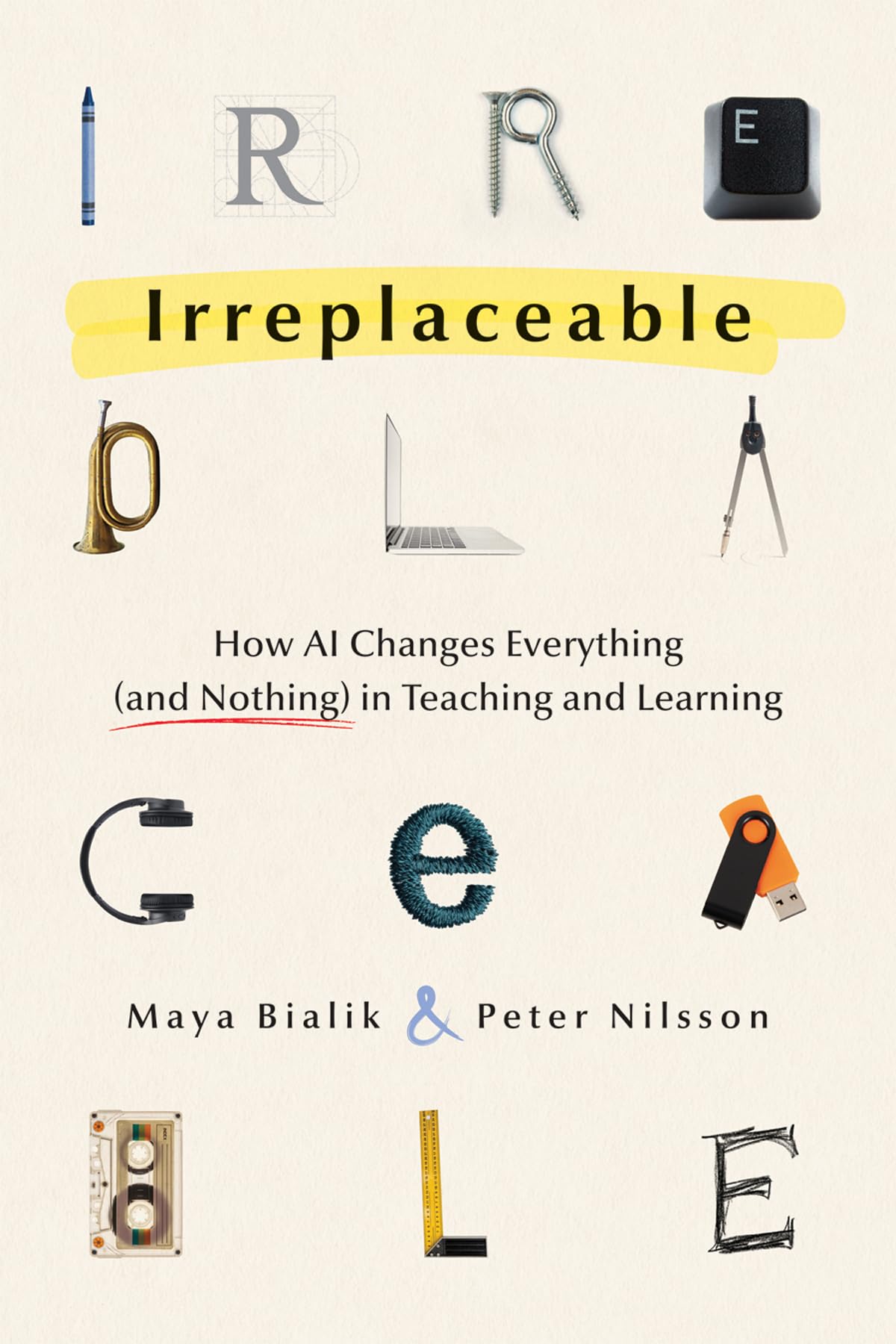
Irreplaceable: How AI Changes Everything (and Nothing) in Teaching and Learning
$45.95
by Maya Bialik



Artificial intelligence (AI) is changing education, but what works in teaching and learning remains irreplaceable. Authors Maya Bialik and Peter Nilsson move beyond the fear and hype to provide a balanced guide for a new era. With practical examples, they show how to leverage AI as an indispensable tool for research, lesson planning, and feedback to enhance learning and foster creativity. K–12 teachers and leaders can use this book to: Build their confidence in diagnosing where AI does and does not belong in education - Provide a rigorous foundation for a human-centered AI strategy in schools - Gain practical approaches for using AI to support research, planning, and feedback - Design lessons in which students use AI to enhance rather than replace learning - Deepen knowledge of how learning sciences inform effective use of AI - Anticipate how AI might support teaching and learning in the years to come Contents: Introduction Part 1: AI for Teachers Chapter 1: The Research Assistant Chapter 2: The Planning Assistant Chapter 3: The Feedback Assistant Part 2: AI for Students Chapter 4: The Learning Assistant Chapter 5: The Doing Assistant Part 3: AI for the Classroom Chapter 6: The Administrative Assistant Chapter 7: The Teaching Assistant Epilogue References and Resources Index Maya Bialik is earning her PhD in educational studies at Boston University, and is the founder of QuestionWell AI, which creates research-aligned AI tools for education. A former middle school science teacher, Maya’s focus is on how AI can improve working conditions for teachers, making their creative work easier, more effective, and more enjoyable. Her two previous books are Artificial Intelligence In Education: Promises and Implications for Teaching and Learning and Four-Dimensional Education: The Competencies Learners Need to Succeed . Maya has worked with teachers, school leaders, entrepreneurs, and policymakers, leading workshops, giving keynotes, teaching courses, presenting at conferences, and consulting. Since earning her master’s degree in Mind, Brain, and Education from Harvard Graduate School of Education in 2012, Maya has been passionate about bridging the gaps among researchers, practitioners, and technologists. Combining her immigrant experience and her experience learning, performing, and directing narrative and musical improv, she creates collaborative spaces for grappling with complex topics and building mutual understanding. Maya serves on the board of The Plenary, Co., a civic arts and sciences nonprofit building collective knowledge, community agency, and public imagination. She is also an adviser for the Center for Curriculum Redesign, a nonprofit that asks the question “What should students learn to be prepared for the twenty-first century?” She holds bachelors’ degrees in psychology, biology, and linguistics from the University of Massachusetts Amherst. Peter Nilsson is an educator, writer, and musician with over two decades of experience in teaching and school leadership. He was the head of school at King’s Academy, a coeducational boarding school in Jordan, and he taught English for fifteen years and served in leadership positions at Deerfield Academy in Massachusetts. Peter is also the editor of The Educator’s Notebook , a weekly newsletter that gathers education- and learning-related news from around the web for the purpose of promoting innovation in education. He is the cofounder of Athena Lab, a collaborative online platform for teachers. Peter serves on the advisory boards for SXSW EDU, the Center for Curriculum Redesign, and the Middle States Association Responsible AI in Learning endorsement. His presentations on AI in education, creativity, cognitive science, and educational technology have been featured at national and international conferences, including SXSW EDU, the College Board, and the OECD. In 2017, he became the first high school teacher to receive an Innovation Award from Wolfram Research for the design and implementation of a digital humanities course. A composer and writer, Peter is also the creator of a musical about schools. His creative work in music and education reflects his belief that the most powerful learning happens at the intersections of disciplines, cultures, and ideas. Peter studied English and music at Middlebury College, earned his master of arts from Columbia University, and received a National Endowment for the Humanities Institute grant to study Paradise Lost . He lives with his wife and two children, and enjoys reading, trail running, and writing music.