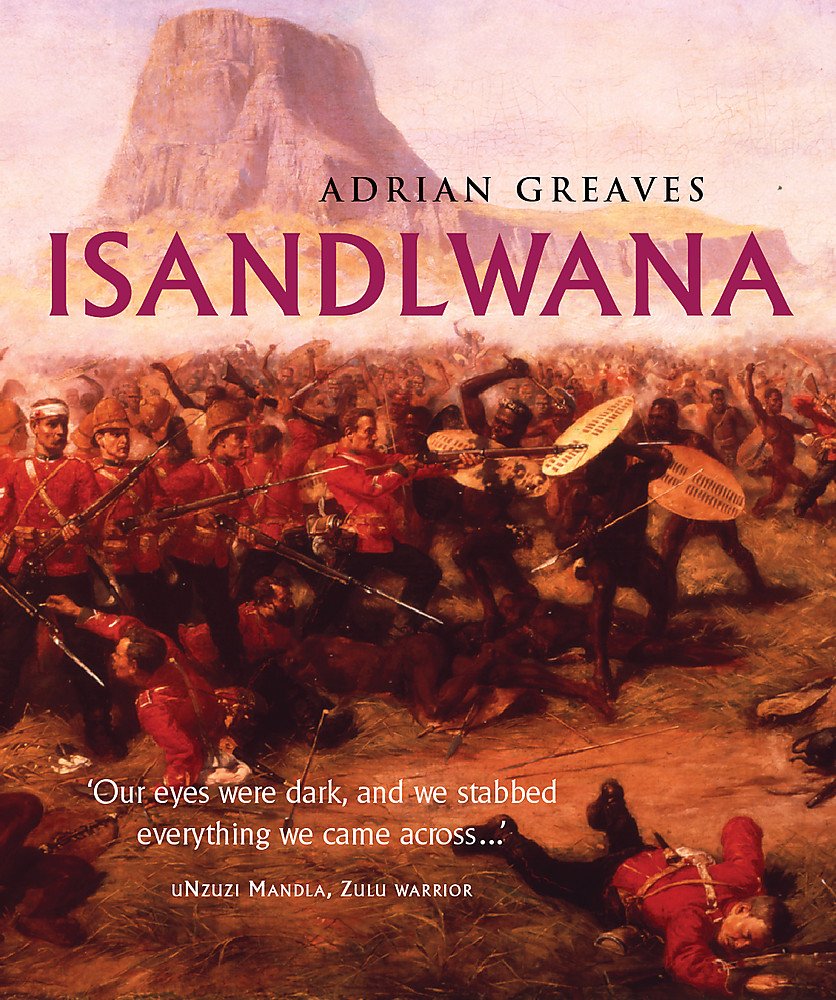



On 22nd January 1879, shortly after the British invasion of Zululand, Viscount Chelmsford established a camp at Islandlwana for his centre column, consisting of 1800 Europeans and 1000 natives. But while Chelmsford and about half of the Europeans were away trying to intercept a Zulu force, the camp was hit early in the morning by a surprise Zulu attack. All but 55 Europeans and 300 natives were killed. Returning the next day, Chelmsford discovered the ruined camp, strewn with bodies, and immediately fell back through Rorke's Drift to defensive positions. This book is a brand new look at the opening battle of the war, and one of the biggest disasters for the British in South Africa. This book serves as a volume in Cassell's Fields of Battle series - and as such, carries a Forward by the Series Editor - the eminent British military historian, Richard Holmes. Holmes speaks of the shockingly sudden and convincing nature of the defeat of the British Army, at a part of Western Zululand known as 'Isandlwana', on January the 21st, 1879. He also points out that the British Army suffered two simlar defeats in the 1800's at the hands of indigenous forces - the 1844 retreat from Kabul, and in 1880 the debacle at Maiwand, curiously both disasters involved the destruction of British-Indian forces at the hands of Afghanis. These defeats may be compared and constrasted with the defeat of the Italian Army at Adowa (Ethiopia) in 1896, where an army of around 17,000 Italians was destroyed by Ethiopian tribesmen. The author of this book - Adrian Greaves - has served in the British Army as an infantry officer, and held a senior rank in the UK Police Service. His experience and analytical skills have been put to good use in this publication. The hardback (2001) edition contains 216 numbered pages and as well as containing a Foreword, Introduction and 6 very important appendices, it is separated into 7 comprehensive chapters: 1) Conditions At Home. 2) The Adversaries. 3) Preparations For The War. 4) The Battle Of Isandlwana. 5) The Flight From Isandlwana. 6) After Isandlwana. 7) The Re-Invasion And Destruction Of Zululand. The book is lavishly illustrated throughout, and contains a number of campaign maps, showing the position of the British camp to the east of Isandlwana, and how the Zulu attack unfolded from the north and north-east of that position. Numbers vary, but the numbers of British troops stationed at Isandlwana is thought to be around 1,700 - 800 imperial infantry troops, Mounted Infantry and around 800 Natal Native Contingent. It is estimated that the Zulu army on the day numbered some 25,000 warriors. The British forces used Henry-Martini Breech-loading rifles, cannons and rocket natteries, the Zulus, although in possession of some rifles, nevertheless were not trained in their use, and relied instead upon their traditional weapons - namely the short stabbing spear (iklwa), the battle-hammer (iWisa) and the cowhide shield (umBumbuluzo). Using their famous 'Horns of the Buffalo' (Impondo Zanknomo). The battle commenced around 12 noon, and was all but over just 2 hours later. In that time, around 1,300 British troops were killed, with only 55 Europeans escaping the carnage and riding out of Zululand to the safety of the British colony of Natal. No one survived who was on foot, and every British soldier serving in the Imperial companies was killed to a man. Of the 55 Europeans who survived, 5 were Imperial officers. It has been suggested, at least in official circles, that the officers who survived, left Isandlwana whilst British soldiers were still fighting for their lives, often in desparate last stands, exhibiting the highest level of bravery. Zulu accounts of the battle often talk about the bravery of the soldiers in red. Assessments of Zulu casualties vary and are uncertain. It is estimated that between 1000 and 3000 Zulu warriors died at Isandlwana, with perhaps the same number (or more) being wounded. Interestingly, the Natal Native Contingent (NNC) is often ignored in the assessment of British battle casualties at Isandlwana. Essentially, these units comprised of African 'Volunteers', who for one reason or another had decided to join the British invasion of Zululand in 1879. Many of these units were hastily formed, badly trained and poorly led. Only 1 in 10 were allowed to carry a rifle, whilst the others had to rely on traditional weapons. All the officers were white, as were many of the non-commissioned officers. --ShiDaDao Ph.D TOP 1000 REVIEWER Isandlwana must conjure a grisly compulsion over readers judging by the number of books written: perhaps the best parallei is The Little Bighorn. Adrian Greaves book debunks the myths that all the other recent works have debunked,lack of amnunition etc, but is concise and well argued. His treatment of the actual battle up to the destruction of the British camp is very brief but in a way this is a strength as it coveys the confusion and shock of the event: which anyo