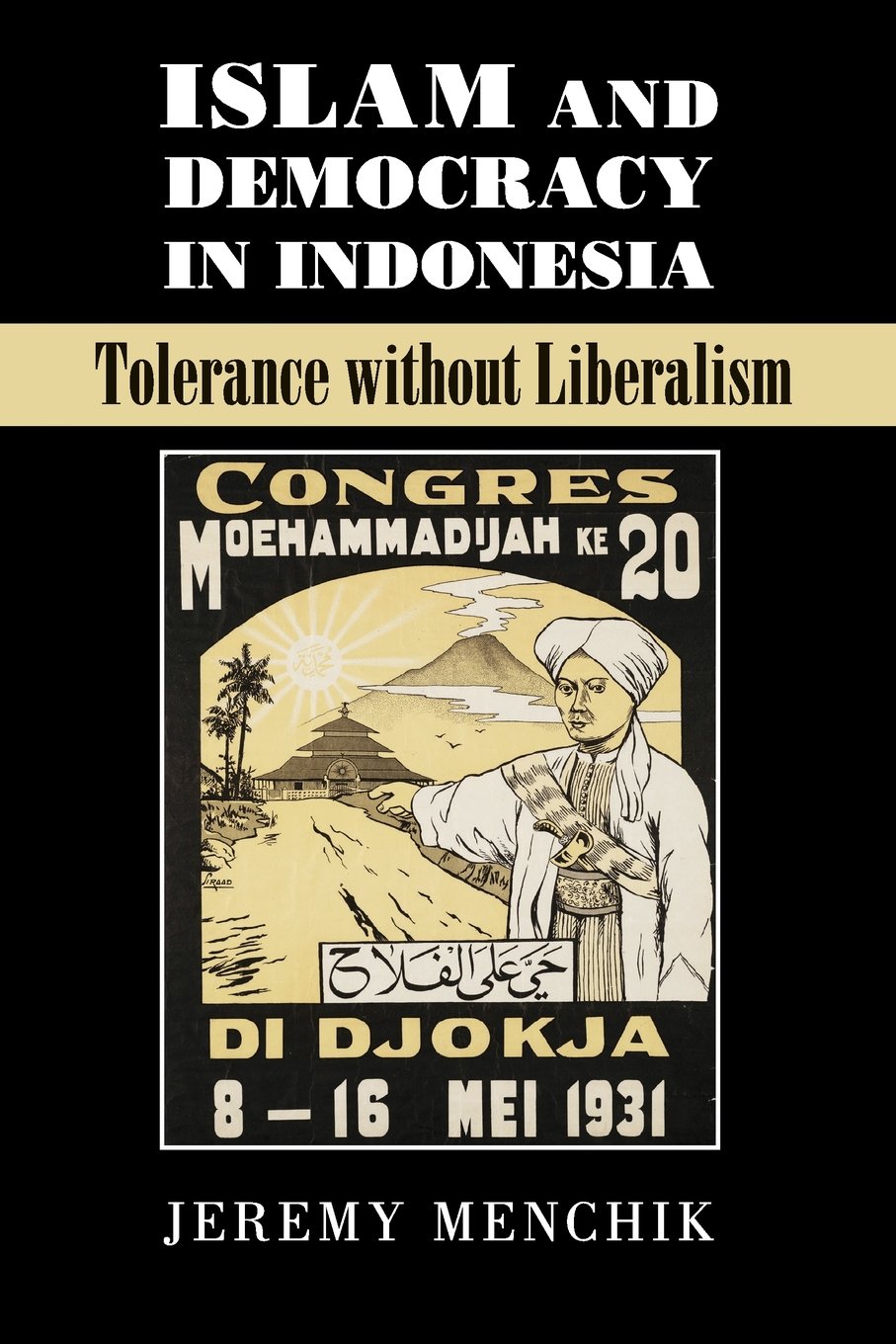
Islam and Democracy in Indonesia: Tolerance without Liberalism (Cambridge Studies in Social Theory, Religion and Politics)
$23.71
by Jeremy Menchik



Indonesia's Islamic organizations sustain the country's thriving civil society, democracy, and reputation for tolerance amid diversity. Yet scholars poorly understand how these organizations envision the accommodation of religious difference. What does tolerance mean to the world's largest Islamic organizations? What are the implications for democracy in Indonesia and the broader Muslim world? Jeremy Menchik argues that answering these questions requires decoupling tolerance from liberalism and investigating the historical and political conditions that engender democratic values. Drawing on archival documents, ethnographic observation, comparative political theory, and an original survey, Islam and Democracy in Indonesia demonstrates that Indonesia's Muslim leaders favor a democracy in which individual rights and group-differentiated rights converge within a system of legal pluralism, a vision at odds with American-style secular government but common in Africa, Asia and Eastern Europe. "The world's largest Muslim-majority country, Indonesia's success at transitioning to democracy has perplexed students of comparative Muslim politics - as has the tendency for Indonesian democracy to show a decidedly non-liberal attitude toward matters of religious pluralism. In this richly researched and elegantly argued book, Jeremy Menchik explains how both phenomena have been possible. In so doing, he also offers a study of great importance, not just to Indonesianists, but to scholars and readers interested in the prospects for democracy in the broader Muslim world." Robert Hefner, Director of the Institute on Culture, Religion, and World Affairs, Boston University "At a time when calls for tolerance usually impugn religion and imply the secular, political scientist Jeremy Menchik proposes an original vision of democracy that includes and is even grounded in religion - godly nationalism, he calls it. To make his case, he turns to Indonesia, the world's largest Islamic democracy, where he conducted tireless research that he presents here with assertive vivacity and intellectual versatility. Ranging across political theory, sociology, religious studies, and political science, the product is a major contribution to scholarship on religion and politics." Daniel Philpott, Director, Center for Civil and Human Rights, University of Notre Dame, Indiana "Jeremy Menchik's thought-provoking and carefully crafted study examines the complex and politically productive role of Islamic organizations in the world's largest Muslim-majority democracy. He challenges the notion that liberal modes of tolerance are a sine qua non of democratization. This book opens new possibilities for the study of religion, governance, politics, and power in a world than can be neither dominated nor defined by Euro-American history and experience." Elizabeth Shakman Hurd, Northwestern University, Illinois "Brilliant! This is by far the best book on the complex relationships between the state and the three major Islamic civil-society organizations in Indonesia. It is a conceptual and empirical tour de force, integrating political science, anthropology and history." Alfred Stepan, Wallace Sayre Professor of Political Science, Columbia University, New York 'Menchik’s illumination of an alternative to the Rawlsian vision of secular-liberal democracy operating in Indonesia challenges long held assumptions that place religion on the fringes of political science. He provides a different way of conceptualizing religion and politics that is productive for not only the field of political science, but also religious studies, area studies, Islamic studies, and Indonesian studies. His notions of godly nationalism and communal tolerance deserve further analysis and inclusion in other contexts outside of Indonesia.' James Edmonds, Reading Religion 'Jeremy Menchik’s wonderful new book takes the challenges of doing constructivist political science theory seriously. That is no simple task, since even the best works in the constructivist tradition often avoid the difficult work of actually defining the approach and its implications. What Menchik achieves is not a replacement for the grand theoretical traditions of religion and politics that he criticizes but something more useful. He provides a careful research design that produces a handful of empirically consequential mechanisms explaining why leading Indonesian Islamic organizations are sometimes more or less tolerant of non-Muslim minorities, a credible account of how these mechanisms might generalize to other times and places, and a clear examination of their normative consequences. … [t]his is a book that deserves to be widely read and debated not only by Indonesia scholars but also by all who study religion and democratic politics.' Brandon Kendhammer, Perspectives on Politics 'His revealing research into local history shows how the diverse experiences of different Muslim organizations have produced a wide rang