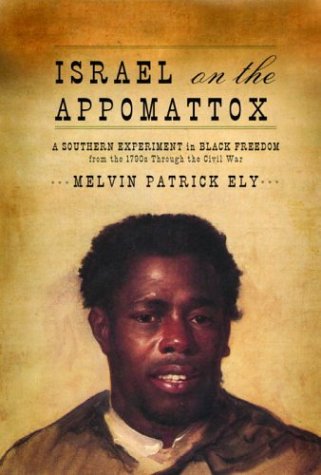
Israel on the Appomattox: A Southern Experiment in Black Freedom from the 1790s Through the Civil War
$43.54
by Melvin Patrick Ely



Thomas Jefferson condemned slavery but denied that whites and liberated blacks could live together in harmony. Jefferson’s young cousin Richard Randolph and ninety African Americans set out to prove the sage of Monticello wrong. When Randolph died in 1796, he left land for his formidable bondman Hercules White and for dozens of other slaves. Freed, they could build new lives there alongside white neighbors and other blacks who had gained their liberty earlier. Fittingly, the Randolph freedpeople called their promised land Israel Hill. These black Israelites and other free African Americans established farms, plied skilled trades, and navigated the Appomattox River in freight-carrying “batteaux.” Hercules White’s son Sam and other free blacks bought and sold boats, land, and buildings, and they won the respect of whites. Melvin Patrick Ely captures a series of remarkable personal and public dramas: free black and white people do business with one another, sue each other, work side by side for equal wages, join forces to found a Baptist congregation, move West together, and occasionally settle down as man and wife. Even still-enslaved blacks who face charges of raping or killing whites sometimes find ardent white defenders. Yet slavery’s long shadow darkens this landscape in unpredictable ways. After Nat Turner’s slave revolt, county officials confiscate and auction off free blacks’ weapons–and then vote to give the proceeds to the blacks themselves. One black Israelite marries an enslaved woman and watches, powerless, as a white master carries three of their children off to Missouri; a free black miller has to bid for his own wife at a public auction. Proslavery hawks falsely depict Israel Hill to the nation as a degenerate place whose supposed failure proves blacks are unfit for freedom. The Confederate Army compels free black men to build fortifications far from home, until Lee finally surrenders to Grant a few miles from Israel Hill. Ely tells a moving story of hope and hardship, of black pride and achievement. He shows us an Old South we hardly know, where ties of culture, faith, affection, and economic interest crossed racial barriers–a society in which, ironically, many whites felt secure enough to deal fairly and even cordially with free African Americans partly because slavery still held most blacks firmly in its grip. While Thomas Jefferson lived with the contradiction of slave ownership and the ideals of liberty, his cousin Richard Randolph could not reconcile the two. When Randolph died in 1796, he freed 90 slaves, granting them land to build a settlement among whites. Near the Appomattox River, they built a community called Israel Hill, defying the skepticism about whether blacks and whites could live in harmony as equals. Princeton-trained historian Ely presents a portrait of life during the 1790s in this little-known Virginia settlement, where whites and black former slaves lived together, working as farmers and tradesmen, even founding a Baptist congregation together. Revealed through the personal and public stories of the residents of Israel Hill, Ely reveals this extraordinary settlement where racial cooperation reigned but was not untarnished by the raging conflicts of slavery and impending war. This is a well-researched and absorbing look at the history of freedmen and race relations from an angle that defies the conventional wisdom of blacks and whites at the time. Vernon Ford Copyright © American Library Association. All rights reserved “Melvin Patrick Ely previously wrote a wonderfully original and significant book on the popular radio and television series Amos ‘n' Andy that upset a number of facile assumptions. He has now done exactly the same for Israel Hill, a largely forgotten community of free Black farmers and workers in antebellum Virginia. Once again we are indebted to him for enabling us to take a deeper look at aspects of our past and our culture we thought we fully understood.” --Lawrence W. Levine author of Black Culture and Black Consciousness “Melvin Ely achieves an astonishing project by meticulously mining rich veins of archival sources to give us a fresh (and refreshing) view of the constraints and possibilities for rural free blacks living in antebellum times. The book unfolds as a revelation, and it contributes profoundly to the revision of our understanding of African-American life in the nineteenth century.” --Michael Kammen, author of American Culture, American Tastes "This remarkable account of a free black community in the heart of antebellum Virginia is rich with new insights on the dimensions of bondage and freedom in the slave South. The author's meticulous research and elegant writing make the experience of reading it both a reward and a pleasure." --James M. McPherson, author of The Battle Cry of Freedom "In an astonishing act of historical research and imagination, Melvin Ely has recreated an entire world in a forgotten corner of the