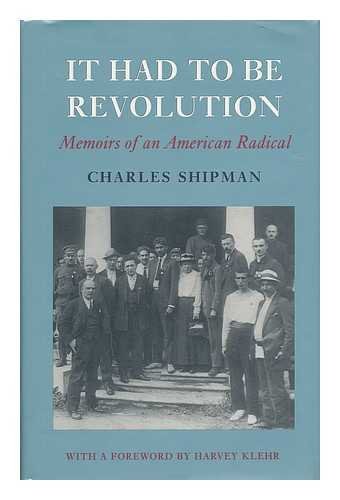
It Had to Be Revolution: Memoirs of an American Radical (Studies in Soviet History and Society)
$66.00
by Charles Shipman



Frank Seaman, Jesus Ramirez, Manuel Gomez. Student activist, draft resister, political refugee, delegate to the Moscow Comintern congress, underground organizer, railroad executive, investment columnist for The Wall Street Journal. The man who was born Charles Francis Phillips in 1895 and died Charles Shipman in 1989 was all of these. In this robust memoir, Shipman gives us an incomparable view of modern history from the inner circles of the Communist movement. An unruly boy in a middle-class family, Shipman chose revolution from the start. From his undergraduate days at Columbia he pursued a career of activism that led through a complex - and at times dangerous - series of double lives. During the 1920s, Shipman tirelessly supported the Bolshevik call for an international social revolution and the liberation of colonial peoples; and as a founding member of the Mexican Communist Party, he encountered face-to-face many of the most important figures of the left. Shipman offers pithy portraits of an array of writers, artists, comrades, and friends including Dorothy Day, Walter Lippmann, and Bertolt Brecht, as well as Lenin, Zinoviev, and Michael Borodin. After Stalin assumed power in the USSR, Shipman's enthusiasm for the Party ebbed, and he chronicles his gradual withdrawal from American communism. But interwoven with the drama of Shipman's political odyssey is another story: his personal struggle to come to terms with elusive questions of ethnic identity, friendship, parenthood, and love. Including nineteen evocative illustrations, It Had to Be Revolution documents the early years of the American and international left from the perspective of a man who was as successful at the front lines of communism as he was within the boardrooms of capitalism - and who preserved the commitments of his youth throughout his remarkable life. This is the story of an adventurous life in the extraordinary interwar period when everything was being turned upside down. Shipman (1895-89) joined the Communist Party after World War I and traveled widely, working to build communism in Mexico and the United States. Although he worked with other professional revolutionaries such as Michael Borodin and even had an audience with Lenin, his memoir is most interesting for the details of routine party work--the fear, boredom, confusing infighting, and lack of funds. After falling out with the Communists over Stalin in the 1930s, Shipman entered the American economic mainstream. An interesting addition for collections in U.S. and Latin American history and Communist studies. Index not seen. - Daniel Blewett, Loyala Univ. Lib., Chicago Copyright 1993 Reed Business Information, Inc. A priceless Old Left memoir by Shipman (1895-1989), who began as a student activist and became a founding member of the Mexican Communist Party and an intimate of leftists and literati around the globe. Writing from retirement in Texas during the Bush Administration, Shipman--then in his 90s but still taking college courses--tells a story that spans the decades from Wilson to Reagan. As a child, he says, he was so wild that he was sent to a boarding school at age five and didn't come home until he was ready for high school. Launched by Walter Lippmann into a delayed college career at Columbia, the author became a member of Henry Ford's bizarre ``peace-ship'' contingent prior to WW I, as well as a friend to Lorenz Hart, Bertolt Brecht, and the Mankiewicz brothers. Son of a Jewish father who changed both his name and religion, Shipman was a classic rebel and idealist, as well as a tremendously resourceful man who, even while toiling for the CP, worked at various times at The Wall Street Journal, Standard and Poor's, and Dow Jones. Hounded out of the US as a conscientious objector (his father supplied decisive testimony), Shipman fled to Mexico, where he assumed the first of many identities and met everyone from boxing champ Jack Johnson to the legendary Russian diplomat/agent Michael Borodin, who sent him to Haiti to track down a missing courier and a mysterious suitcase. The intrepid author retrieved both, thus becoming Borodin's assistant. Travelling the world for Communism, he ended up associating with Lenin, John Reed, Trotsky, et al. But Shipman couldn't stomach Stalin and, in 1929, he was expelled from the Party for ``petit-bourgeois'' tendencies-- although he remained a radical. The story of a shrewd, observant, daring, and hardheaded man who always gravitated to interesting people and issues: both an autobiographical cliffhanger and an important historical document. (Nineteen b&w photographs) -- Copyright ©1993, Kirkus Associates, LP. All rights reserved.