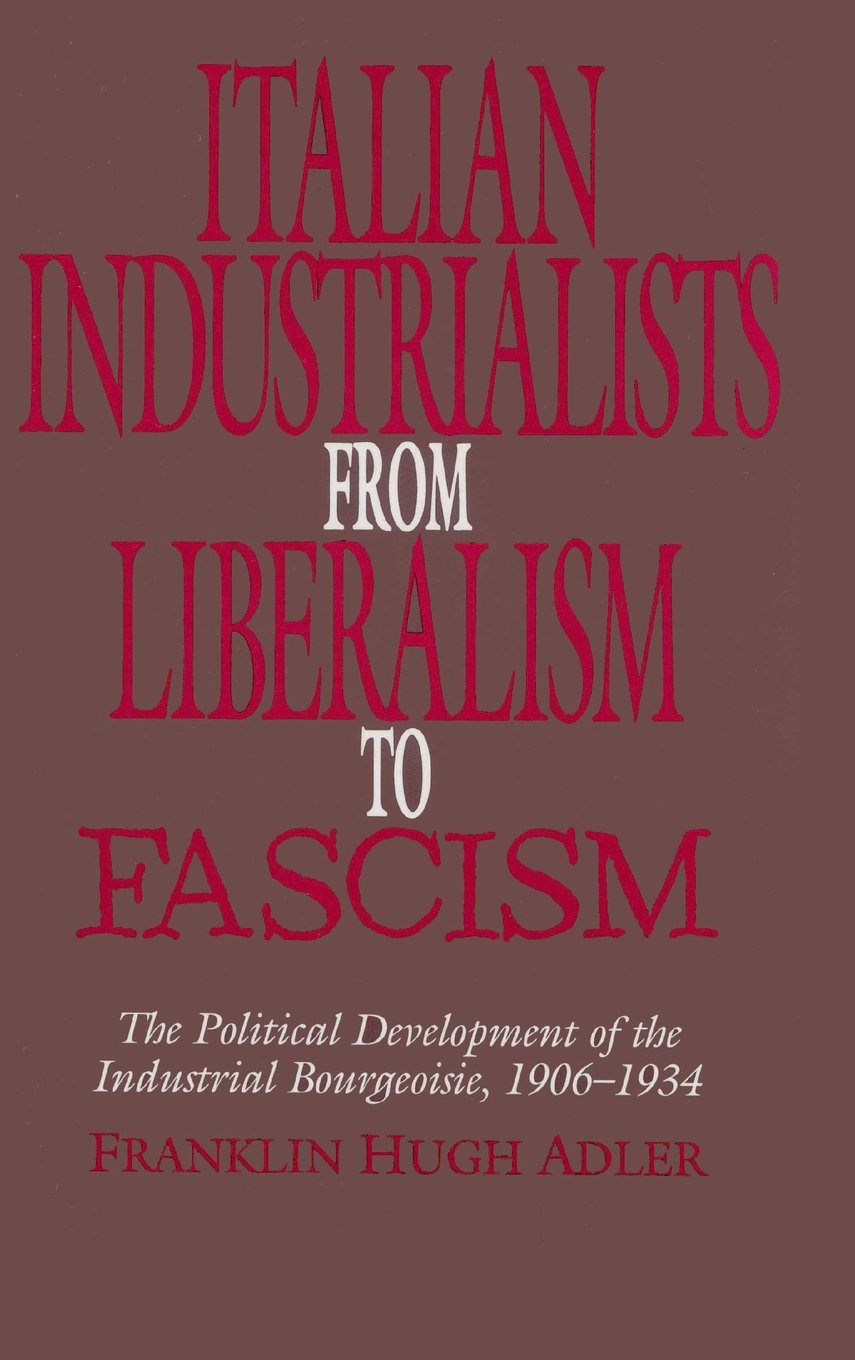
Italian Industrialists from Liberalism to Fascism: The Political Development of the Industrial Bourgeoisie, 1906-1934
$98.48
by Franklin Hugh Adler



In tracing the development of industrial associations in Italy from 1906 to 1934, this study challenges traditional interpretations of the rise of fascism. Unlike other studies of industrialists and fascism that begin with the post-World War I crisis, Professor Adler reconstitutes the prior relations between industrialists and Italian liberalism, and then situates industrialists within the liberal crisis and the transition to fascism. Adler's study is theoretically informed by current interests in assessing interpretations of fascism, relating corporatism to crises in liberalism, and applying hermeneutics to historical analysis. "Adler's monumental study makes several unique and original contributions to our understanding of the role of Italy's industrial associations in the coming to power of fascism in that country....[his] lucid, richly detailed, and compelling account will stand as the benchmark study of this topic for years to come; it also makes a major contribution to the general field of comparative political development." Choice "The monograph furnishes a deep picture of the Italian business class and its institutions. It is an unusual history useful for general readers interested in one of modern Italy's most crucial periods, as well as a theoretical and methodological work of value to scholars and graduate students trying to puzzle out the 'new political history.'" Choice "Adler's rich historical account...succeeds in stripping the debate over the relation between industrialists and fascism of many of the facile assumptions that have often clouded the issue." Dwayne Woods, Telos "...there is quite a wealth of thought-provoking material in this fascinating and very well-written book." Brian A'Hearn, The Journal of Economic History This book examines industrial associations in Italy from 1906 to 1934 as they relate to the crisis in liberalism and the rise of fascism. In tracing the development of industrial associations in Italy from 1906 to 1934, this study challenges traditional interpretations of the rise of Fascism. Unlike other studies on industrialists and Fascism, which begin with the post-World War I crisis of liberalism, Professor Adler reconstitutes the prior relations between industrialists and Italian liberalism and then situates industrialists within the crisis and the subsequent transition to Fascism. Applying a hermeneutic approach to public and private texts produced by industrial associations, Adler uncovers the industrialists' self-constitution as a class, especially that subjective dimension of their development which accounts for collective consciousness, a sense of agency, and the will to act politically. Particular attention is paid to the ideological dimension of this development; the formative self-understandings, performative practices, and durable dispositions of this class; as well as their strategic, instrumental, and self-interested interventions in social and political life. Used Book in Good Condition