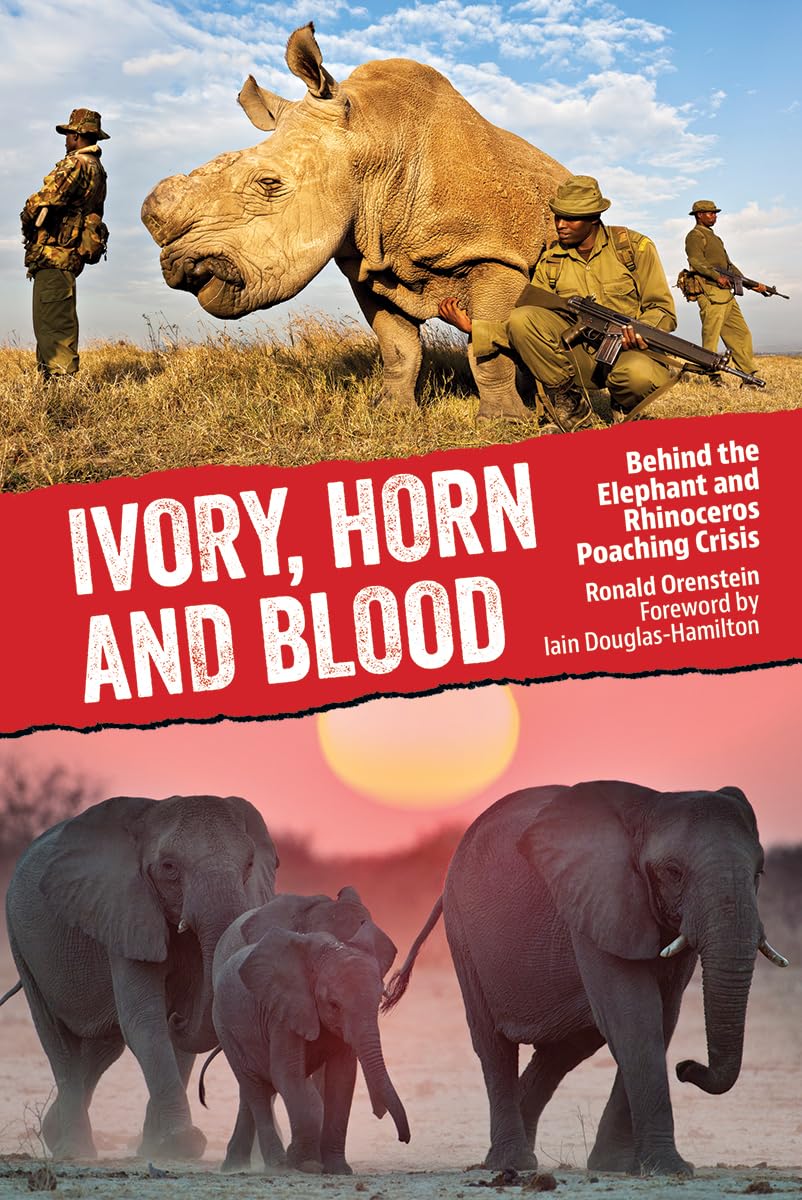
Ivory, Horn and Blood: Behind the Elephant and Rhinoceros Poaching Crisis
$29.00
by Ronald Orenstein



Meticulous research, chilling facts.... an important and much needed book. -- Dr. Jane Goodall, DBE, Founder, The Jane Goodall Institute If it is understanding you seek, turn these pages. -- Virginia McKenna, OBE, Founder, The Born Free Foundation If you care about elephants and rhinos, and the poaching onslaught that threatens their extinction in the wild, this is the book for you. -- Ian Redmond, OBE, Ambassador, UN Great Apes Survival Program As recently as ten years ago, out of every ten African elephants that died, four fell at the hands of poachers. The figure today is eight. Over sixty percent of Africa's Forest Elephants have been killed by poachers since the turn of the century. Rhinoceroses are being slaughtered throughout their ranges. The Vietnamese One-horned Rhinoceros and the Western Black rhino have become extinct in the last decade, and the Northern White Rhinoceros, the largest of them all, barely survives in captivity. This alarming book tells a crime story that takes place thousands of miles away, in countries that few of us may visit. But like the trade in illegal drugs, the traffic in elephant ivory and rhinoceros horn has far-reaching implications not only for these endangered animals, but also for the human victims of a world-wide surge in organized crime, corruption and violence. Since the worldwide ban on commercial ivory trade was passed in 1989, after a decade that saw half of Africa's elephants slaughtered by poachers, Ronald Orenstein has been at the heart of the fight. Today a new ivory crisis has arisen, fuelled by internal wars in Africa and a growing market in the Far East. Seizures of smuggled ivory have shot up in the past few years. Bands of militia have crossed from one side of Africa to the other, slaughtering elephants with automatic weapons. A market surge in Vietnam and elsewhere has led to a growing criminal onslaught against the world's rhinoceroses. The situation, for both elephants and rhinos, is dire. Silver Award for Journalism/Investigative Reporting, 2014 Nautilus Book Awards Honorable Mention for General Non-Fiction, 2014 Green Book Festival It is a depressing fact that 8 out of every 10 elephants that die have been killed for their ivory. The situation for rhinos is even worse, with rising prices for rhinoceros horn and the escalation of killing in what had been secure and protected habitats. All of this poaching has been going on, and even increasing, despite the highest protection offered by international treaty (the Convention on International Trade in Endangered Species of Wild Flora and Fauna, or CITES) and the international ban on the ivory trade. What went wrong? Orenstein, a zoologist, lawyer, and author (Turtles, Tortoises and Terrapins, 2012), has worked for years on elephant and rhinoceros conservation issues at CITES meetings, and here he presents a concise and very readable history of the attempts to protect rhinos and elephants, along with the economic and criminal issues that drive the illegal trade in ivory and horn. Describing wildlife crime at this international level as threatening not only to the environment but also the overall rule of law, Orenstein’s impassioned yet precise and well-documented text is a call to action. --Nancy Bent Reduced over millennia from vast herds across Eurasia and Africa to tiny remnant populations in Africa and Asia, elephants and rhinoceroses are vulnerable to human predation in a way smaller, more numerous animals can never be. Now, politics, war and economics have converged to create an ecological crisis of epic proportions, one exacerbated by underfunded law enforcement and a vast network of poachers and traffickers. Conservationist Orenstein provides a short but informative guide to this latest phase of the crisis. The work has three sections: a historical context, both ancient and recent, and explanation of what efforts have been made to preserve the remaining populations; a discussion of what went wrong--an unfortunate confluence of misapprehension, human greed and political malfeasance; and what might be done to mitigate the situation. Orenstein rejects a simplistic monochromatic moral worldview, providing a nuanced perspective of the issues involved. Although the situation is serious and some species have already been driven to extinction in recent years, the author does not give into despair. He believes that some of these magnificent animals may yet be saved and that the means to do this are at hand. ― Publishers Weekly Published On: 2013-09-30 Ivory, Horn and Blood thoroughly examines both the historical and the current situation facing elephants and rhinos. The book is compact, yet answers the questions everyone is asking about trade in elephant ivory, rhinoceros horn--and the Convention on International Trade in Endangered Species (CITES). (It) goes far beyond most treatments of ivory and rhino horn trade, thanks to Dr. Orenstein's extensive knowledge.... .... For t