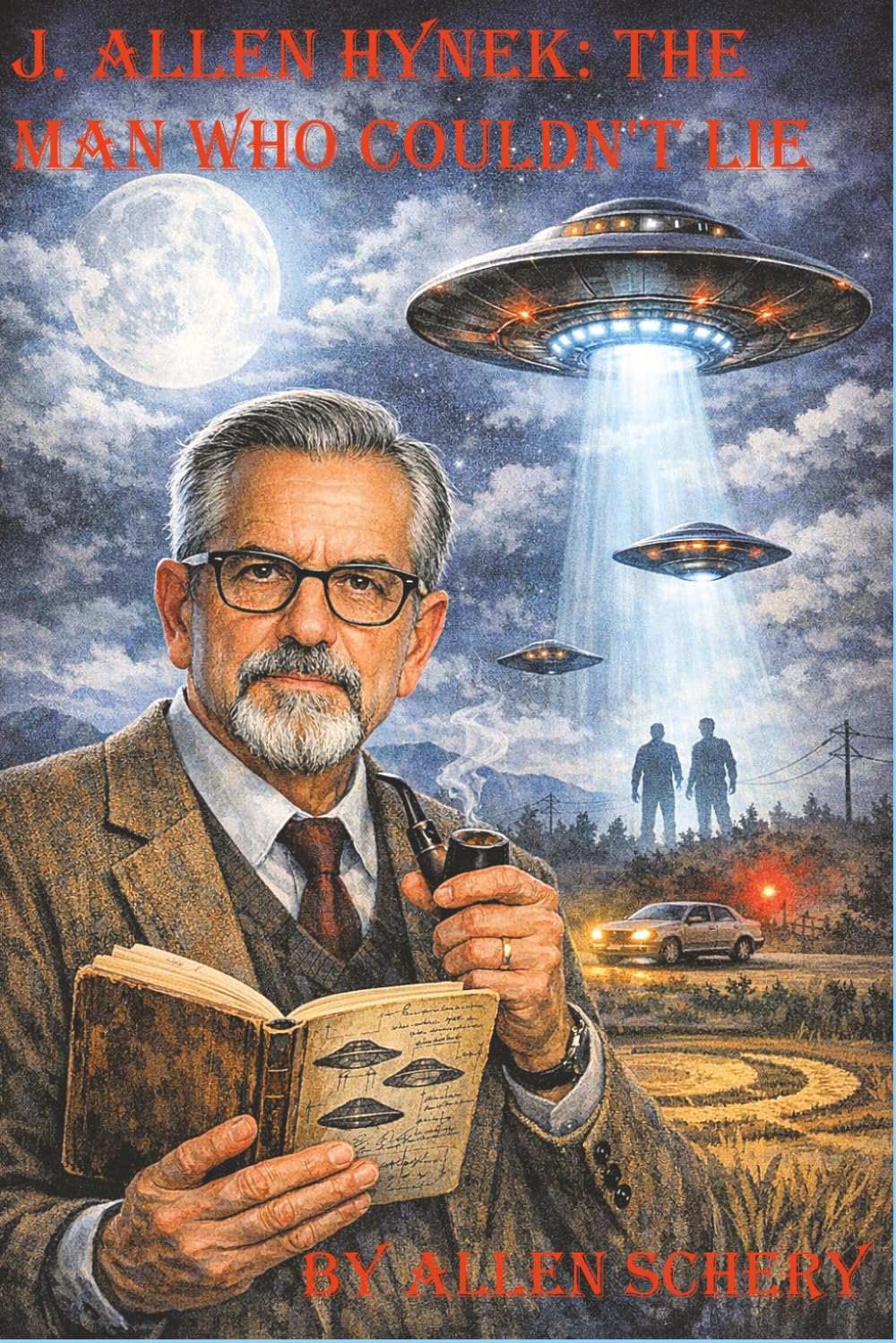



J. Allen Hynek: The Man Who Couldn’t Lie is the definitive scholarly biography of the astronomer whose reluctant involvement with the U.S. Air Force reshaped the scientific and cultural landscape of the twentieth century. Written with historical precision and philosophical depth, the book traces Hynek’s evolution from a meticulous photometrist trained in the empirical traditions of the University of Chicago to the most influential scientific voice in the study of unidentified aerial phenomena. Rather than portraying Hynek as a convert to belief, the biography presents him as a scientist whose commitment to methodological integrity forced him to confront evidence that resisted conventional classification. The narrative opens with the 1966 Michigan “swamp gas” incident, a moment that crystallized the tension between Hynek’s scientific conscience and the institutional demands of Project Blue Book. As the manuscript records, “He gives them marsh gas,” a phrase that would follow him for decades and symbolize the cost of offering an explanation he did not believe. This event becomes the structural hinge of the biography, illuminating the conflict between bureaucratic necessity and empirical honesty. Hynek’s discomfort in that Detroit press room marks the beginning of a transformation that would redefine his career and reputation. The book then reconstructs Hynek’s early life in Chicago’s Czech immigrant community, his rigorous academic training, and his rise as a respected astrophysicist specializing in stellar photometry. His wartime work on the proximity fuze demonstrates his ability to integrate theoretical precision with applied problem‑solving under national urgency. These chapters situate Hynek within the broader history of American science, emphasizing the methodological discipline that shaped his worldview and the intellectual habits that made him both valuable to the Air Force and increasingly uneasy within it. Hynek’s eighteen years with Project Blue Book are presented as a crucible in which his scientific values were repeatedly tested. Through detailed case analyses, the biography shows how Hynek encountered credible witnesses, unresolved data, and institutional resistance to ambiguity. Over time, he recognized that many cases could not be dismissed without violating the principles of evidence‑based inquiry he had spent his life defending. As the text notes, he eventually realized “he has not been doing that” —not following the evidence where it led. This admission marks the turning point of his intellectual life. The book concludes with Hynek’s break from the Air Force, his founding of the Center for UFO Studies, and his articulation of a disciplined, hypothesis‑neutral framework for studying anomalous phenomena. J. Allen Hynek: The Man Who Couldn’t Lie restores Hynek to history as a foundational thinker whose insistence on scientific integrity reshaped the discourse surrounding the unknown and established a model for inquiry grounded in courage, precision, and intellectual honesty.