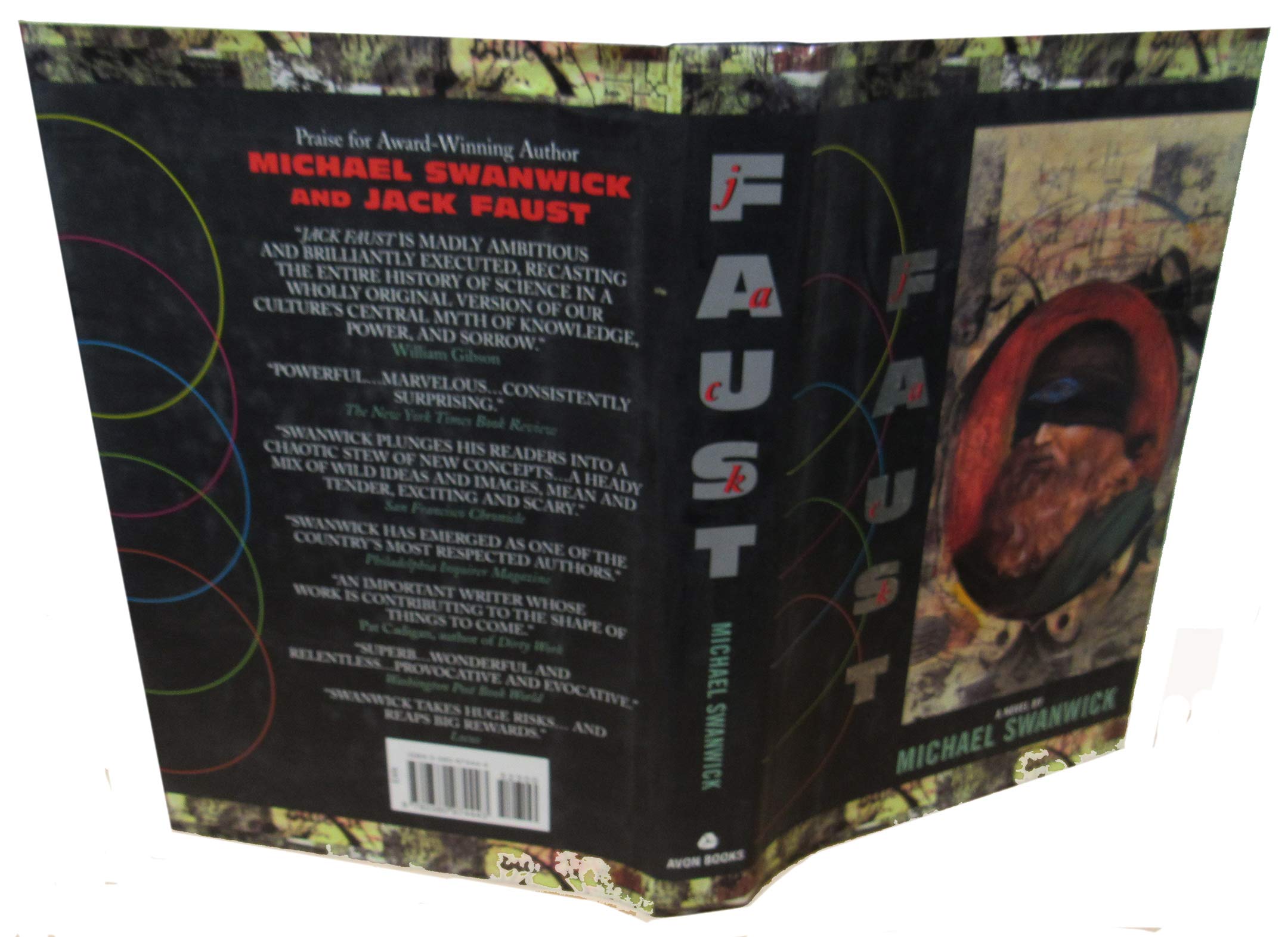



Despairing at his powerlessness over ignorance, Dr. Faust is promised absolute knowledge by Mephistopheles, and as Faust begins to mold the world toward the New Age of Mechanization, his love for a woman threatens all of his plans. 30,000 first printing. Michael Swanwick ( Stations of the Tide and The Iron Dragon's Daughter ) has long been too innovative for his own good, and Jack Faust continues that tradition. This story has elements of science fiction, fantasy, horror, comedy, literature, and probably a few other genres, which means it's likely too confusing to get the attention it deserves. But don't let that stop you from reading this wonderful take-off on the famous story of Dr. Faust, who in this tale conjures up the Devil after a fit of book-burning. The Devil, it seems, can offer Faust the knowledge he seeks in the form of hard science (flight, electricity, etc.). But Faust is blind to the fact that this gift from Mephistopheles will lead not only to his destruction but that of humanity as well. Which, of course, is just what the Devil wants. In this reworking of the Faust legend by a Nebula Award-winning author (for Stations of the Tide, LJ 2/15/91), the medieval and the modern intertwine, but the classic theme remains intact: Will complete knowledge bring about ennoblement or destruction? Swanwick's Faust is still set in the Old World Europe of Goethe and Marlowe, but this Faust is more interested in marketing his new inventions?such as rockets?than in alchemy. We follow Faust in his frustrated intellectual quest, especially as he burns his library, which, instead of revealing to him the knowledge he has so desperately sought, has rewarded him only with uncertainty. At war with God for concealing life's meaning from humankind, he turns to the only other source of help for him: Mephistopheles. Swanwick's literary power lies in his ability to blend seamlessly elements of fantasy with the most mundane concepts. His characterizations are carefully controlled. Readers will benefit by delving into the original Faust before tackling this grim tale.?Margaret A. Smith, Grace A. Dow Memorial Lib., Midland, Mich. Copyright 1997 Reed Business Information, Inc. What if Faust in the 16th century had been offered the knowledge available in the 20th? Well, Swanwick (The Iron Dragon's Daughter, 1994, etc.) strives to outdo a couple of literary giants (Marlowe, Goethe) with this recasting of the familiar story. At the start of the 16th century, scholar Johannes Faust of Wittenberg burns his library in despair at the stupid lies the books contain. But then he strikes a bargain with Mephistopheles, a devil from another, higher-energy universe: In exchange for knowledge--which, Faust maintains, humanity will use to ennoble and perfect itself- -Faust agrees that he will listen only to whatever Mephistopheles has to say (the devil's intention, plainly stated, is for humanity to exterminate itself). Faust's initial attempts to disseminate his new knowledge are rejected. Then, in Nuremberg, he determines to win the heart of the lovely and intelligent Margarete Reinhardt, while his moneymaking inventions are enthusiastically taken up by Margarete's industrialist father. Under Faust's guidance, an industrial revolution explodes across Germany--but, rejected again, Faust must flee to London, leaving Margarete to manage the business. Among other developments, the ironclad Spanish Armada sets sail, pitting German cannons against English rockets. Faust continues to drive science and technology forward, manipulating and betraying poor Margarete as mercilessly as he does everybody else. A vivid and energetic reworking, set forth with all Swanwick's considerable skill. And yet the reader is constrained to ask, so what? -- Copyright ©1997, Kirkus Associates, LP. All rights reserved. Micahel Swanwick is the author of four previous critically-acclaimed novels. He lives in Philadelphia, Pennsylvania, with his wife and son.