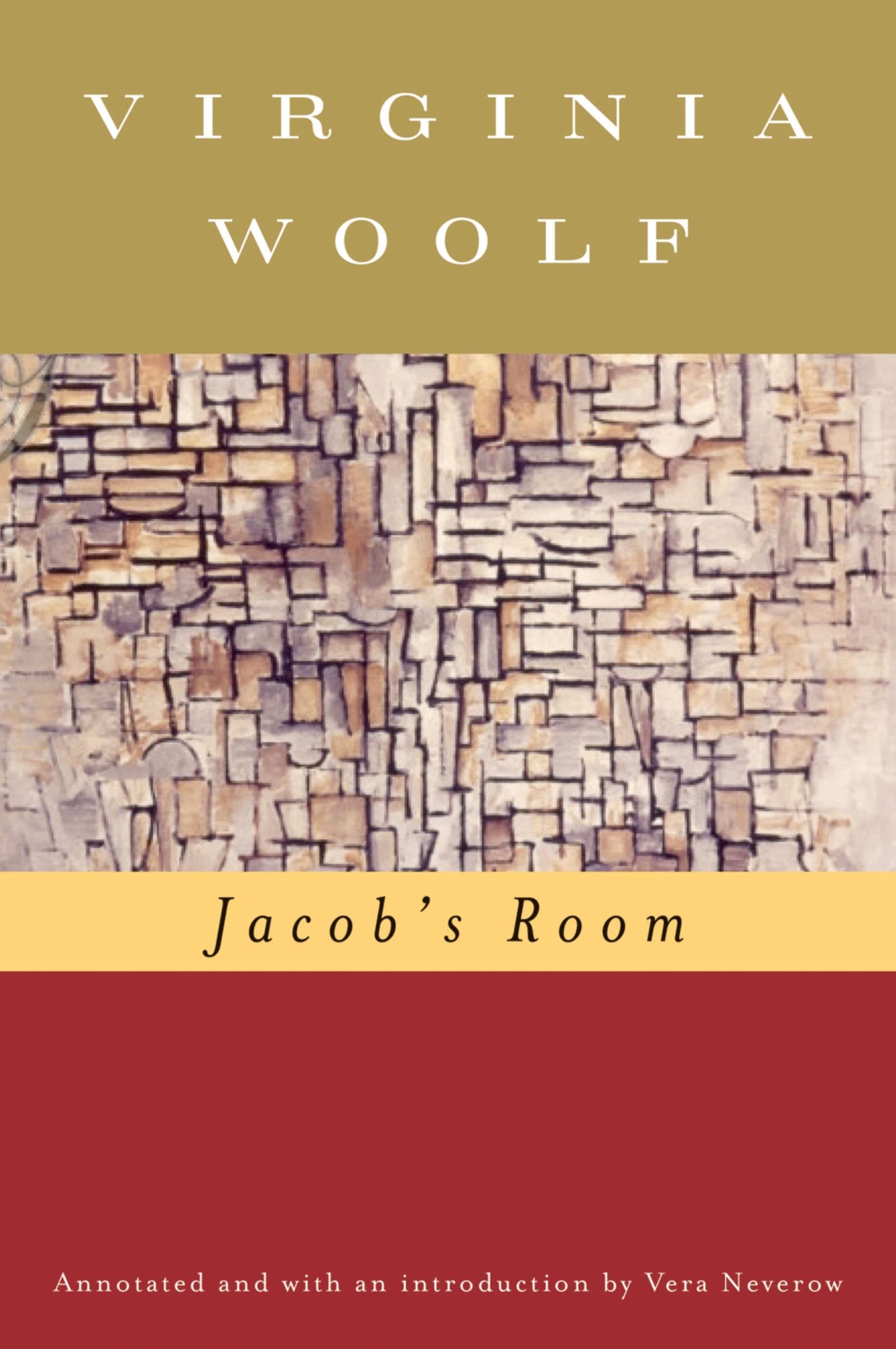
Jacob's Room (annotated): Virginia Woolf's First Modernist Coming-of-Age War Drama – 20th Century Classic (The Virginia Woolf Library)
$15.99
by Virginia Woolf



Woolf's first distinctly modernist novel follows an aloof yet beloved young man from his childhood through his student days to his too-early death during World War I. Annotated and with an introduction by Vara Neverow ? Jacob’s Room . . . comes as a tremendous surprise. The impossible has occurred . . . A new type of fiction has swum into view.” --E. M. Forster This landmark novel tells the story of the all-too-brief life of Jacob Flanders, from his childhood in Scarborough through his student years at Cambridge and his bachelor days in London to his death while still a young man during World War I. Though he is an object of love and desire for many of the characters in the novel, Jacob remains curiously unknowable during his short life, as remote and mysterious as the classical landscapes and Greek ruins to which he is drawn. His room, the focus of so much longing and wondering over the course of the novel, is opened to those who care about him only after his death. This haunting elegy marks Woolf’s assumption of her full powers as a Modernist novelist. Virginia Woolf (1882-1941), one of the major literary figures of the twentieth century, transformed the art of the novel. The author of numerous novels, collections of letters, journals, and short stories, she was an admired literary critic and a master of the essay form. Mark Hussey , general editor of Harcourt's annotated Woolf series, is professor of English at Pace University in New York City and editor of the Woolf Studies Annual. Vara Neverow is professor of English and women's studies at Southern Connecticut State University. She is the managing editor of Virginia Woolf Miscellany and a past president of the International Virginia Woolf Society. VIRGINIA WOOLF (1882–1941) was one of the major literary figures of the twentieth century. An admired literary critic, she authored many essays, letters, journals, and short stories in addition to her groundbreaking novels, including Mrs. Dalloway, To The Lighthouse, and Orlando. ONE "SO OF COURSE," wrote Betty Flanders, pressing her heels rather deeper in the sand, "there was nothing for it but to leave." Slowly welling from the point of her gold nib, pale blue ink dissolved the full stop; for there her pen stuck; her eyes fixed, and tears slowly filled them. The entire bay quivered; the lighthouse wobbled; and she had the illusion that the mast of Mr. Connor's little yacht was bending like a wax candle in the sun. She winked quickly. Accidents were awful things. She winked again. The mast was straight; the waves were regular; the lighthouse was upright; but the blot had spread. ". . . nothing for it but to leave," she read. "Well, if Jacob doesn't want to play" (the shadow of Archer, her eldest son, fell across the notepaper and looked blue on the sand, and she felt chilly'it was the third of September already), "if Jacob doesn't want to play"'what a horrid blot! It must be getting late. "Where is that tiresome little boy?" she said. "I don't see him. Run and find him. Tell him to come at once." ". . . but mercifully," she scribbled, ignoring the full stop, "everything seems satisfactorily arranged, packed though we are like herrings in a barrel, and forced to stand the perambulator which the landlady quite naturally won't allow. . . ." Such were Betty Flanders's letters to Captain Barfoot'many-paged, tear-stained. Scarborough is seven hundred miles from Cornwall: Captain Barfoot is in Scarborough: Seabrook is dead. Tears made all the dahlias in her garden undulate in red waves and flashed the glass house in her eyes, and spangled the kitchen with bright knives, and made Mrs. Jarvis, the rector's wife, think at church, while the hymn-tune played and Mrs. Flanders bent low over her little boys' heads, that marriage is a fortress and widows stray solitary in the open fields, picking up stones, gleaning a few golden straws, lonely, unprotected, poor creatures. Mrs. Flanders had been a widow for these two years. "JA'COB! JA'COB!" Archer shouted. "SCARBOROUGH," MRS. FLANDERS wrote on the envelope, and dashed a bold line beneath; it was her native town; the hub of the universe. But a stamp? She ferreted in her bag; then held it up mouth downwards; then fumbled in her lap, all so vigorously that Charles Steele in the Panama hat suspended his paint-brush. Like the antennae of some irritable insect it positively trembled. Here was that woman moving'actually going to get up'confound her! He struck the canvas a hasty violet-black dab. For the landscape needed it. It was too pale'greys flowing into lavenders, and one star or a white gull suspended just so'too pale as usual. The critics would say it was too pale, for he was an unknown man exhibiting obscurely, a favourite with his landladies' children, wearing a cross on his watch chain, and much gratified if his landladies liked his pictures'which they often did. "JA'COB! JA'COB!" Archer shouted. EXASPERATED BY the noise, ye