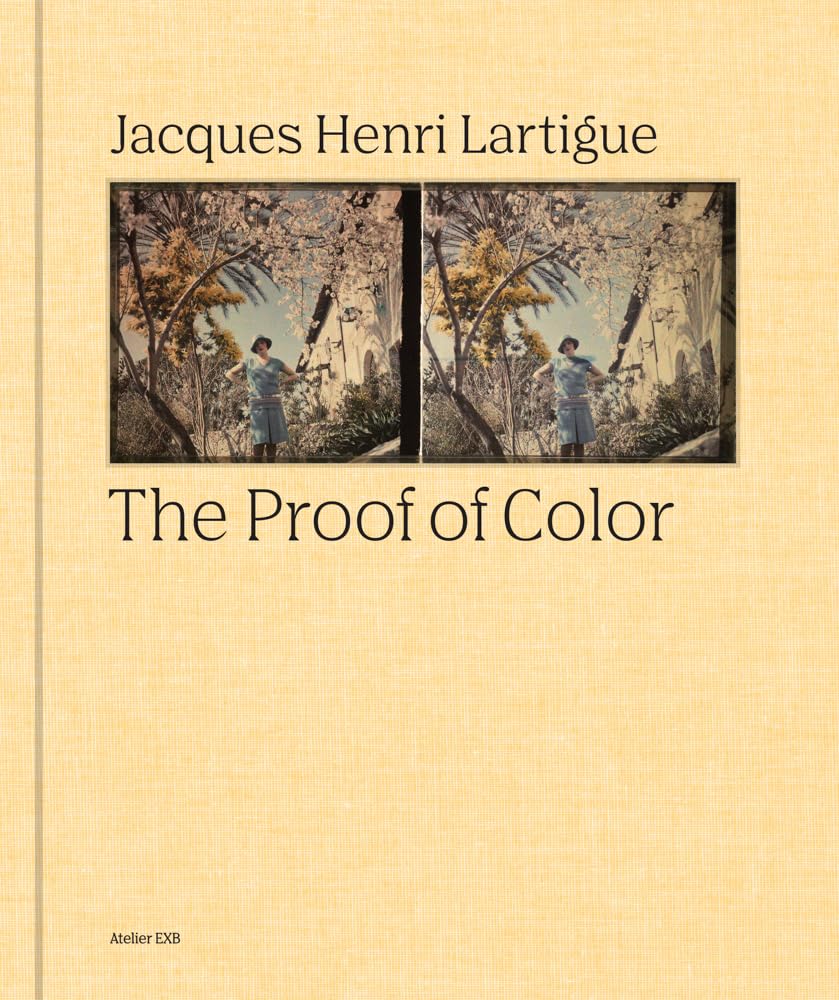



Breathtaking autochrome images capture the beauty and wonder that nurtured Lartigue's love of photography An indisputably important figure in photography, Jacques-Henri Lartigue was fascinated by new inventions such as the automobile and telecommunications, and concurrently the new possibilities that the photographic medium offered. In 1912 he began taking photographs in a radically different way by using a surprising anachronistic technique: stereoscopic autochrome on glass plates. This process relied on meticulous technical preparation and a long, precise exposure time for his staged compositions. The end result is not a print but a double stereoscopic view that he projected onto a screen. Lartigue filled each frame with bright colors through a mix of sunny landscapes, dazzling flowers and playful scenes of his well-to-do family and friends at leisure. During the short time he produced these images--from 1912 to 1927--Lartigue made an important series of double-view autochromes, from which the 90 remaining pieces are presented here for the first time in their entirety and at full scale. In order to understand the effect this series has had in the history of color photography, the images in The Proof of Color are accompanied by a contextual commentary. Born to a prosperous family, Jacques-Henri Lartigue (1894-1986) was unknown as a photographer until 1963 when his work was shown for the first time at the Museum of Modern Art, New York. That same year, a spread published in Life magazine in an issue on John F. Kennedy's death also introduced Lartigue's work to a wider public. In contrast to his better-known snapshots of automobile races and sporting events, Lartigue's autochromes are studies in patience.--Angelina Torre "The Wall Street Journal" Jacques Henri Lartigue's 'L'épreuve de la couleur' sheds light on a little-known part of the famous photographer's work: his fascination with stereoscopic Autochrome - one of the first color photography processes just introduced.-- "The Eye of Photography" Jacques Henri Lartigue est resté inconnu en tant que photographe jusqu'en 1963, date à laquelle, à 69 ans, son travail a été présenté pour la première fois dans le cadre d'une exposition individuelle au Museum of Modern Art de New York. La même année, une série de photos publiées dans Life pour un numéro consacré à la mort de John Fitzgerald Kennedy a également permis de faire connaître son travail à un large public. À sa grande surprise, il devient rapidement l'un des photographes les plus célèbres du XXe siècle. Issu d'une famille prospère, Lartigue et son frère sont fascinés par l'automobile, l'aviation et les sports en vogue, que Jacques documente avec son appareil photo. En grandissant, il continue à fréquenter les événements sportifs, à participer et à enregistrer des loisirs d'élite tels que le ski, le patinage, le tennis ou le golf. Mais le jeune Jacques, conscient de l'évanescence de la vie, craint que les photographies ne suffisent pas à résister au temps qui passe. Comment des images prises en quelques secondes pourraient-elles transmettre et conserver toute la beauté et l'émerveillement qui l'entourent ? Parallèlement à la photographie, il commence donc à tenir un journal, qu'il continuera à tenir tout au long de sa vie. Refusant de renoncer à sa liberté en acceptant un emploi fixe, il vit chichement de sa peinture pendant les années 1930 et 1940. Au début des années 1950, tout en poursuivant sa carrière de peintre, il commence à être reconnu comme photographe. En 1962, avec Florette, sa troisième épouse, il se rend à New York où ils rencontrent Charles Rado, fondateur de l'agence photographique Rapho. Après avoir vu les photographies de Lartigue, Rado le présente à John Szarkowski, le nouveau directeur du département de photographie du MoMA. Szarkowski est tellement impressionné qu'il organise l'année suivante la toute première exposition du travail de Lartigue. Une rétrospective des photographies de Lartigue a été organisée au musée des Arts décoratifs de Paris en 1975, l'année où le président français Valéry Giscard d'Estaing lui a demandé de réaliser son portrait officiel.Il a continué à photographier, à peindre et à écrire jusqu'à sa mort à Nice le 12 septembre 1986, à l'âge de 92 ans, laissant derrière lui plus de 100 000 photographies, 7 000 pages de journal et 1 500 peintures.