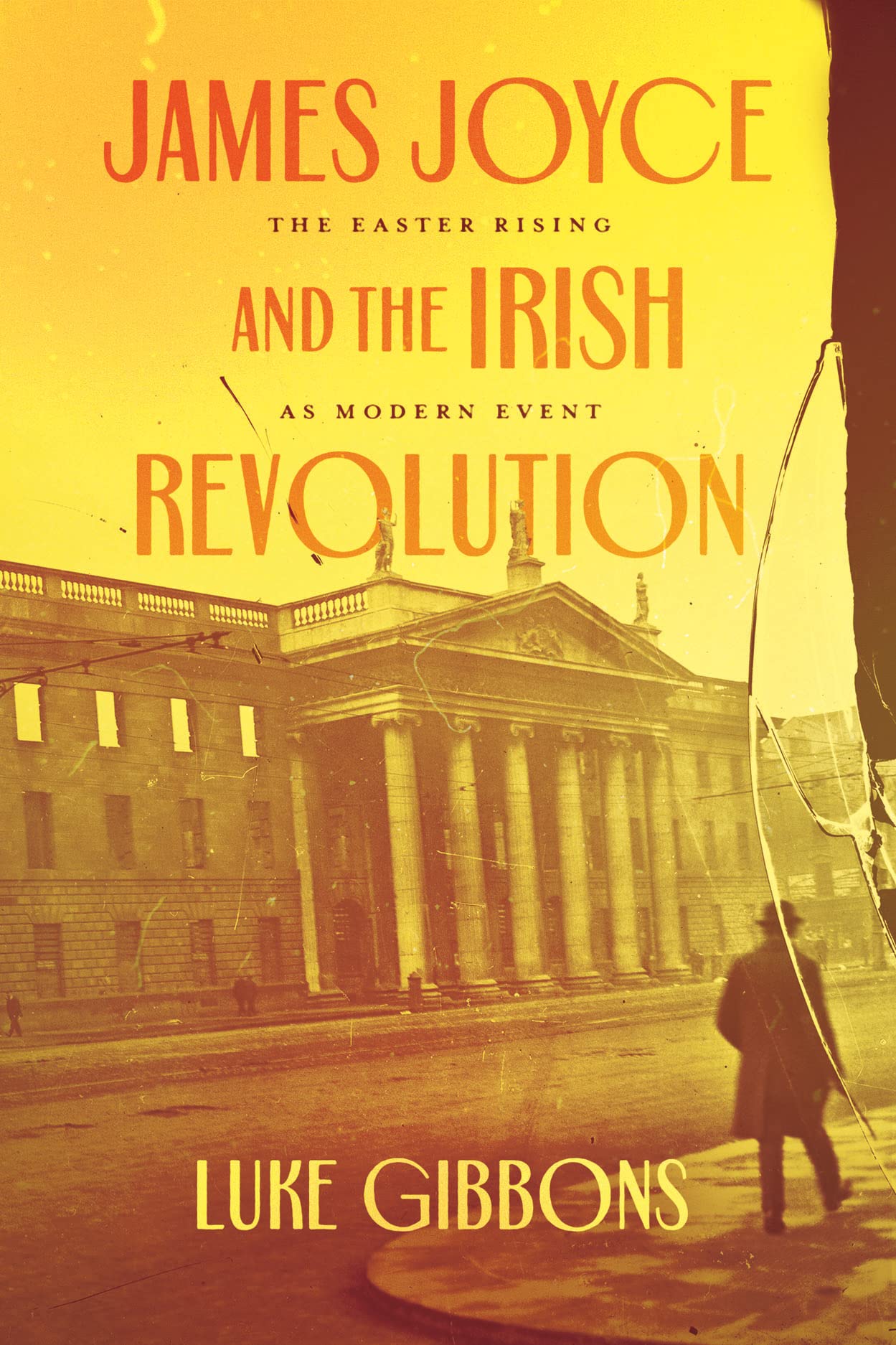
James Joyce and the Irish Revolution: The Easter Rising as Modern Event
$35.00
by Luke Gibbons



A provocative history of Ulysses and the Easter Rising as harbingers of decolonization. When revolutionaries seized Dublin during the 1916 Easter Rising, they looked back to unrequited pasts to point the way toward radical futures—transforming the Celtic Twilight into the electric light of modern Dublin in James Joyce’s Ulysses . For Luke Gibbons, the short-lived rebellion converted the Irish renaissance into the beginning of a global decolonial movement. James Joyce and the Irish Revolution maps connections between modernists and radicals, tracing not only Joyce’s projection of Ireland onto the world stage, but also how revolutionary leaders like Ernie O’Malley turned to Ulysses to make sense of their shattered worlds. Coinciding with the centenary of both Ulysses and Irish independence, this book challenges received narratives about the rebellion and the novel that left Ireland changed, changed utterly. “An important development in the understanding of the Irish relationship to Joyce’s work – and of his relationship to his native country. . . . For this superb, transformative undertaking the author deserves our gratitude.” ― Dublin Review of Books “The Easter Rising, far from being consigned to nostalgia, is seen as a catalyst for global processes of decolonization . . . [Gibbons’s] tracing of connections and influences—real, virtual, and suggestive—between revolution in the street and in the word results in richly layered and sometimes erudite chapters that repay close reading . . [and] open up many fascinating paths.” ― Irish Times “The interest key figures in the Rising and the subsequent War of Independence (1919–21) showed in Joyce’s work and its revolutionary potential is . . . compelling. For example, Gibbons shines a light on the Irish revolutionary leader Ernie O’Malley, who devoted considerable attention to Joyce . . . [Gibbons’s] case is unassailable. Political radicalism and radical art call one another to arms.” ― Times Literary Supplement “[A] fascinating and well-researched study . . . James Joyce and The Irish Revolution should find an eager readership among students and scholars of Joyce criticism, literary modernism, Irish history and Irish studies.” ― Irish Literary Supplement "[Gibbons] is out to demolish the image of Joyce as a non-political aesthete seeing his literary experiments as fueled by much the same energies that unseated British rule in its oldest colony. . . . James Joyce and the Irish Revolution is an exceptionally erudite work . . . a courageous intervention as well as a finely perceptive one.” -- Terry Eagleton ― New Left Review "One of Ireland’s most profound if idiosyncratic cultural critics, Luke Gibbons, seeks to bring these two revolutions into the same framework in his important new work, J ames Joyce and the Irish Revolution: The Easter Rising as Modern Event . Through a series of engrossing vignettes drawn from a wide array of contemporary sources, he positions Joyce’s 'revolution of the word' under the light emitted by the 1916 Easter Rising and sets out to 'reclaim what was radical in the Irish revolution for a modernist project akin to that of Joyce’s.'" ― Jacobin “This is a study deserving of an audience beyond the confines of Irish literary criticism. Underscoring the electrifying analysis is the hard evidence of patient scholarship and profound insight that makes this book one of the most original interventions to appear during the Decade of Centenaries.” ― History Ireland “Gibbons examines how the aesthetic innovations in James Joyce’s Ulysses reflect the political turmoil of Ireland’s 1916 Easter Rising and subsequent War of Independence . . . with some eye-opening insights.” ― Publishers Weekly " James Joyce and the Irish Revolution accomplishes three interwoven objectives: it reshapes our understanding of the Easter Rising and its importance to global decolonisation movements; it expands our understanding of Joyce’s influence on a generation of Irish revolutionaries; and it productively argues for the alliance of revolutionary tactics with modernist formal experimentation. . . . Erudite and expansive, Luke Gibbons’ James Joyce and the Irish Revolution is essential reading for cultural critics, historians, and Joyceans looking to understand the complex interrelationship of Joyce’s modernism and Ireland’s anticolonial struggle." ― Irish Studies Review "This book is a ground-breaking and original addition to the decade of centenaries. Luke Gibbons’ familiarity with the ‘underworld’ figures of the anti-Treatyites and supporters, who understood Ulysses because of their lived experience, extends our understanding of the more commonly reported Free Staters’ refusal of Ulysses , mainly on moral censorship grounds. Replete with a superb index and 56 pages of exemplary footnotes, a study in themselves, it is a generous book. It is a work that manages to yoke modernist literary expression with a broad array of transna