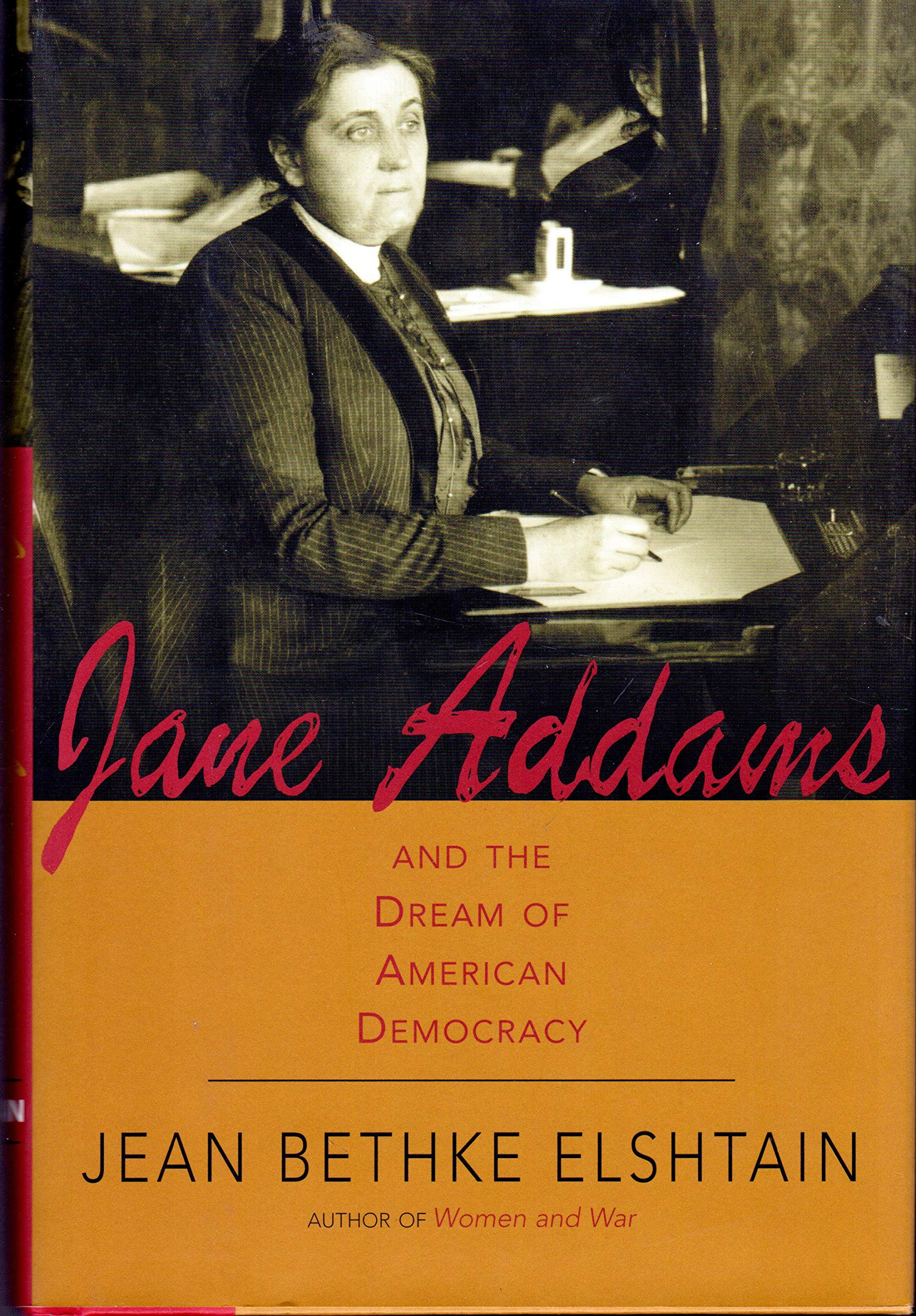



The founder of the famed Chicago institution Hull House and first American woman to win the Nobel Peace Prize has for too long been misunderstood as a mere "do-gooder," argues Jean Bethke Elshtain in this eagerly anticipated new interpretation of the life and work of Jane Addams. Like her biographer, Addams (1860-1935) was a quintessential "public intellectual." Under her hand, Hull House became a cultural and intellectual center, a place where beauty was served, where University of Chicago professors lectured and debate and discussion filled the auditorium.Elshtain examines Addams's life chronologically and thematically, exploring Addams's embrace of "social feminism" and her challenge to the usual cleavage between "conservative" and "liberal"-themes Elshtain brilliantly explores in her own writings. Jane Addams and the Dream of American Democracy is a rich and revealing portrait of one of the most extraordinary figures in American history. Today Jane Addams is one of those people whose name "rings a bell," writes biographer Jean Bethke Elshtain. At the time of her death in 1935, however, she was more than the answer to a trivia question--she was "America's best-known and most widely hailed female public figure." Addams had recently won the Nobel Peace Prize and was famous for her social work as the founder of Hull-House in Chicago. Elshtain's innovation is to treat Addams like the protofeminist intellectual she was, a thinker whose "vision of generosity and hopefulness ... made the American democracy more decent and more welcoming today than it would otherwise be." Hull-House, for instance, was not merely a poorhouse for immigrants struggling to become citizens; it was a major cultural center that hosted speeches and debates. Because of the many books Addams wrote (including the classic Twenty Years at Hull-House ) and her political activism, "her name is attached to every major social reform between 1890 and 1925," writes Elshtain. Addams has deserved a book of this caliber for quite some time; readers drawn to her are fortunate that an intellectual figure of Elshtain's stature took up the project. As the author says of her subject near the end of Jane Addams and the Dream of American Democracy : "Such a tremendous force." --John Miller Jane Addams, the founder of Hull House and winner of the Nobel Peace Prize for her work in the international peace movement, inspired both great adoration and great censure in her day. Elshtain (social and political ethics, Univ. of Chicago; Women and War) here seeks to reassess the impact of this most unusual woman. She argues that Addams was a great humanitarian and a spokesperson for a new brand of American democracy that was fairer and more tolerant than what had gone before. Relying heavily on Addams's voluminous writings, Elshtain offers a fascinating chronological and thematic account of the life of one of the most innovative and significant women of the late 19th and early 20th centuries. Written in a highly readable style, her volume is likely to become the standard biography of this significant social reformer and is highly recommended for all public or university libraries. Theresa McDevitt, Indiana Univ. of Pennsylvania Lib. Copyright 2002 Cahners Business Information, Inc. Jean Bethke Elshtain is the Laura Spelman Rockefeller Professor of Social and Political Ethics at the University of Chicago. She holds seven honorary degrees and in 1996 was elected to the American Academy of Arts and Sciences. She is a contributing editor of The New Republic and the author of more than nine books, including Women and War and Democracy on Trial , both published by Basic Books.