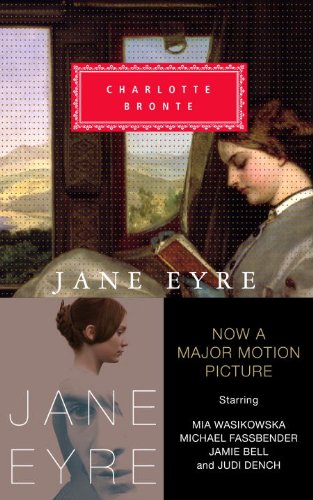



Initially published under the pseudonym Currer Bell in 1847, Charlotte Brontë's Jane Eyre erupted onto the English literary scene, immediately winning the devotion of many of the world's most renowned writers, including William Makepeace Thackeray, who declared it a work "of great genius." Widely regarded as a revolutionary novel, Brontë's masterpiece introduced the world to a radical new type of heroine, one whose defiant virtue and moral courage departed sharply from the more acquiescent and malleable female characters of the day. Passionate, dramatic, and surprisingly modern, Jane Eyre endures as one of the world's most beloved novels. This Modern Library Paperback Classics edition includes newly written explanatory notes. (Cover features a removable movie tie-in bellyband.) "At the end we are steeped through and through with the genius, the vehemence, the indignation of Charlotte Brontë." --Virginia Woolf Diane Johnson is the author of many books, including the bestselling novel Le Divorce, which was a 1997 National Book Award finalist, and Le Mariage . From the Trade Paperback edition. From the Introduction by Lucy Hughes-Hallet Jane Eyre was published in 1847. One year later, a year during which Europe had been convulsed by revolution, a contributor to the Quarterly Review declared 'We do not hesitate to say that the tone of the mind and thought which has overthrown authority and violated every code human and divine abroad, and fostered Chartism and rebellion at home, is the same which has also written Jane Eyre .' Conservatives hostile to innovation — political or artistic — are often surer judges of innovation's potency than its supporters. (Anti-feminists who prophesied that the enfranchisement of women would irreparably disrupt the institutions of home and family have proved more prescient than the liberals who maintained that a vote was just a vote.) Jane Eyre has frequently been underestimated by those who have enjoyed it most. True, it boasts a pair of beguiling lovers whose romance is written in a prose so flexible and sensuous that to read the passages describing their courtship is to be seduced just as they are seduced by each other. True, it is a multi-faceted wish-fulfillment fantasy in which the heroine marries her true love while retaining her independence. True, it is a romantic melodrama, with saintly dying orphans, dark secrets, supernatural voices and crises marked by lightening flashes and a blood-red moon. True, in the words of Sandra Gilbert and Susan Gubar, it is 'the archetypal scenario for all those mildly thrilling romantic encounters between a scowling Byronic hero (who owns a gloomy mansion) and a trembling heroine (who can't quite figure our the mansion's floor plan)'. But it is also, as the Quarterly Review's Elizabeth Rigby divined, a revolutionary text. It questions the institutions of marriage and inheritance. It makes a laughing stock of religious cant and presume to suggest that even sincere religious conviction is morbid and barren. It proclaims the equality of a governess and a gentleman. It flouts contemporary sexual propriety. When the novel was first published Charlotte Brontë was accused of desperate radicalism on all of these grounds. Now, after a lapse of near on a century and a half, such transgressions against convention seem tame, but Jane Eyre retains its power to subvert and exhilarate for a reason which is unlikely to go out of date for a long while yet. In it, for what was arguably the first time in literary history, a female author gave full, shameless and magnificently achieved expression of the ardour, vicissitudes and ultimate gratification of a woman's desire. The desire is largely, but not solely, sexual. Jane Eyre is one of the most intensely erotic works of fiction in English. Its hero's allure was instantly recognized and he was imitated accordingly. As Caroline Norton complained in 1864, 'Ever since Jane Eyre loved Mr Rochester a race of novel-heroes have sprung up . . . Brutal and selfish in their ways, and rather repulsive in person, they are nevertheless represented as perfectly adorable and carrying all before them.' But Jane wants much more than a dominating broad-chested lover with a grim jaw, a harsh line in banter and great dark eyes. She wants independence, she wants money of her own, she wants work for her imagination and intellect, she wants a house with beloved people in it, she wants liberty and she wants power. Above all, she wants to be herself. As a child she sees her own image look out of the red-room mirror, 'a strange little figure' with 'glittering eyes of fear'. The apparition precipitates the 'fit' which is the first of the psychic rites of passage punctuating her story. Her relationship with that strange littler person remains problematic, but she will not, or cannot abandon it any more than she can free herself from the wailing child that clings to her in her dreams. At her greatest crisi