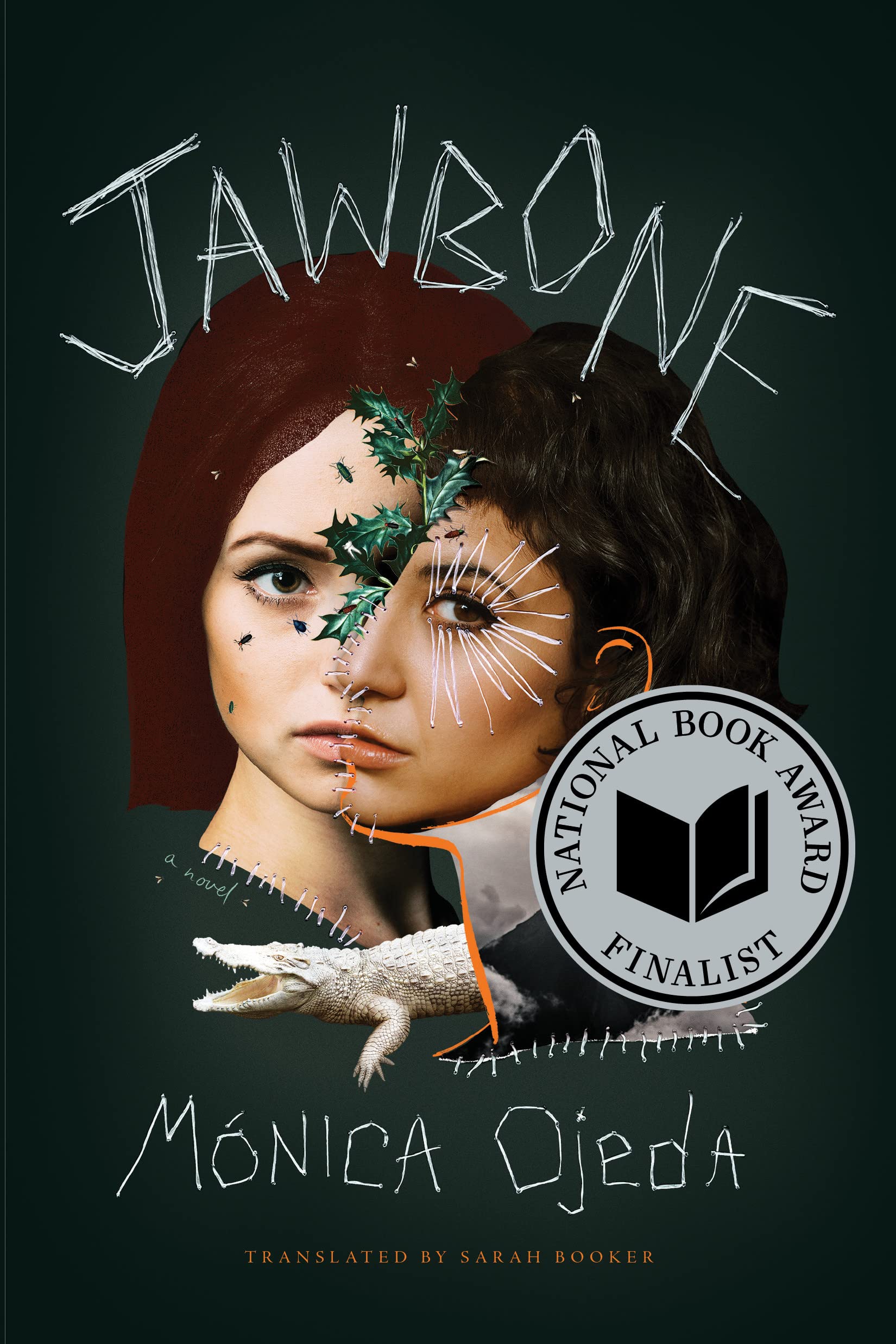



“Was desire something like being possessed by a nightmare?” Fernanda and Annelise are so close they are practically sisters: a double image, inseparable. So how does Fernanda end up bound on the floor of a deserted cabin, held hostage by one of her teachers and estranged from Annelise? When Fernanda, Annelise, and their friends from the Delta Bilingual Academy convene after school, Annelise leads them in thrilling but increasingly dangerous rituals to a rhinestoned, Dior-scented, drag-queen god of her own invention. Even more perilous is the secret Annelise and Fernanda share, rooted in a dare in which violence meets love. Meanwhile, their literature teacher Miss Clara, who is obsessed with imitating her dead mother, struggles to preserve her deteriorating sanity. Each day she edges nearer to a total break with reality. Interweaving pop culture references and horror concepts drawn from from Herman Melville, H. P. Lovecraft, and anonymous “creepypastas,” Jawbone is an ominous, multivocal novel that explores the terror inherent in the pure potentiality of adolescence and the fine line between desire and fear. Praise for Jawbone Finalist for the 2022 National Book Award for Translated Literature Finalist for the 2023 Lambda Literary Award in Lesbian Fiction Longlisted for the 2023 PEN Translation Prize A Ms. Magazine Favorite Book of 2022 A Words Without Borders Most Anticipated Book of 2022 A Latinx in Publishing Most Anticipated Book of 2022 “Expertly characterizing her protagonists while providing an engrossing, compelling story, Mónica Ojeda has hewn out her own version of contemporary gothic set in Ecuadorian culture.” —Judges’ Citation, 2022 National Book Award in Translated Literature “Strange, twisted . . . . [Ojeda's] language, like adolescence itself, is unruly and excessive, full of dramatic shifts and capable of both beauty and horror.” —Anderson Tepper, The New York Times “Ojeda [draws] comparisons to Shirley Jackson, H.P. Lovecraft, and Edgar Allen Poe.” — The A.V. Club “ Jawbone depicts the process of becoming a woman as the ultimate horror story. . . . With terrifying ease, Ojeda illustrates how womanhood is characterized by dualities: fearful and feared, desired and desiring.” —Morgan Graham, Chicago Review of Books “Rife with gothic body horror and the darkness of the jungle and within ourselves. . . . Ojeda is a strikingly singular voice, combining basic teen angst with stark madness and the power of teen girls to push back in a world that tries to make them powerless.” —Yvonne C. Garrett, The Brooklyn Rail “Like the strange bloom of a corpse flower, the novel evokes life, death, and a vortex of twisted beauty.” —Meg Nola, Foreword Reviews starred review “A wild, dirty, surreal, creepy narrative.” —Gabino Iglesias, Southwest Review “Mónica Ojeda is one of the most powerful and provocative voices in Latin American literature today.” —Rose Bialer, Asymptote “There’s very little that will be published this year, or any year, that will surpass this devastating novel.” —Ian Mond, Locus “Ojeda deals with horror and desire like few others, with a beauty so extreme that it sometimes leaves you gasping. She scares me, and she amazes me, and I think she is one of the most important writers working in Spanish today.” —Mariana Enríquez “As chilling as it is necessary, like all of Ojeda’s work.” —María Fernanda Ampuero “Mónica Ojeda has at her disposal the most enviable combination I can imagine, and she has it in spades: a lucid mind, an exacting language, and a wild heart.” —Andrés Barba Mónica Ojeda (Ecuador, 1988) is the author of the novels La desfiguración Silva (Premio Alba Narrativa, 2014), Nefando (Candaya, 2016), and Mandíbula (Candaya, 2018), as well as the poetry collections El ciclo de las piedras (Rastro de la Iguana, 2015) and Historia de la leche (Candaya, 2020). Her stories have been published in the anthology Emergencias: Doce cuentos iberoamericanos (Candaya, 2014) and the collections Caninos (Editorial Turbina, 2017) and Las voladoras (Páginas de Espuma, 2020). In 2017, she was included on the Bógota39 list of the best thirty-nine Latin American writers under forty, and in 2019, she received the Prince Claus Next Generation Award in honor of her outstanding literary achievements. Sarah Booker (North Carolina, 1989) is a doctoral candidate at the University of North Carolina at Chapel Hill with a focus on contemporary Latin American narrative and translation studies. She is a literary translator working from Spanish to English and has translated, among others, Cristina Rivera Garza’s The Iliac Crest (Feminist Press, 2017; And Other Stories, 2018) and Grieving: Dispatches from a Wounded Country (Feminist Press, 2020) and Mónica Ojeda’s Jawbone (Coffee House Press, 2021). Her translations have also been published in journals such as the Paris Review , Asymptote , Latin American Literature Today , 3:am m