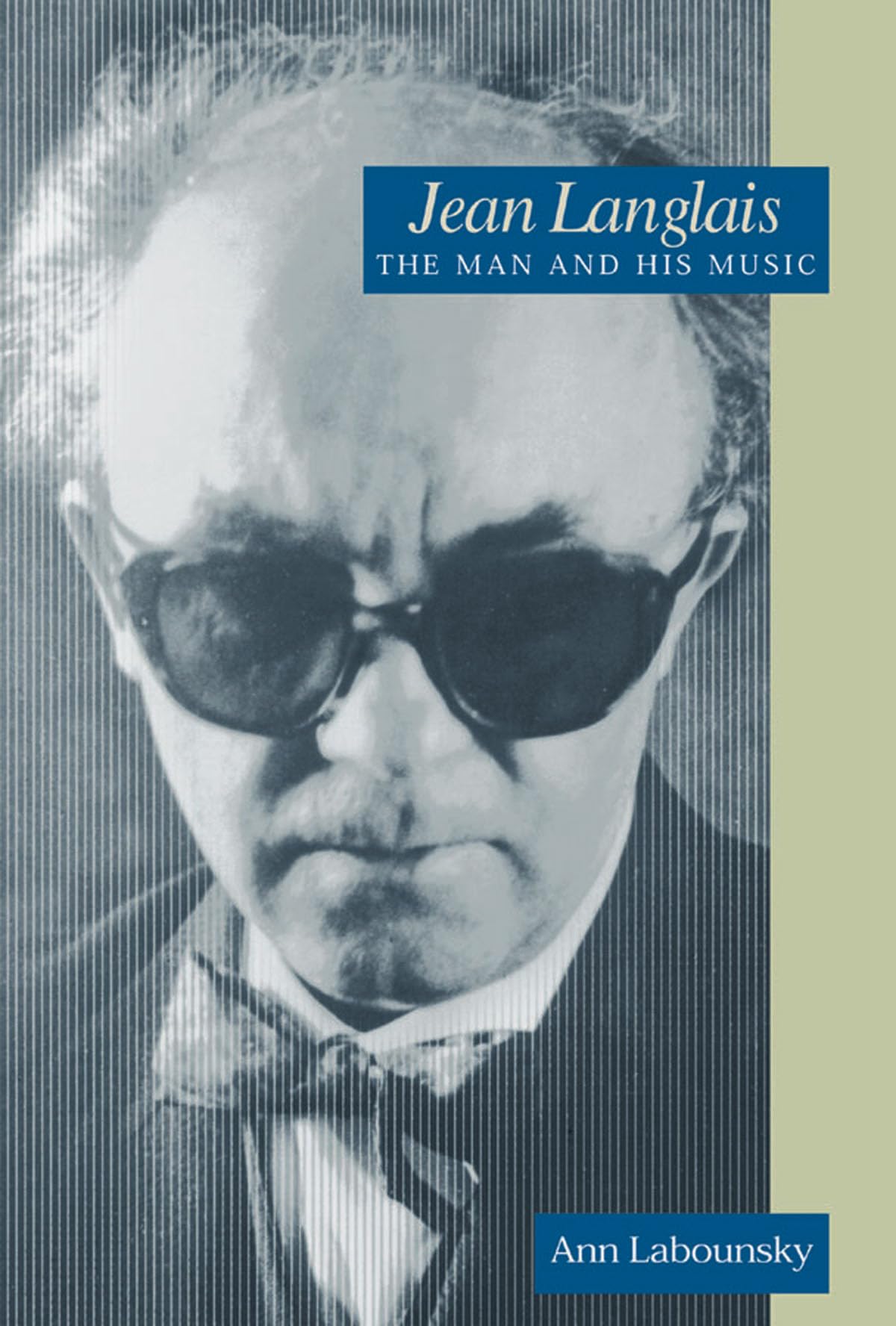



Jean Langlais (1907-1991) was among the foremost French musicians of his time. He was the successor to the musical tradition established by César Franck and, like him, was organist at the church of Sainte Clotilde in Paris. Though blind from early childhood, he became one of the most celebrated touring virtuos of his time, his legendary recitals always concluding with an improvisation upon a submitted theme. Langlais wrote a body of music for organ second only in extent to that of Bach, and his compositions for organ remain widely played. This biography by one of his favorite pupils examines both his life and music. HARDCOVER. Blind performer, composer, and teacher Langlais (1907-91) was one of the most prominent members of the organ world throughout most of the 20th century. This biographical study by Labounsky, a Langlais proteg e and chair of organ and sacred music at Duquesne University, delves into all facets of his personal and professional life, including some analysis of his major compositions. Especially interesting are the discussions of his often contentious relationships with friends (one of his closest was with French composer/organist Olivier Messiaen) and relatives. Despite the author's close personal contact with Langlais (she also acted as his guide and interpreter during his 1964 U.S. tour), she does not gloss over the more unpleasant aspects of this complex personality, although most stories are told from Langlais's point of view. Labounsky's approach is quite different from Kathleen Thomerson's in Jean Langlais: A Bio-Bibliography (Greenwood Pr., 1988), which is principally a detailed bibliographic catalog of his compositions by category. Recommended for public and academic libraries.DTimothy J. McGee, Univ. of Toronto Copyright 2000 Reed Business Information, Inc. An achievement we should all be delighted to read. -- The Organ, Vol 79 No. 314 An exhaustively researched biography of a grand virtuoso of twentieth-century music. -- Willis M. Buhle, The Midwest Book Review, April/May 2002 Music fans will enjoy reading it; organists will love it, and with good reason. This is an absolutely splendid effort." -- Donald E. Metz, American Record Guide The book is hard to put down and is readable at a sitting or two. -- Haig Mardirosian, The American Organist Ann Labounsky, Ph.D., is chair of organ and sacred music at Duquesne University in Pittsburgh, Pennsylvania. She studied with Jean Langlais in Paris and accompanied him as guide and interpreter on his 1964 U.S. tour. As well as asking her to be his biographer, Langlais authorized Labounsky to record his complete organ works, a monumental twelve volume project for the Musical Heritage Society started in 1979 and still in progress. Volume nine will be released in October 2000. The folk songs of Brittany impressed Jean at a very early age. These songs, like all Breton folklore, expressed the Breton temperament and feelings: they were usually in somber modes, reflecting the hardships of their daily life. Many dealt with the loss of fishermen and the storms at sea. Langlais later recognized their pathos and brooding quality as an important element of his own music. It was his grandmother Henriette who first encouraged Jean s interest in music. She told him of an uncle who was a priest and also a fine musician, who directed church choirs and bands in a village close to Dol-de-Bretagne, and another uncle who played the cello. Henriette recognized in Jean a similar musical talent. When he was seven or eight, Jean sang in the church choir with the other children. There he gained a large store of his musical experience by singing Gregorian chants. The eight chant modes were to become an integral part of his musical vocabulary. There was no organ in La Fontenelle, only a small harmonium played by the local blacksmith, who also directed the choir. From time to time, Jean went to mass at a larger church in the neighboring town of Antrain, where the organ had nine stops. "When I heard that for the first time," he was to recall, "I was at mass with my mother. It seemed to me to make a terrific noise and I found it terrifying. I was afraid terribly afraid."21 Ironically, it was through the fearsome pipe organ, and his blindness, that he eventually achieved an important musical career; he would later say that he thanked God for this handicap. Used Book in Good Condition