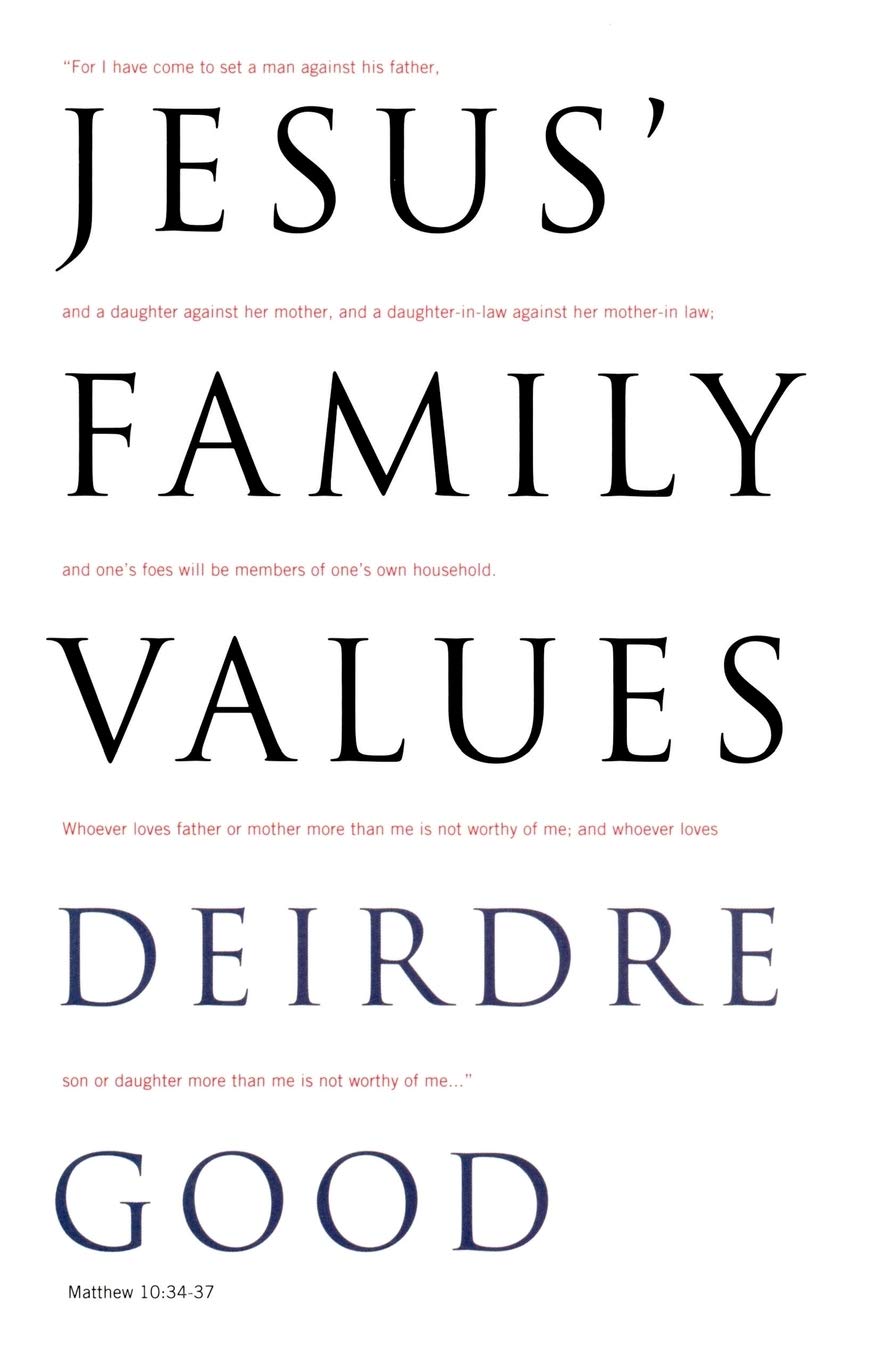



Many people claim to know what Jesus would say or do in the kinds of ethical dilemmas we face today, but applying "traditional" Christian values out of context actually sells Jesus' teaching short. What are Christian family values, Deirdre Good asks, why are there so many interpretations of what Jesus actually taught and said, and which of these biblical values should guide our lives? She begins by setting this conversation in the context of the Greek, Roman, Jewish, and first-century sectarian world, and criticizes the attempts to use biblical texts literally in advocating for marriage and the family. Other chapters will take up the meaning of house and home, marriage and divorce, and biological ties vs. extended families and communities. Through careful attention to the words and stories of Matthew, Luke, Mark, John, and the letters of Paul, Good provides an ideal method for studying the Bible to find out what it actually says to our communities and households today. "A desperately needed antidote..." - Midwest Book Review Deirdre Good is Professor of New Testament at The General Theological Seminary in New York. A widely published author and prominent lecturer, she is also a program consultant to television on religious history. Her most recent book is Mariam, the Magdalen, and the Mother, a collection of essays on the Mary figures of the Bible. JESUS' FAMILY VALUES By DEIRDRE GOOD Church Publishing Incorporated Copyright © 2010 Deirdre Good All rights reserved. ISBN: 978-1-59627-027-5 Contents ACKNOWLEDGMENTS1. THE BIBLE AND FAMILY VALUES2. THE HOLY FAMILY3. MATTHEW'S NEW FAMILY4. LUKFS RESPECTABLE FAMILY5. PAULS URBAN HOUSEHOLDSCONCLUSION: JESUS AND FAMILY VALUESAPPENDIX: EASY REFERENCE CHARTSELECTED BIBLIOGRAPHY CHAPTER 1 THE BIBLE AND FAMILY VALUES When I was about thirteen, I wrote an essay for homework on the importance ofwood in modern life. Having identified only two items, namely telegraph polesand wooden shafts in mines to support tunnel construction, I asked my mother'sopinion. "What's the most important thing wood is used for today?" I asked her."A bed," she said. I was sufficiently taken aback to remember the story to thisday. However, her answer points not just to the need for rest (at that time myfather, an ordained priest, was working in a teacher training college, and shehad her own job as a physiotherapist, in addition to household responsibilitiesthat included two teenagers), but to the importance of structures of support forher life and that of her family. She herself, of course, was the primary"structure of support" for her husband and children, and while she considered abed to be the most important use of wood, no mere thing would be the mostimportant support structure in her life. To this day my parents' primary support structures include each other, dailyprayer time together, the routine of daily work despite "retirement," meals,recreation, and affection shared, as well as work and recreation taken apartfrom each other. The needs and difficulties and interests attendant upon a largenetwork of extended family and parish relationships provide a different kind ofsupport for my parents, who have both a vocation and passion for ministry Theirbaptismal vows, marriage vows, and his ordination vows are crucial structures ofsupport for them and have remained constant through radically different settings— rural East Africa where two children were born and raised; urban England withtwo adolescents growing up; tropical Fiji, far distant from any relatives; urbanEngland again, but this time with responsibility for an aging parent. This core family of two adults and two children looks very much like thearchetypal conservative Christian family promoted by groups like James Dobson'sFocus on the Family. The sources of support for this family — the God of JesusChrist, Holy Scripture, purpose-driven lives — seem very similar, if notidentical, to the sources of support for mine. But move one degree out of mycore family into the extended family, and every possible variation that can befound in modern Western society exists — except perhaps polygamy, although Icouldn't absolutely guarantee that! There are divorces, remarriages, step-relatives,partnerships (heterosexual and homosexual) without benefit ofmarriage, ex-spouses and ex-spouses' children. There are people in my extendedfamily for whom there are no English terms to describe the nature and degree ofrelationship. Further, there are lots of people in my extended family, related to me by nomore than one degree of separation, for whom the sources of support my parents'generation consider indispensable — the God of Jesus Christ, Holy Scripture — areperipheral if not meaningless. And there are still more members who findtheir sources of support in scriptural Christianity but understand family as farlarger than those related by blood or indissoluble marriage. But whatcharacterizes my extended family members as famil